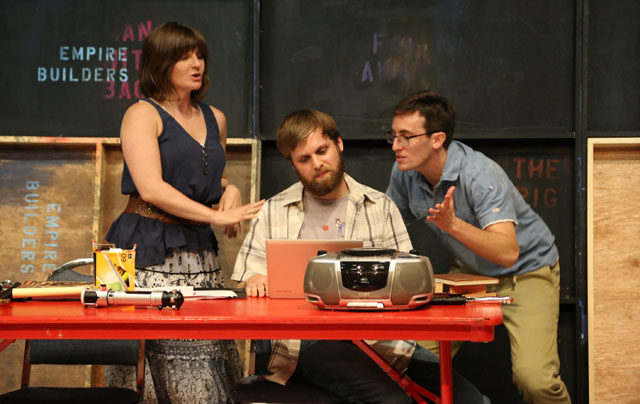
 Jennifer Hopkins, Tom Carman, and Vincent Eisenson (Longacre Lea)
A Shakespeare production can be a slam dunk for a theater company’s ticket sales, and D.C. is no stranger to this phenomenon, with multiple companies dedicated to his work. But can directors, performers, and a creative team muster any excitement about their umpteenth production of A Midsummer Night’s Dream?
No, argues Fear, the world premiere play by Kathleen Akerley staged as Longacre Lea’s annual summer endeavor. In the play, a wealthy patron (Amal Saade) makes an edgy and scrappy theater company an offer they can’t refuse: she will fund their entire creative process as they workshop ideas from each company member and actor-for-hire in the production. But each idea has to make Shakespeare exciting and vibrant.
As the actors and creative team argue over whether they can lower themselves to the conventional task of performing The Bard (some ask whether they can afford to go “off brand”, as they put it, or risk permanent damage to the company), Fear veers into frustrating territory. While the play’s stereotypical actor types feel familiar, they also verge on the insufferable—does the audience really want to spend the entire play in their company?
Worry not, as Akerly fleshes out these stereotypes into fully-rounded characters as Fear progresses. The histrionic Elizabethan actor (Michael Glenn) on loan for the production fears for his legacy; artistic director Timothy (the intense but self-aware Seamus Miller) becomes more changed by the production than he probably would have imagined. Of the fine set of actors assembled, Ashley DeMain and Tom Carman seem particularly comfortable in their skin, DeMain as the most marketing-savvy of the actors and Carman as one struggling with a return to the stage.
It’s fun to see each performer work through their own interpretation of Shakespeare’s works (Fear sticks to Hamlet and Macbeth as a familiar shorthand), though it can be tough to see what differentiates this company’s experiments from other, edgier productions over the years. It’s even more interesting to see the actors speak in a kind of comfortable second language with each other, and then find themselves forced to explain themselves to patron Penelope, a kind of stand-in for an audience less immersed in the language of theater.
Some of the more cerebral, insider-baseball discussions don’t make for the most gripping stage scenes, and the play could use trimming as it approaches the three-hour mark; a few scenes feel repetitive, and a guest appearance from Shakespeare himself probably isn’t necessary. But Fear has a winning sense of humor about itself and provides a thoughtful window into the creative process, even when creatives are “reduced” to tackling conventional repertoire.
Fear runs through September 4 at the Catholic University Drama Complex,
3801 Harewood Road NE. $20. Tickets are available here.