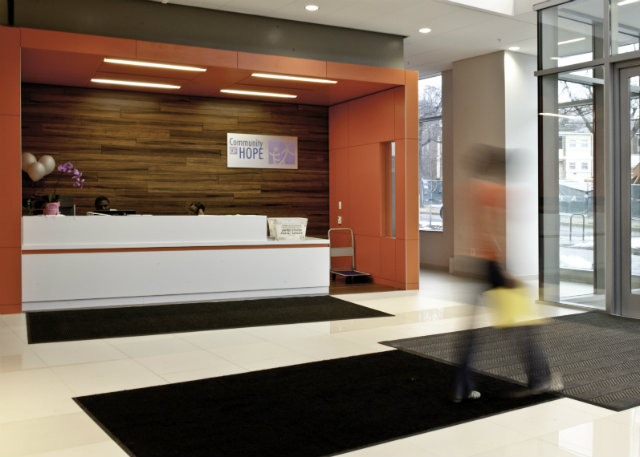
 Photo courtesy of Community of Hope
After much research, the non-profit Community of Hope decided to open its latest facility on a side of town where chronic illnesses are prevalent, and quality medical resources are scarce. Since cutting the ribbon in January 2014, the Conway Health and Resource Center has become a fixture in Southwest’s Bellevue neighborhood. Thousands of patients—86 percent of whom live in Ward 8—are accessing medical, dental, clinical, and social services in the gleaming Southwest facility.
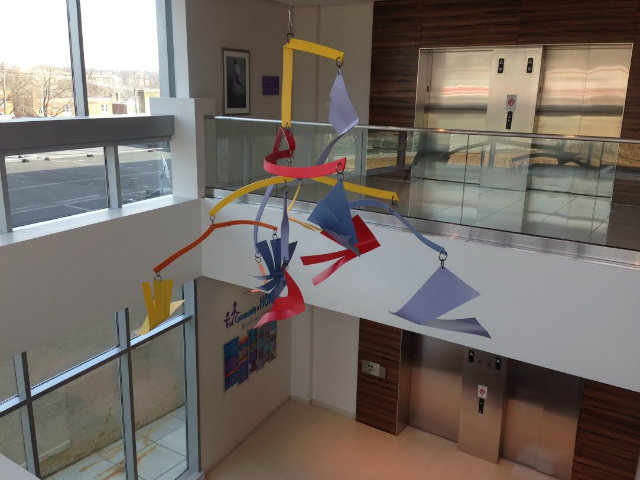
The building features 20 medical exam rooms, 11 dental rooms, six rooms for behavioral health services, a large meeting room for educational activities, offices for social services, and an ophthalmology screening center. It also houses Breast Care for Washington, which brings diagnostic imaging, patient navigation, and one of the first 3D mammography machines to Ward 8.
The center is well on its way to meeting Community of Hope’s five-year goal of 40,000 visits by 10,000 people, says Kelly Sweeney McShane, the organization’s president and CEO. And while the center’s current staff members “are great and incredibly committed,” McShane says, “our challenge right now finding enough providers to meet the demand.” The center still has nearly 20 open positions for physicians and other healthcare providers.
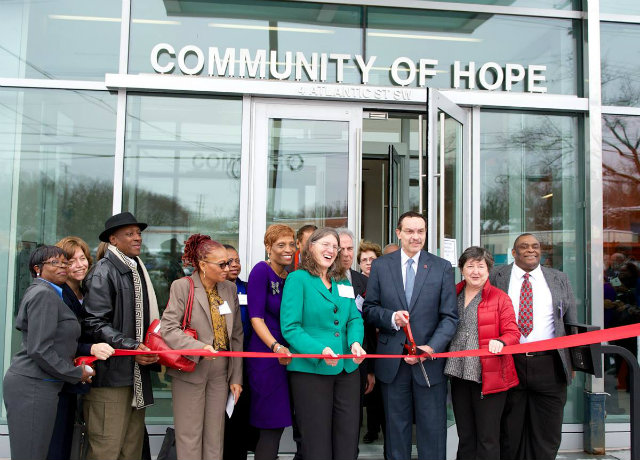 Conway Center opening January 2014. (Photo via Facebook.)
In recent years, the country’s shortage of primary care physicians has made headlines, with researchers predicting a nationwide deficit of as many as 90,000 physicians by 2025. But the Conway Center may have it even harder based on its location, in a poverty-stricken ward with few amenities, far from a Metro station.
In her staff recruitment efforts, McShane acknowledges the nationwide crisis, as well as competition from other healthcare facilities. But with experience recruiting for Community of Hope’s two other centers in Ward 1 and Ward 5, she admits, “It’s a little harder in Ward 8 than, for example, in Adams Morgan. But I don’t know if I can truly prove that.”
One D.C. researcher, Edward Salsberg, a director at George Washington University’s Health Workforce Institute and School of Nursing, has some theories. As a former director of the workforce center at the Health Resources and Services Administration, Salsberg once believed that the shortage predictions were true. Now he says that technological advances and an increase in nurse practitioners and physicians assistants largely means there will be enough doctors to go around. “But to be clear, we do face shortages in individual communities and specialties,” he said.
Bellevue, and Ward 8 as a whole, is the type of place that often faces health workforce shortages “even though it is within D.C., which overall has a more than adequate supply of practitioners,” Salsberg told DCist.
Although many of the country’s areas with limited health resources are in rural communities, shortages can also appear “in poor urban communities,” Salsberg says. According to a recent report by the D.C. Healthy Communities Collaborative (DCHCC), the percentage of families living below the poverty line in Ward 8 is about twice the citywide average. Moreover, the median household income in Ward 3 (highest, $116,001) is more than 3 times that of Ward 8 (lowest, $36,722). And physicians often flock to positions in wealthier communities, which tend to offer better compensation and working conditions, Salsberg says.
The Conway Center’s patients can also come with a different set challenges. In terms of health disparities, DCHCC’s 2016 Community Health Needs Assessment points to higher percentages of clinically-diagnosed depression, obesity, physical inactivity, and smoking, as well as dramatic differences in rates of sexually contracted diseases and hospitalization in Ward 8 compared to the rest of the city.
In addition, “our patients often face challenges that providers don’t see in private doctor’s offices, such as with transportation, access to fresh fruit and vegetables, housing instability, exposure to traumatic or violent situations, and difficulties with navigating a fragmented healthcare system,” McShane says.
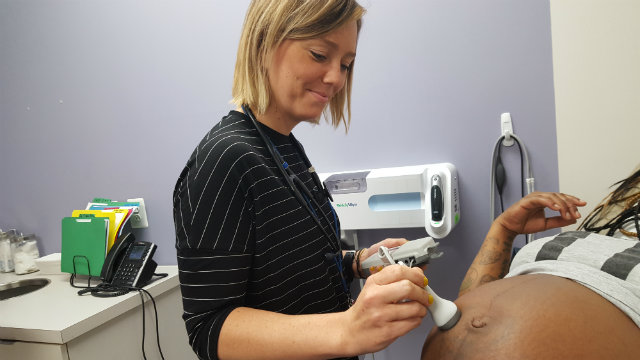
The center’s new patients may come with little to no primary care history or records of using emergency rooms as primary care sites, says Dr. Carla Henke, Community of Hope’s chief medical officer. “So that’s added an extra challenge to all of us as providers in terms of the best care—gaining old patient records or just getting the information and history,” she says.
Over the past two years though, Henke says that she’s seen a shift patients’ patterns as they utilize the center as resource for preventative care, “and that’s been really great to see.”
 (Photo courtesy of Community of Hope)
Henke, who treats patients twice a week in addition to her administrative duties, says she’s also excited about the center’s new initiative around chronic diseases. “We’re looking at our patients who have diabetes that’s been uncontrolled and [seeing] what we can do to really improve the care of the patient and increase some of their own self management,” she says.
Many of the new programs come from McShane’s priority to create services based on community feedback, in addition to research and funding.
Over the past two years, she says the community has responded well to Arcadia Mobile Market, which sets up a truck with fresh fruits and vegetables on a weekly basis outside of the center. “The community has often said that we need a grocery store—it’s a food desert,” McShane says. “I think this is a really good example of connecting the dots to meet a need within the community.”
The center has also expanded its outreach and support for pregnant mothers she says, adding that expecting moms in Ward 8 receive prenatal care much later than their counterparts across the city. Research shows that there are increased rates of teen pregnancy, infant mortality, and pre-term births in the ward.
A lot of the center’s prenatal programming mirrors services provided at Community Hope’s Northeast facility, the Family Health and Birth Center, which offers guidance from midwives, among other services.
And intertwined with other initiatives such as homelessness prevention programs, the center has also become a resource for family-centered activities such as back-to-school nights, holiday markets, and more.
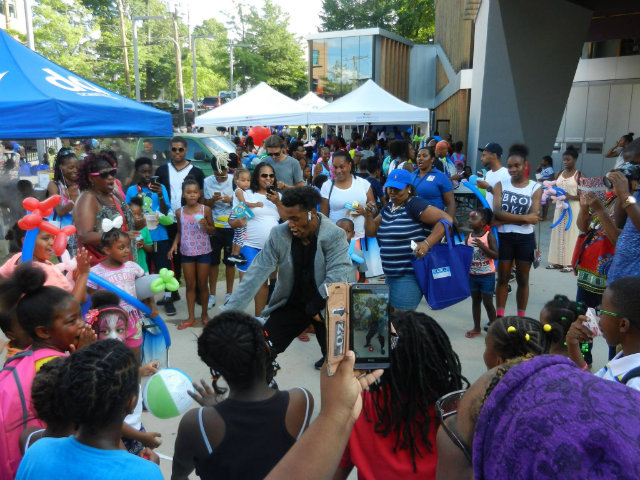 Bellevue back-to-school bash. (Photo via Facebook)
But the continuous addition of new, popular services further emphasizes the center’s need to fill open positions.
According to Salsberg, one strategy that’s often used in urban communities is creating partnerships with existing health facilities such as hospitals and education programs. But Ward 8’s only hospital, United Medical Center, has been in dire shape, with both financial and infrastructure problems over the years.
Having a strong partner in a hospital is also important because a lot of the center’s patients live close to UMC and look to access it, McShane says. But “I do think it has been difficult with so many leadership transitions to get some traction—so we’re certainly paying a close eye and reaching out if there is new leadership,” she adds. In June, the hospital’s Board of Directors voted to approve a site selection study to build a new hospital east of the Anacostia River.
But in the meantime, the center is looking to hire nearly 20 staffers, ranging from dental assistants and registered nurses to housing specialists and therapist.
 (Photo courtesy of Community of Hope)
When the Conway Center opened two years ago, it became home to Community of Hope’s administrative offices.
For Henke, Bellevue “is a great place to work and we’re here for all the right reasons—I really like that we’re here in a community that needs us most.” And besides the lack of restaurant options, McShane has embraced the neighborhood as well. “I love working in Ward 8—I enjoy the people I meet, our neighbors greet me on the street, and I stop by the library periodically to pick up books.”
While the physician shortage is challenging, the non-profit isn’t settling for just anyone. “We are looking for nurse practitioners, physicians, dentists, and therapists who have experience and are committed to providing care to an underserved population,” McShane says.
“We’re trying to improve the health of our neighbors and communities in D.C.,” Henke adds. “We’re looking to hire staff who are really aware of the mission and are mission-driven.”