 Rachel Sadon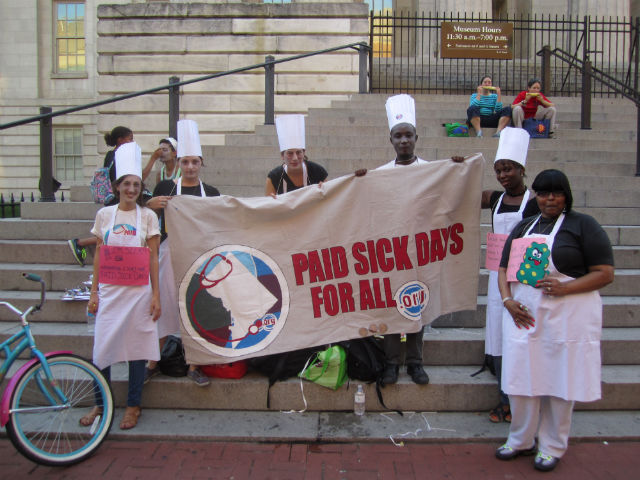
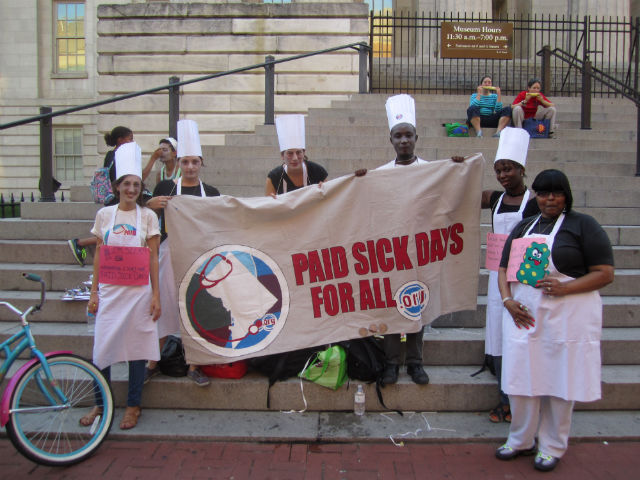 Advocates dressed up as ill chefs in 2013 to push for an expansion of the city’s landmark paid sick leave law. (Photo by Sarah Anne Hughes.)
A recent National Bureau of Economic Research paper provided hard data for what many labor advocates have long predicted: cities that guarantee paid sick leave see a drop in rates of the flu and other contagious illnesses—to the tune of more than 5 percent. But the curious case of how D.C. implemented its law shows just how significant the effect is for waitstaff and other service sector workers.
When the D.C. Council passed a paid sick leave law in 2008, the city became only the second in the country (San Francisco was the first) to guarantee compensated time off in the event of illness. But amid a concerted lobbying effort from the business and restaurant industries, the law passed in a weakened form that mandated a year on the job first and completely excluded tipped employees and most healthcare workers.
Since then, more than a dozen other cities, four states, and a number of counties have passed legislation guaranteeing workers paid sick leave (including Montgomery County, which followed suit last year, with a law that officials believed would extend the benefit to more than 89,000 works who didn’t have it previously).
According to an analysis of GoogleFlu data from Cornell’s Nicolas R. Ziebarth and Stefan Pichler, of the KOF Swiss Economic Institute, data from seven cities showed an average drop of about 5.5 percent in influenza-like illnesses after gaining access to paid and unpaid sick leave (corresponding analysis of three states, plus D.C., showed a lower increase of about 2.5 percent—but it had less data and included laxer laws).
Despite the early concerns from the business community in D.C., a 2013 audit showed that the paid sick leave law “neither discouraged business owners from locating in the District nor encouraged business owners to move their business from the District.” After a concerted effort from labor and restaurant worker advocates, including a campaign featuring people dressed up as sick chefs, D.C. expanded the legislation in 2013 to cover tipped workers and shorten the length of time before workers begin accruing sick leave. After it went into effect, the difference in the number of flu-like illnesses in D.C. was stark.
Ziebarth ran the numbers (the CDC collects data by metropolitan area but doesn’t share it with researchers over security concerns, so the researchers used comparable GoogleFlu data) for DCist on the effects of the original Accrued Sick and Safe Leave Act. Between November of 2008 and February of 2014, D.C. saw a decline in cases of flu-like illnesses of 1 percent, which roughly translates to about 400 cases per year, according to Ziebarth.
But after the extension to waitstaff and other tipped workers went into effect in 2014, D.C. saw an additional 5 percent decrease of flu-like illnesses, or about 2,000 fewer cases of coughing, sniffling coworkers between February of 2014 and July of 2015.
“The law, as it is now, is pretty comprehensive. [The numbers are now] more or less what we saw in other cities—on average 5 to 6 percent,” Ziebarth says. “The question is who reacts to these reforms when you have this mandate and stays at home to recover.”
Nationally, an analysis of the 2011 Leave Supplement of the American Time Use Survey found that roughly 65 percent of the population has paid sick leave. But that drops to below 20 percent for employees who make less than $10 an hour, part-timers, and those employed in the hospitality industry.
In D.C., a survey of 189 businesses conducted by the D.C. auditor last year found that less than 1 in 10 businesses had to make a change to their paid sick leave policy after 2009—but the effect was much more pronounced in particular industries. About one in three retail outlets reported implementing a paid sick leave policy or modifying existing policies and more than half of businesses in the accommodation or food service industry said they did so.
“When you give restaurant or service sector workers paid sick leave, it is most effective because they have the lowest coverage rate,” Ziebarth notes.