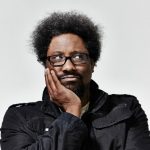
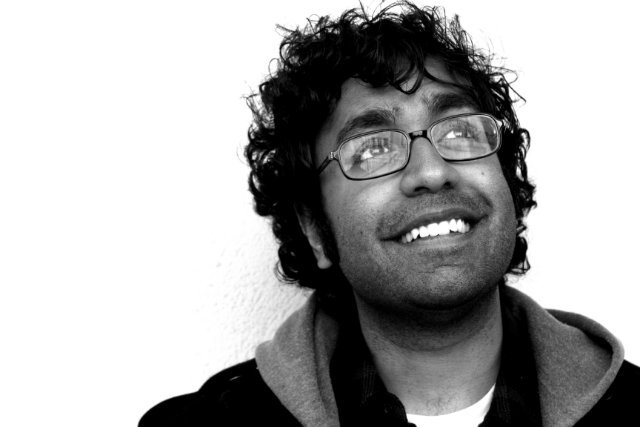
 Comedian Hari Kondabolu performs tomorrow night at Sixth & I Synagogue. Photo by Elizabeth Griffin.
Hari Kondabolu’s resume reads more like someone on track to become the Executive Director of a major NGO than a comic whose career is on a steep rise.
The son of Indian immigrants from the South Indian state of Andra Pradesh, he graduated from Bowdoin College with a degree in Comparative Politics before working as an intern in the office of then-Senator Hillary Clinton and an immigrant rights activist in Seattle. Of course, we would be remiss in failing to mention the Masters in Human Rights from the London School of Economics.
“I’m a killjoy who does comedy,” he jokes during a recent phone interview, in advance of his sold-out performance Saturday night at the Sixth & I Historic Synagogue.
Social issues are never far from Kondabolu’s mind and his humor stems from sobering topics like poverty, gender inequality, and race relations, which formed the basis of his first album, 2014’s Waiting for 2042.
“Everything that I’m going to put forward for the most part is in search of justice,” Kondabolu says. “What are the things about the world that are unjust and how do we create a fairer world.”
The subject matter has not stopped Kondabolu from landing high profile appearances, including performances on Conan, Letterman, and Totally Biased with W. Kamau Bell. Judging by his performances over the last few years at Black Cat and U Street Music Hall, this socially-driven approach plays well in liberal bastions like the District, but Kondabolu would like to challenge his audience and not simply pander to it.
“I don’t just want to play for a choir. I want to question the choir and make them stop singing for a second, and also make them ask, ‘What are we singing?'”
With his latest album, Mainstream American Comic, Kondabolu is also trying to broaden his palette. Though the word, “mainstream,” is used ironically, he believes that the issues that drive him affect everyone and should not be considered niche in any way.
“We might not like the words ‘activist’ and ‘social justice,’ but the idea behind those things are fundamentally American ideals, at least that’s what we publicly say.”
Additionally, he wanted to develop a routine that addressed the current election cycle and how that frames all the topics that are central to Kondabolu’s work, while also exploring a more personal form of self-expression.
For the former, Kondabolu’s goal was to create bits that were “evergreen,” meaning they would be topical even beyond November’s ballot. In terms of being more open about himself, he believes that talking more about his own experience makes the material relatable to those who may not be otherwise on board.
“There’s a mask that jokes give you, you can hide behind words,” Kondabolu says. “Think about the friends that you have. Some people are fun and you goof around with them, but you don’t know who they are and they generally don’t become your best friends.”
Kondabolu is also keeping himself busy outside of his stand-up career. He is working on a pilot for Tru TV and a documentary about the Apu character from The Simpsons for the same network. He and W. Kamau Bell co-host a podcast called Politically Re-Active and he is also one of the rotating co-hosts stepping in for John Oliver on The Bugle podcast.
“Ultimately, popularity is not the issue, it’s about the quality of the work,” Kondabolu says. “Is it genuine? Does this person have an honest point of view?”
Hari Kondabolu will perform tomorrow at the Sixth & I Historic Synagogue with opener Carmen Lagala. 8 p.m. Tickets are sold out.