 Rachel Sadon
Founding director Lonnie Bunch and the curators who have worked to fill the African American History and Culture Museum have frequently described their mission as telling “the American story through the African American lens.” More than any other Smithsonian museum—with the notable exception of the underrated Anacostia Community Museum—it is also telling the D.C. story. Or, more accurately, many D.C. stories.
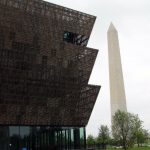
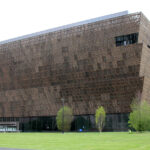
Strategically placed cutouts in the building’s mesmerizing bronze wrap offer windows to the nation’s memorials and monuments—meant for visitors to quite literally see America as they contemplate its fraught history—but also to the District that lies beyond the Mall. And beyond, of course, is a place that has long been known as Chocolate City.
The stunning museum pays homage in ways big and small, flashy and subtle, particularly in the top two floors, which are populated with culture and community galleries. Find the P-Funk Mothership and sing your prayers: “God bless CC and its vanilla suburbs.” Spot the pot that had been used at one of the District’s oldest soul food restaurants, Florida Avenue Grill, and wonder if you’ve ever eaten collard greens that were cooked in what is now a museum artifact. Make the connection between BK Adams’ Blue Horse and the blue chairs that occasionally pop up around town. Or seek out a small book in the sports gallery titled The Negro in Sports, published in 1939. Its author, Edwin Henderson, raised money for D.C.’s first YMCA for African Americans—and is credited with not only bringing basketball to D.C. but popularizing the sport with the larger black community.
This isn’t to overstate the role that the District plays in the museum—it is just one place among multitudes with stories that illuminate the black experience in America. But as a Washingtonian, it was thrilling to happen upon local examples amidst the exhibits and illuminating to reflect on how they fit in with the changing city (latte city?) outside the museum’s walls. After years of steady declines, the percentage of African American residents in D.C. fell below 50 percent for the first time in a half century in 2011. And it has continued to get whiter (and younger) since.
The fourth floor “Cultural Expressions” gallery offered up a particularly jarring moment. While admiring a gown designed by Ann Lowe—who famously also designed Jacqueline Kennedy Onassis’ wedding dress—curator Elaine Nichols explains that it was part of a much larger collection of more than 2,000 garments and accessories designed by African Americans. Lois Alexander Lane painstakingly collected them beginning in the middle of the century, displaying them for 15 years in New York before relocating the Black Fashion Museum to D.C. in 1994. Struggling to keep the collection going after her mother’s death, Joyce Bailey donated the sartorial treasures to the museum in 2007. Their previous home? 2007 Vermont Ave. NW—right around the corner from a very different kind of fashion mecca now being developed at The Shay.
Back in the sports gallery, a number 49 jersey presents a different opportunity to reflect on the collision of local past and present. Bobby Mitchell was drafted in 1961 to play for the Washington Football Team—making it the last team in the NFL to integrate, thanks to an intransigent owner—amid threats from the Interior Department that they would deny use of the District of Columbia Stadium (now known as RFK) over discriminatory hiring practices. “It was the way that sports became part of a larger conversation about integration,” says curator Damion Thomas. The parallels to the current stalemate over the team name, the Interior Department’s unwillingness to allow them to return to the RFK site without a change, and a larger national conversation about racism are striking.
Nearby, the “Making a Way Out of No Way” gallery highlights the resilience and perseverance of African Americans in a society that systematically denied them opportunity, with highlights including Civil Rights activism in D.C. (which is more thoroughly explored in the history galleries below) and the story of the National Council of Negro Women and Mary McLeod Bethune.
But perhaps nowhere is the District so joyously celebrated as in the “Musical Crossroads” gallery, where visitors can bask in the regal orange, turquoise, and black outfit that Marian Anderson wore for her 1939 performance at the Lincoln Memorial. “Most of her collection is at the University of Pennsylvania, so I had no hope of this,” says curator Dwandalyn Reece. But when Anderson’s niece-in-law told her “Oh by the way, we happen to have this,” Reece recalls, she was floored. No color photos of the day exist, and seeing how brightly Anderson shined offers another dimension to that history-making moment.
A few paces away are the bright green stylings of the one and only Chuck Brown, part of a set of displays on go-go. The gallery is “organized around genres and themes, one of which is the role that music can play in creating a regional identity,” Reece explains. “Go-go is the perfect opportunity to explore.” One of the plaques explains the venues in D.C. and Prince George’s County where the genre has thrived, name checking Southeast Gardens and the Howard Theatre, among others.
Next door, visitors can flip through rows of album covers, divided by musical genre, or choose samples to play to the entire room from a pool table-sized interactive flat screen. While clicking through the go-go section (which defines the genre as “the soundtrack of Washington, D.C. since the 1970s)”, I chose a Rare Essence cover of Ashlee Simpson’s “Pieces of Me,” and a reporter who recently moved to D.C. makes a connection. “So is this what’s up with the Adele song I keep hearing?” he says quizzically. When I confirm, he nods along to the beat, saying “I’ve gotten a crash course on go-go today. This museum is already doing its job.”
The National Museum of African American History And Culture opens on September 24, but free tickets are required for entry into the museum throughout the opening weekend. President Barack Obama will ring in the inauguration, and the public can watch on screens broadcast on the grounds of the Washington Monument or streaming online. Passes are being distributed online for entry for the next few months (the next available date is in November); a limited number of walk-up tickets will also be available on a first come, first served basis after the first weekend.