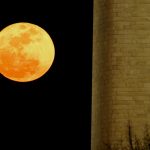
A Harvest Moon rises over D.C. landmarks on September 19, 2013. (Photo by Bill Ingalls/NASA via Getty Images)
Later this evening, you can see the “Harvest Moon”—the full moon closest to the autumnal equinox—take shape in the sky.
The moon will officially turn full when it reaches the spot in the sky opposite to the sun, which will happen at 3:05 p.m. Eastern standard time, according to Space.com, but it won’t rise until several hours later.
A minor penumbral lunar eclipse will accompany the moon tonight—the last harvest moon eclipse until 2024. Unfortunately, it’ll only be visible from Europe, Africa, Asia, Australia, and the Western Pacific, according to Space.com, which is broadcasting the Slooh Community Observatory’s four-hour live webcast of the eclipse that started at 12:45 p.m.
In D.C., the sun will set today at 7:14 p.m., and the moon rise at 7:22 p.m., the Capital Weather Gang reports, which means that this particular moon rises at about the time the sun sets. More importantly, according to Space.com, “at this time of year, instead of rising its normal average of 50 minutes later each day, the moon seems to rise at somewhat the same time each night.”
It gets its name from the fact that its bright light allowed harvest crews to work late into the evening, according to the Old Farmer’s Almanac.
But what’s a lunar event without a little controversy? There’s a debate happening about whether today’s moon can also be dubbed a super moon, meaning a new or full moon happens when the moon is at the closest part of its orbit with Earth.
To understand the basics on the Harvest Moon, which everyone agrees is happening, Science at NASA has some good insight.