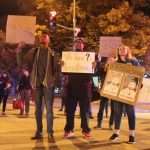
Update: Kevin Donahue, Deputy Mayor for Public Safety and Justice, tweeted today that officials will release the name of the officer involved in the fatal shooting of Terrence Sterling. This comes a day after protesters blocked streets in Northwest where the incident took place, calling for transparency in the case, and more than a week after activist group BYP 100 released a statement calling the incident “a violation of protocol.”
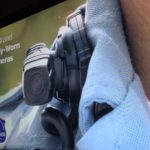
Donahue also announced via Twitter that officials will release the police body-worn camera footage from the incident. “The video does not answer all questions,” he said, noting that the incident is still under review by the Metropolitan Police Department and the U.S. Attorney’s office.
Last week, Mayor Muriel Bowser and MPD said they wouldn’t release the officers’ names out of concern for their safety.
We demand the @DCPoliceDept to release the names of the cops who murdered #TerrenceSterling https://t.co/jMmte1msYm pic.twitter.com/uMF4i8PgMY
— BYP100 (@BYP_100) September 19, 2016
Original: A group of black activists is demanding that D.C. Police reveal the names and terminate employment of the officers who were involved in the deadly shooting of Terrence Sterling.
“In a violation of protocol, the officers disobeyed orders to not pursue Terrence and turned off their body cameras before shooting and killing him,” a statement from the D.C. chapter of BYP 100 reads.
Following the incident on September 11, the Metropolitan Police Department released a statement saying that the officer who shot 31-year-old Sterling was put on administrative leave. A day later, Mayor Muriel Bowser told FOX 5 News that a second officer, who was driving the cruiser, was placed on leave because he allegedly broke police protocol by using the vehicle as a barricade.
An MPD spokesperson told DCist that she is unsure if the department has plans to release the officers’s names or fire them.
The case initially received attention after officials announced that the officer’s body-worn camera was turned off during the shooting. A witness has also given a contradicting report from the official police account of what happened leading up to the shooting.
According to the MPD report, an officer saw Sterling driving a motorcycle recklessly near the 1700 block of U Street NW around 4:30 a.m. A few moments later, another officer spotted him at 3rd and M Streets NW. Police say that when the officer was exiting the passenger side of his cruiser “to stop the driver,” Sterling “intentionally drove into the passenger door.” As a result, the officer shot Sterling, who was taken to a hospital where he was pronounced dead.
However, Kandace Simms told Fox 5 that “the motorcycle was trying to speed off and drive away, but he couldn’t because he was kind of caught in between the sidewalk at the curb and the police car. So the police were trying to open the passenger side door and he couldn’t because the motorcycle was right there, and I guess when he couldn’t open the door, he rolled down his window and shot twice.”
Police say that other witnesses have come forward and given their accounts of what happened that morning as well, according to Fox 5.
Four days after the shooting, Mayor Bowser announced policy changes for police body-worn cameras to require dispatchers to remind officers to turn their cameras on before encountering a member of the public. In return, officers must confirm that they have done so.
BYP 100’s statement also references the death of 27-year-old Alonzo Smith, who was found unconscious and handcuffed inside an apartment building in Anacostia last year. The medical examiner’s office has ruled the case a homicide, but no charges have been filed and the names of the special police officers involved have not been released. Special police officers are currently afforded limited arrest powers after 40 hours of training, though officials have proposed increasing and enhancing the requirements. They aren’t required to wear body cameras.
“MPD and their ‘Special Police’ mercenary counterparts have no interest in protecting or serving Black lives,” Erin Shields of BYP 100 said in the statement. “Terrence’s death illuminates why we fight to divest from police and invest resources in Black communities.” Shields goes on to say that investments in police body-worn cameras and sensitivity trainings for police “do not reduce frequency or increase accountability in police killings of civilians.” These initiatives simply expand police budgets with funding that should instead be invested in black communities, she argued.
The group is directing people to call MPD Interim Police Chief Peter Newsham to demand that the officers’ names be released and that the department fires them.