Rachel Kurzius
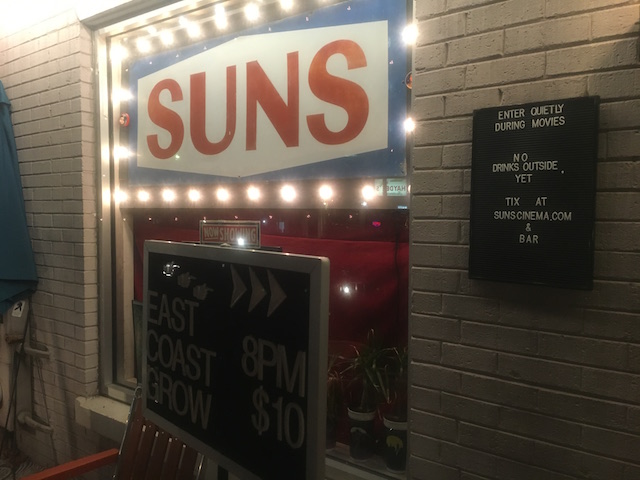 The marquee outside the East Coast Grow screening at Suns Cinema. (Photo by Rachel Kurzius)
When five producers get the chance to pitch their projects to a panel of television executives in D.C. this October, the team behind weed dramedy East Coast Grow will be among them.
Amy Tasillo and Matt Doherty are hoping that the CINE PitchFest will provide them with a chance to move their passion project forward, after filming their pilot last fall and debuting it in the spring.
After all, they’ve got a narrative arc for the entire first season, 10 episodes-worth of storyboards along with scripts for the two episodes after the pilot. In total, 25 producers will pitch their ideas in five cities, and one from each location will score a formal pitch meeting with executives from cable channel A&E.
The D.C. competition will also feature three unscripted series (which could mean either reality shows or documentary-style episodes)—Saving Places, Boss and Kodiak, and Rookie Pastors—and a scripted feature called Mrs. Wildermuth.
If East Coast Grow wins, it could be the key to moving forward with financing their vision—a show about D.C.’s weed scene post-Initiative 71, and the District more generally, told through the perspective of a knowledgeable grower who can’t catch a break.
The main character, Mike, is based loosely on Doherty (the first scene depicts a kidnapping in Vegas, and Doherty says he had a similar experience) and he describes his working relationship with Tasillo as “not only a couple and a business partnership, but also partners in life.”
The question is whether they can find a distributor who will let them execute their project without dramatically changing its focus. After all, this is a show about D.C. that includes landmarks like Amsterdam Falafel rather than the Washington Monument. Can it gain traction with a national audience?
“Obviously we’d love to get distribution from a Netflix or a Hulu or Amazon or something like that, but the main thing is getting some outlet where we can continue to tell the story the way we want to tell it,” says Tasillo.
Arda Mohamed, who attended a recent screening of the pilot, says that she enjoyed East Coast Grow precisely because it dramatized thorny local issues about legalization. “They add a lot of things that, generally, you don’t see—the segment of the population that’s still affected by prohibition, marijuana for the elderly and ill, it just checks off all those boxes that I want to see.”
If Doherty and Tasillo want to ensure that they keep those elements in the show and avoid network execs pushing them to turn it into the next House of Cards, they could go another route, too: self-distribution. That would allow them total creative control over the show, coupled with complete responsibility over funding and building the audience. “It’s a lot more difficult to self-produce if you want to continue to make it at the quality you want,” says Tasillo.
Doherty estimates that filming the pilot cost around $50,000, but any other episode would run them more money. “We called in a lot of favors,” he says. “Anything subsequent now we want to make sure we’re paying these people what their market value is.” They also scored a “new media” contract for the Screen Actors Guild for the pilot, but more episodes would put them on a different, more costly union scale.
If Tasillo and Doherty do choose to self-launch, they ideally want to make a couple of episodes and post them at the same time. They’ve written the first three with a cliffhanger that they’d use as an “ask” for viewers to donate to see more.
At a screening of the pilot last Friday at Suns Cinema, the small room was packed. During the question-and-answer session, a woman raised her hand and asked how everyone there could help bring the entire series to fruition.
Surely, she was an audience plant. (The answer, by the way, mainly involved liking East Coast Grow on its social media accounts and telling your friends to do the same.) But when I asked Mieko Dean if she was friends with the folks behind the show, she said that she had just learned about it that day. Her reaction was precisely what Tasillo and Doherty are hoping for.
“At this point, really it’s about developing interest in the show,” says Tasillo. “Now that we’ve had a few screenings in D.C., we know there’s an audience here. We’re applying to film festivals to get people to see it outside of D.C. That’s the big thing in terms of getting seen by bigger distribution channels—we need evidence that the content has a wider interest.”
She estimates that she spends about an hour or two every day on East Coast Grow-related tasks, researching which festivals accept television pilots and applying to them, and trying to meet people who can help them increase their exposure.
Doherty says it was tough to keep the show’s participation in the CINE PitchFest a secret from the audience at Suns, “especially three cocktails in,” but they couldn’t publicly tell anyone until today’s announcement. They’ll have five minutes to wow the panel with their presentation, which they’re working on now.
Also in October, the show is up for four Indie Capitol awards, including Best Web Series.
“I’ve got to figure out what my wardrobe is going to be” for the awards show, says Doherty. “I don’t think Vera Wang is going to send me anything.”
East Coast Grow Trailer from Aboveboard Productions on Vimeo.