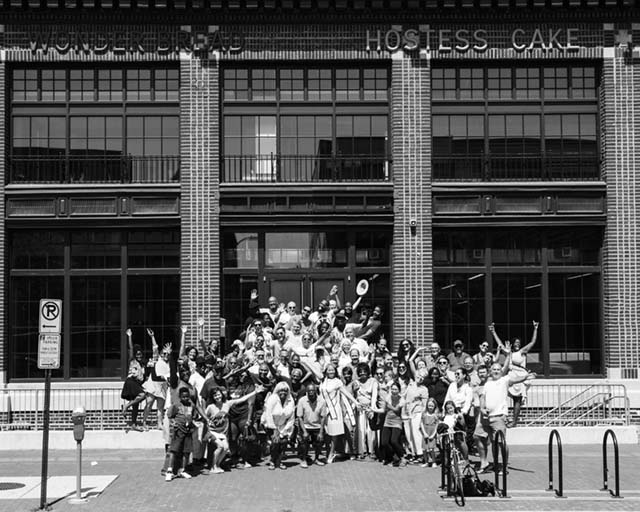
 A Great Day In Shaw (Jared Soares)
What’s going on in Shaw? Like many native Washingtonians, I was shocked the first time I saw The Shay and Atlantic Plumbing developments. For months, anyone going to the 9:30 Club navigated a maze of construction; then suddenly, the neighborhood seemed as if it had turned into a hipper Bethesda.
But with all the massive development, Shaw has still managed to retain an old Washington diversity. Can it last? Coinciding with Art All Night, which takes place around the city, the arts festival What’s Going On: Voices of Shaw, directly addresses the area’s changing demographic. The idea is to celebrate the history and culture of the area, while bringing neighbors new and old together. The artists involved hope to foster a conversation that can be sustained as Shaw continues to change.
The curators behind the festival have a strong track record with public art projects. To support emerging artists in the community, Kristina Bilonick Royer founded Pleasant Plains Worskhop, which currently operates out of the space above Mess Hall in Edgewood but was born near Howard University. Deirdre Ehlen MacWilliams was a public art coordinator for the DC Commission on Arts and Humanities and curated the Foggy Bottom Sculpture Biennial.
What’s Going On came out of a call for proposals from The District of Columbia Office of Planning for the initiative Crossing the Street, developed to support local artists and diverse communities in the District. Although it existed before this initiative, the expanded Funk Parade is one example of a community event that benefited from the program.
As Royer explains, the proposal requirements were unusual in that they required curators to reach out to the community to an extent that they might not have otherwise, including mandatory attendance at ANC meetings.
Detroit’s Thick Air Studios also spent time in the neighborhood to prepare for their project, a roving performance called “Portable Punctuation.” They hired five people from Shaw to be part of the performance, MacWilliams explains. “They take luminous punctuation marks and stop at different areas highlighting historical sites and churches, and it will be driven by community members. Through these punctuation marks, we create a dialogue with why these places exist and why these sites are important to the community.”
People who live and work in Shaw will give walking tours and classes throughout the festival, which runs through October 2. “A lot of our projects have an element of surprise,” Royer says. “Whether or not you know it’s going on, you’ll probably run into it.” One of these surprises may come from The Bohemian Caverns Jazz Orchestra, which saw their long-time home base close earlier this year, are participating in the project “Scattered Orchestra,” where musicians will be simultaneously playing the same piece of music from different locations in the neighborhood.
Shaw is just one of a number of communities around Washington that has had to deal with the successes and struggles of new development.
ANC Commissioner and head of Shaw Main Streets Alex Padro argues that it’s one of the city’s success stories. “One of the major reasons it’s gone so smoothly in Shaw,” Padro says, “is that we made a commitment early on to preserve affordable housing and to maintain the ethnic and economic diversity of the neighborhood.”
“That doesn’t happen very often. Usually entire buildings are bought and turned into condos and everybody’s gone. We were successful in convincing the property owners of the major affordable high rises and garden complexes to renew and continue their commitment to affordability. ”
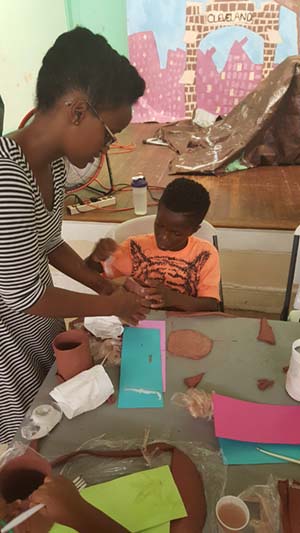 Tsedaye Makonnen with one of her students
It almost sounds as if nothing has gone wrong, but Padro does have one regret: the long-term families who left the neighborhood amid rising home values.
“Some of the elders were having trouble going up two or three flights of stairs in a row house, so these families decided to take half a million for their unrenovated homes and move out to suburbs where they can have a one-story house where grandma and grandpa can be accommodated and still have a college fund for the grandkids, “ he says. “We lose the institutional knowledge, the wonderful history of those who’ve been on the block for generations. But I can’t fault the family for wanting to take advantage of that opportunity.”
Photographer Jared Soares’ “A Great Day in Shaw” (pictured above) was inspired by Art Kane’s 1958 photograph “A Great Day in Harlem.” It paints a picture of a diverse, thriving neighborhood, with young families with children and new arrivals mingling with seniors and long-time Shaw residents.
Those that did stay, benefit from safer streets and new dining options, Padro says, “there’s so much positive that have happened.” Still, crime remains a major concern in the area and there are questions of who can afford and feels comfortable in these new establishments.
While development of The Shay didn’t displace any original shops—it was an empty lot that had been used for a local flea market—it is perhaps symbolic of a progress that leaves some longtime residents feeling like they don’t belong. ”Talking to [neighborhood] children and their parents and siblings,” artist Tsedaye Makonnen says,” A lot of them feel there’s an invisible border that starts at Cleveland Elementary School right before the block of The Shay. A lot of them have never walked over to the block where the Shay is.”
Makonnen, who was born at Howard University hospital, will be hosting an updated version of the Ethiopian coffee ceremony she grew up with in Shaw. “Common Grounds and ReciproCITY” is a stark contrast to modern “grab and go” coffee culture, and in fact this ritual will take place in front of Shaw’s own hip coffee chain, Compass Coffee.
At the festival’s closing party, Makonnen will honor community leaders like the owner of the salon Wanda’s on 7th . “She’s a perfect example of someone who’s survived the changes,” Makonnen says. “She was in Shaw when nobody knew about it. Now she’s thriving and employs a lot of the community members. She gives free haircuts to children who are about to start school, she grooms adults looking for employment.”
She’s also honoring Donald, who owns the Metro PCS at the corner of Florida and Seventh Street. “He plays go-go all day long. He’s been doing that forever—anybody who’s grown up around here knows that place. The kids we work with at the community center, we’ll go there after classes and he’ll turn up the go-go and we’ll dance.”
Makonnen teaches art to kids at the Shaw Community Ministry, and her students created the more than 100 ceramic coffee cups that will be used during the ceremony. As much as the festival is about Shaw, for Makonnen, “it’s really about them. They’re the ones witnessing all these changes and are affected by it. They’re a source of inspiration and they’re all leaders. They’re the ones who will carry the conversation forward.”
What’s Going on? Voices of Shaw runs from September 24-October 2 at locations throughout the neighborhood. See a complete festival schedule here.