The Washington Valor’s first season will start in the summer of 2017. First, though, they held tryouts at the Verizon Center on Saturday. (Photo courtesy of the Washington Valor)
By DCist contributor Scott Harris
If you’ve never watched arena football before, you may want to strap in. Think about all the action of a typical football game concentrated down to the size of a hockey rink.
“Fast,” said Washington Valor head coach Dean Cokinos when asked to describe the sport, which will make its debut in D.C. next year. “It’s a lot of action. The music plays, the nets go up, and you’re in the no-fly zone. There are balls coming at you. Not a lot of breaks.”
The Valor will be the newest member of the Arena Football League, and the fourth team on the East Coast, when they take to the field in the summer of 2017. Owned by Ted Leonsis’ Monumental Sports and Entertainment company (which also owns the Wizards, Capitals and Mystics), the Valor also marks a return of indoor football to D.C. (the D.C. Armor last played in the American Indoor Football Association in 2009).
Played during the NFL offseason, the Arena Football League makes a point to cater to fans with high-scoring games and access to players. “It’s a good product on the field, but that’s not what it’s all about. We’ll be doing lots of appearances. We’re going to work with players and youth,” Cokinos said. “The community always has been and always will be a part [of arena football].”
And as they gear up for their first season, the Valor held open tryouts on Saturday at the Verizon Center (where they will play home games), giving potential fans an early look.
 More than 300 people came out to open tryouts for the new Arena Football League team. (Photo courtesy of the Washington Valor)
The tryouts drew about 360 pro hopefuls, many from D.C., Maryland, and Virginia. However, Cokinos admitted that the odds were slim that any uninvited free agent would essentially walk on and make the team. But that didn’t stop players from turning out in force to run sprints and drills in front of a bevy of trainers and coaches, as hundreds of onlookers took it in from the stands.
“There’s a lot of talent in this area,” said Mulku Kalokuh, a wide receiver who grew up in Alexandria and starred at West Potomac High School before playing at Southern Illinois University and then for a time in the Indoor Football League, an AFL competitor. “But I didn’t think it was going to be this huge. The competition has been pretty stiff out here.”
At first glance, the long odds facing Saturday’s competitors are probably in line with those facing the Valor itself. It’s no secret that the Washington Football Team dominates the local sports landscape; is there room for another football team?
Time will tell, but Leonsis clearly believes there is. The Verizon Center’s downtown location will help, officials said, as will the high number of fan-friendly features the typical arena football game contains. Scores frequently top 60 and beyond, with the field being only 200 feet long and 85 feet wide—creating an offensive crucible much smaller than the NFL’s 360-foot-long, 160-foot-wide dimensions. That high-octane scoring has always been a key factor distinguishing traditional NFL-style American football with its arena counterpart, which started in its current form in the early 1980s. The AFL currently has nine teams.
Perhaps recognizing the uphill battle the Valor will face in finding purchase in a NFL- and entertainment-saturated market, the “something for everyone” mantra is prevalent in the team’s strategic blueprint.
“It doesn’t matter if you’re a diehard fan or if you’ve never been to a football game before,” said Jeff Bowler, the Valor’s vice president of business operations. “You’ll walk out having had a good time. We’re going to have giveaways, T-shirts, music, all kinds of entertainment. Our promotion staff is going to be all over the building on game days.”
Leonsis has also added that the team will be “millennial-sensitive” in its marketing and promotions. Along with operating sports teams, Monumental also is a media company. Video streams and other digital outreach will be a key part of the Valor playbook, providing a virtual complement to the real-time speed and stimulation of the game itself.
The product will also be much more affordable. Valor season tickets run as low as $180, or about as much as the cost of two basic tickets to a single Washington Football Team game, not including add-ons like parking.
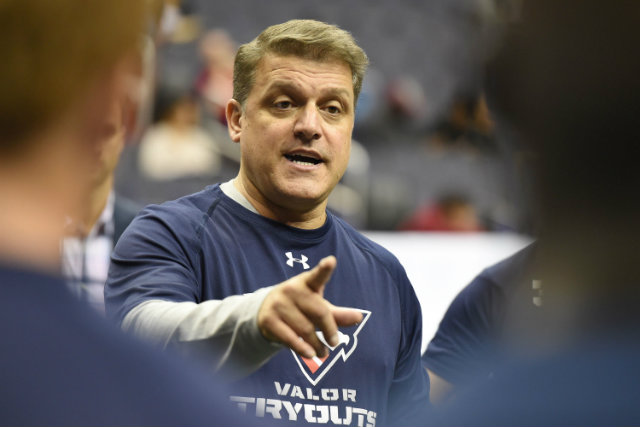 “It’s a good product on the field, but that’s not what it’s all about,” says Valor head coach Dean Cokinos.
Local fans may be more receptive to these kinds of messages than they have been before. After years of mainly mediocrity on the field and consternation over the team name, disillusionment with the Washington Football Team may be on the rise.
What’s more, with videos of brawling in NFL stands grabbing headlines in recent months and the game day experience not exactly being a sparkling affair, it’s possible fans are looking for a more family-friendly situation.
“We’re going to have balloon artists, face painting. We’re going to have post-game field parties where whoever wants to can come down and get autographs and kick field goals,” Bowler said. “Our access to the team is second to none.”
Even so, team officials took pains not to compare themselves to the Washington Football Team. There is bullishness in the front office for the future of arena football in downtown D.C., but no one yet knows whether that will carry over to fans in the longer term.
“We want to tap into the enormous passion for football in the larger D.C. area,” Bowler said. “We don’t want them to stop rooting for their hometown teams. We want to complement what’s already here.”