By DCist contributor Seth Rose
A lot of theater companies in the Washington area try to incorporate audience participation into their work. But nobody does it quite like dog & pony dc, and nowhere is that dominance more evident than in the return of Beertown.
Back in town after a five-year tour, Beertown solves the problem of how to most efficiently break the fourth wall by never building it in the first place.
The action revolves around the 21st Quinquennial Beertown Time Capsule Celebration. For this event, up to three items are added and removed from the capsule based on proposals of Beertown residents and votes from the audience (who become Beertown residents by attending the show).
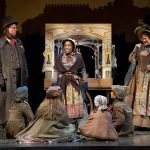
Everything is designed to add detail to this world: the program includes a note from the mayor and ads for local Beertown businesses. Local residents mingle among the audience in a pre-celebration dessert potluck, and those same residents bridge the proceedings with antecedent performances that give some insight into the town’s history. In context, there is no indication that Beertown is a piece of theater at all.
This commitment to and proficiency in world building lets Beertown accomplish more than shows that build audience participation in a more piecemeal fashion. Its intimacy can be jarring: minutes after I sat down for a performance, a Beertown resident asked me how I’ve been and if my father was still in the hospital, which strained my journalistic resolve to act as an impartial observer. As the show progresses however, something impressive happens: the audience starts to care about Beertown as much as the actors do.
After the opening setup, focus shifts to the items in the time capsule and what Beertown residents in the audience have brought for it. All of the items carry a detailed historical context, and the residents’ arguments for their placement are heartfelt and thoughtful.
As residents continued to make the case for different items, the audience began to speak up more. We talked about issues that face us in real life: cultural sensitivity, supporting troops without supporting war, and even some of the struggles of the deaf community (this run of the show is fully ASL interpreted and includes a number of deaf actors). Sometimes Beertown actors hardly needed to contribute at all.
Audience members even began to state their jobs and duties in the Beertown communities, further blurring the line between actor, audience, and setting. In an era when people rarely discuss such things face to face in their own real communities, the opportunity to do so in a carefully curated fake community has a great deal of artistic and maybe even social value.
Note that this assessment is based only on one performance. Beertown features a rotating cast and is often tailored to match host cities, but even without those variations, no two shows will be exactly alike because each one is a new audience.
This is the end goal for any audience-centered show: to use the attendees not just as an ingredient, but to shepherd them into becoming part of the show. Beertown radically discards the conventions of a more traditionally formatted piece, and creates an experience that is far more powerful than your typical night at the theater.
Beertown runs through Nov. 7 at the Thurgood Marshall Center for Service and Heritage. Tickets are available here. All performances are ASL interpreted.