Rachel Kurzius
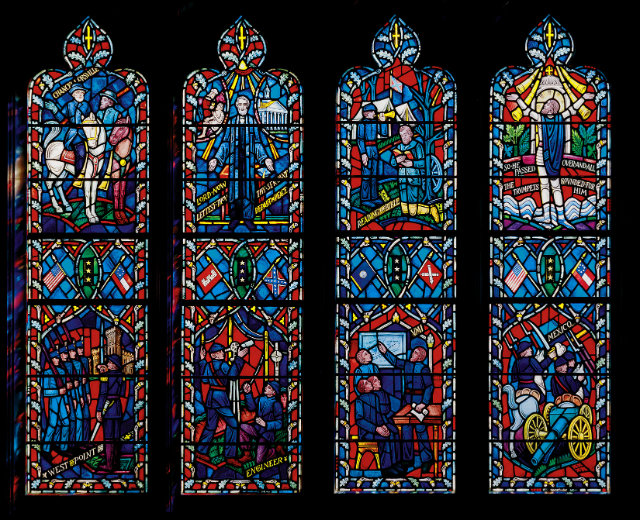 Window panes which include the Confederate Flag were taken down with little fanfare in August. (Photo courtesy of the National Cathedral.)
The first public conversation about the stained glass windows honoring Robert E. Lee and Stonewall Jackson at the Washington National Cathedral began with a prayer.
“So move every human heart so the barriers that divide us crumble,” said Cathedral Dean Reverend Randolph Marshall Hollerith. He emphasized that Jesus Christ “seeks always to reconcile all that is broken in ourselves, our community, and our culture.”
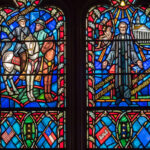
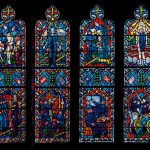
For more than a year, the cathedral has been using the windows as a way to grapple with messy history. Dedicated in 1953, they depict Jackson as a crusader (trumpets blast toward him from the heavens) and the inscription for Lee describes him as a “Christian soldier beyond reproach.”
A press release at the time said that the Lee-Jackson window bay “could help obliterate the Mason Dixon line,” but such alleged unity came at the price of excluding black American voices and perspectives.
After the Charleston church shooting in 2015, now-retired Reverend Gary Hall issued a statement calling on the cathedral to “commission new windows that would not whitewash our history but represent it in all its moral complexity.”
The cathedral’s board established a task force, which published a set of recommendations in June. While the Confederate battle flag should be removed from the windows as soon as possible (which happened over the summer), the windows themselves have become a catalyst for public discussion.
In his letter welcoming the crowd, Hollerith said that “these windows—and the questions they raise—give us an extraordinary opportunity to learn more about ourselves, our collective history, and the perhaps uncomfortable places to which God is calling us.”
Reverend Doctor Kelly Brown Douglas, the cathedral’s canon theologian and a professor at Goucher, calls this “the pit that divides us—a racial pit.” If people just jump over it, by either removing or keeping the windows sans discussion, it’s “cheap grace.” Only through getting dirty and grappling with these issues in their complexity, she says, can we reach a “just reconciliation.”
More than 70 people attended the discussion, wrestling with what precisely these windows mean to different people, and what should happen to them. Should they remain in place? Get a new inscription? Go to a museum? Be destroyed?
Douglas told DCist that for now, there’s no formal process as to what comes next—instead the windows are a “catalyst for building a broad racial justice program.” There are more panel discussions planned, as well as other kinds of programming.
“It’s easy to take the windows down and take them somewhere else, just as it would be easy to leave them up and do nothing,” Douglas said. “It’s harder to discuss the multiple meanings of the windows.”
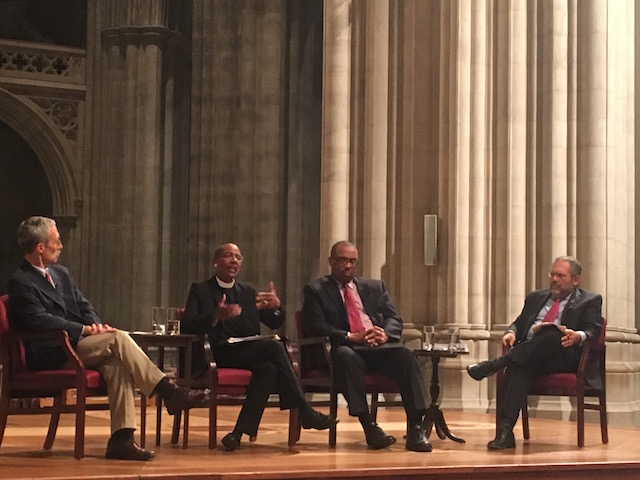 (From L-R), Coski, Douglas, Ellis, and Suarez at the first public discussion about the Lee-Jackson Windows at the Washington National Cathedral. (Photo by Rachel Kurzius)
Douglas was joined during this first public conversation by John Coski, a historian at the American Civil War Museum and author of The Confederate Battle Flag: America’s Most Embattled Emblem, and Rex Ellis, the associate director for curatorial affars at the new Smithsonian Museum of African American History and Culture, moderated by journalist Ray Suarez.
Ellis spoke evocatively about what the battle flag, and the Confederacy more generally, meant to him as a black American. “I just remember all this violence when you talk about liberty and justice,” he said.
The project of the new African American museum, he said, had to do with “wanting to be a part of the memory of what makes America great,” he said. And the deference of that dream for so long “for me, that has a lot to do with the power, promise, and presence of the Confederacy.”
Coski said that many people, specifically white people, react defensively to questioning the Confederate battle flag because, “when you’re comfortable with it, an attack on it is an attack on you.”
Douglas chimed in that “if taking them down is an attack on certain people, then leaving them up is an attack on certain people.”
Joy Rutherford, a black member of the cathedral said it was “uncomfortable for me to come into this space, this sacred space,” knowing the windows were there during the question and answer session.
Douglas said that the history of stained glass windows—which served as a way for illiterate people to learn Biblical stories—means that their context in a church says “something about the God to whom they point.”
As Ellis put it, “to have in God’s house something that questions your sense of what you can do, is anathema to me of God’s example.”
The main concern among those not sold on the idea of getting rid of the windows was that the cathedral would ultimately have to get rid of everything.
“While we have this window that offends some people, we can’t just go throwing everything out,” John Van Wagoner, an 87-year-old white man, said. He wanted more discussion about the significant racial progress that’s already occurred, including a black president, who he said he voted for multiple times. “We have to give thanks for what we have.”
He wasn’t the only one who wanted to refocus the discussion. It became heated at one point—a questioner asked why the panelists weren’t using the word “traitor” to describe Lee and Jackson, and why there wasn’t more of an emphasis on the brutality of slavery during the discussion.
As Coski began to answer in a typical historian’s fashion, talking about the ongoing debate about whether the two Confederate men were traitors, someone from the crowd yelled, “This is insulting!” But he ended by saying that there was no question that both Lee and Jackson fought for a “system that valued white freedom over black liberty.”
One man, William (he declined provide his last name), began yelling after the discussion ended. “They’re here making decisions for my church—I don’t think so,” he said. When a cathedral employee said that everyone was trying to heal, he responded, “You can’t heal one side.”
For the most part, though, the conversation and its aftermath modeled the kind of respect that the panelists discussed.
George Alder came from Fairfax County, where he’s helped spearhead the movement to change the name of J.E.B. Stuart High School, which in title honors a Confederate leader.
“This is a conversation I wish we could have in my community,” Alber said. He described the debate over the school’s name as “full of rancor, full of discord, full of refighting the Civil War,” and asked for tips about how to generate better discussion.
Ellis said that Alber should take comfort in the difficulty of it, because it indicated that they were making headway. “If it were this easy to turn on a dime,” he said, “it would be done.”