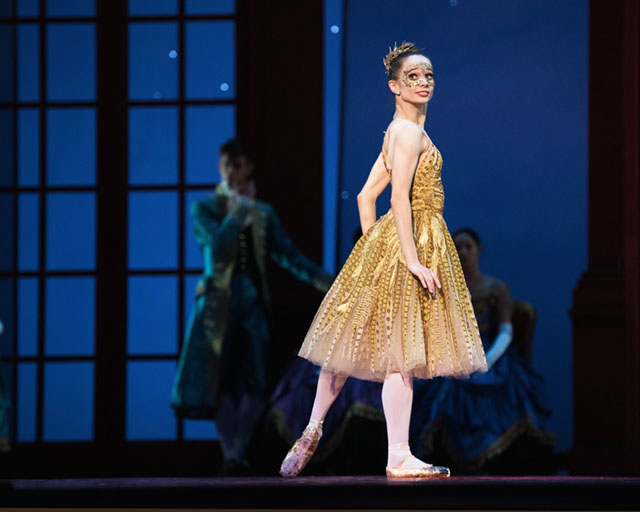
 Maria Kochetkova in Christopher Wheeldon’s Cinderella (Erik Tomasson)
A Halloween treat for the eyes, Christopher Wheeldon’s Cinderella, as performed by the San Francisco Ballet at the Kennedy Center, is a visually stunning fairytale that needs no words to pull audience members into a world of enchantment.
The choreography is set to music by Prokofiev and performed in gorgeous, colorful costumes by Julian Crouch. Basil Twist’s puppetry creates a brilliant complement, adding the magic that this classic story deserves. Creatures such as a long-beaked “Bird Servant” in a layered Victorian gown add an element of elegant whimsy.
You know the story. But if you grew up with Disney’s animated 1950 film or Rodgers & Hammerstein’s musical, a few elements of Wheeldon’s adaptation will stand out.
For one, the father is alive and kicking. But that provides little comfort. It’s honestly less painful to see Cinderella as an emotionally abused orphan then as the daughter of a living parent who fails to stand up to his new wife and family.
Dance—and this ballet is no exception—tells a story through movement. Even those somehow unfamiliar with this classic fairytale will be able to follow along; there is character development through choreography and costumes.
A young family pushes their daughter on a swing until the mother suddenly coughs blood into her hand. She quickly grows weak, ascending into the cloud-filled sky. It’s an emotional moment, this woman floating softly into the next life, leaving her young child and partner below.
Props also help carry the storyline along. The presentation of a bouquet betrays the stepmother’s sinister nature. The bachelorette depicted in a large portrait grows horns and turns red, communicating the Prince’s disinterest in this particular option for his bride.
The sets are beautiful, a storybook on stage. In Cinderella’s home, a tall fireplace stretches to the ceiling beside a massive canvas frame filled with pots, pans, and dried peppers. Act II opens exquisitely, showing a palace ballroom with numerous chandeliers that rise together like a cluster of stars. Later, the night sky will be revealed through the castle windows and doors. It is an enchanting scene, watching strangers fall in love.
A comedy ballet, the choreography sculpts the personalities in this production. That is clearest in the roles of the Stepmother Hortensia, Stepsister Edwina, and Stepsister Clementine. The overeager stepmother and her silly daughters elicit laughter from the audience. At the ball, the girls look a bit gaudy in stripes and feather headpieces, which they gleefully flick at one another.
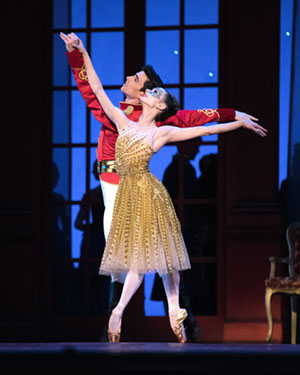 Maria Kochetkova and Joseph Walsh in Christopher Wheeldon’s Cinderella (Erik Tomasson)
While pointed toes are the general rule in ballet, the distinctly déclassé sisters sometimes flex their feet. Eager, exaggerated attempts at femininity add to the humorous display, as the girls prance, perform splits and dramatic extensions, and create grand sweeping gestures with their arms. Combined with the pushing and shoving of sibling rivalry, the young ladies exist in stark contrast to other guests at the ball.
Haughty yet boorish, the stepmother and her daughters provide more comedy than cruelty. After one cocktail too many, the stepmother’s stumbling solo is something to see. She keeps her martini glass upright through wild pirouettes and attempts from well-meaning family members to snatch it from her grasp.
Their complete opposite, Cinderella dances delicately, capturing the attention of all and the admiration of the prince. She is the only guest wearing a mask. The glittering sequins frame her eyes, preserving the secret of her identity.
Throughout the production, Cinderella is often accompanied by four invisible Fates. They assist and guide her, ultimately leading her to the glorious scene that takes places at the end of Act I. Beneath a large leafy tree, spirits dressed in green, yellow, orange and red dance, each representing a season and attribute: Spring/Lightness, Summer/Generosity, Autumn/Mystery, Winter/Fluidity.
Frances Chung is one of the three women who dances the part of Cinderella. “This ballet is just pure joy,” she says. “For me, the most exciting part is the set design and all of the puppeteer work that happens in this production. I’ve never seen anything like it in any other full-length ballets.”
During the forest scene, Cinderella is transformed as the tree’s leaves do their own dance, morphing into each other in psychedelic fashion. Newly outfitted in a stunning goldenrod gown, excess fabric billowing out behind her, Cinderella sits atop a carriage that forms before our eyes: puppeteers joining huge, vine-covered wheels with a quartet of men in horse masks.
Chung says this is her favorite part, the transformation at the end of Act I. “I feel like this one is really spectacular,” she says. “You don’t see it coming and all of a sudden it’s there. You can hear the audience gasp.”
Cinderella is at the Kennedy Center through Sunday. Buy tickets here. Adults under 30 years old can snag discounted tickets through the MyTix program.