 Rachel Sadon
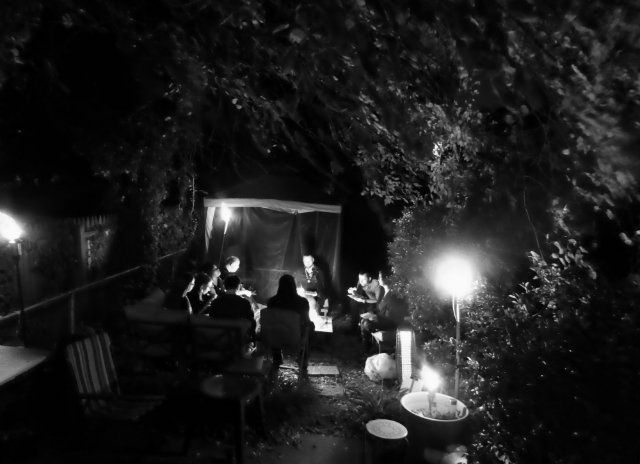 A group of witches dine in silence by an outdoor fire to celebrate Samhain. (Photo by Rachel Sadon)
Everything about Halloween is loud. Shrieking children are amped up on sugar. Uninhibited adults are amped up on both sugar and alcohol. Rainbows of costumes and candy wrappers fill the streets. The secular holiday is a riot of sound and color.
For actual witches—practitioners of Wicca and other pagan traditions—it is the opposite. The night of October 31st is holy, the beginning of a new year and a time to commune with lost loved ones. The religious holiday, called Samhain, is marked in silence and black attire.
“We observe what we consider to be a natural phenomenon, when the veil between the living and the dead is waning thin, allowing us greater contact with our ancestors,” says David Salisbury, a Wiccan high priest. “We draw strength and solace and comfort from them, but also wisdom.”
Twenty five people affiliated with The Firefly House, an organization that brings together multiple pagan traditions, gathered to observe Samhain (pronounced “sow-in”) together last night with a Dumb Supper—followed by the more familiar rituals of a Halloween party.
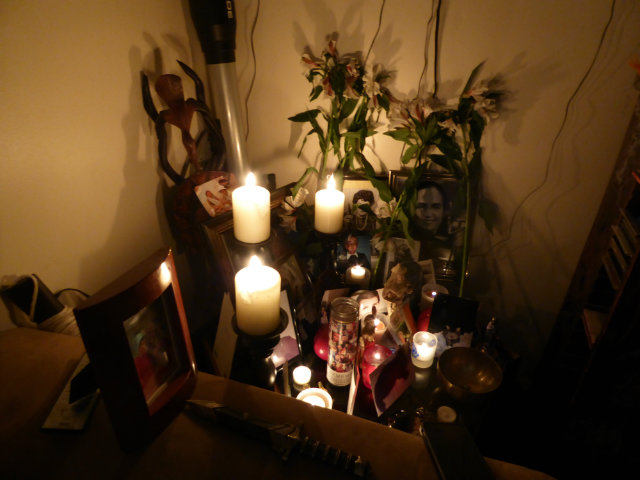 An alter at a Wiccan Dumb Supper featured photos of departed family members and friends. (Photo by Rachel Sadon)
A steady stream of people, layered in black garb, made their way to an unassuming rowhouse in Anacostia.
A candlelit alter grew as they placed photos and mementos of family members who have passed on. The dinner table groaned as people added homemade dishes that their relatives loved in life. Trick-or-treaters occasionally knocked on the door and were greeted with candy.
Some of the guests are long-practicing Wiccans, others were attending their first Dumb Supper. Their day jobs run the gamut of D.C. fields: a civil rights non-profit, the federal government, commercial real estate, retail.
Around 8:30 p.m., Salisbury called the group into a circle and invoked the guardian of the western gate, which opens the doorway to the spirit world. According to pagan traditions, the boundary, or veil, between our worlds is at its thinnest on Samhain. They do the ritual, and bring beloved dishes, to invite loved ones to visit.
“It is a time to reflect on people who have passed on that we care about,” says LaVada delConte, a high priestess in Firefly House’s third and newest coven.
After stretching an actual black veil across the much of the room and slicing it in half, Salisbury ended the ceremony with the ringing of a bell, inviting both complete silence and the opportunity to eat from the communal table.
His goulash honored a Polish grandmother. Caroline Gould brought vodka and smoked fish in remembrance of her husband’s babushka. Akilah Bloomwild, who hosted the gathering, followed her aunt’s recipe for mulled wine. The group served themselves, spreading out throughout the house and around a fire pit in the backyard to dine in silence.
“We’re partly ringing the dinner bell for the ancestors so they pay us a visit,” Salisbury says. While clad in a long cloak, he explains that different colors carry different vibrations, but black acts as an energetic and protective power. Sound, too, creates vibrations—and keeping silent clears the air and makes space for the dead to return.
“You can really feel the ancestors coming in. You feel this strong sense of respect and solace and love for the departed,” Salisbury says. “People who didn’t get the chance to say goodbye get closure. Or they get to say hello or say things that were left unsaid.”
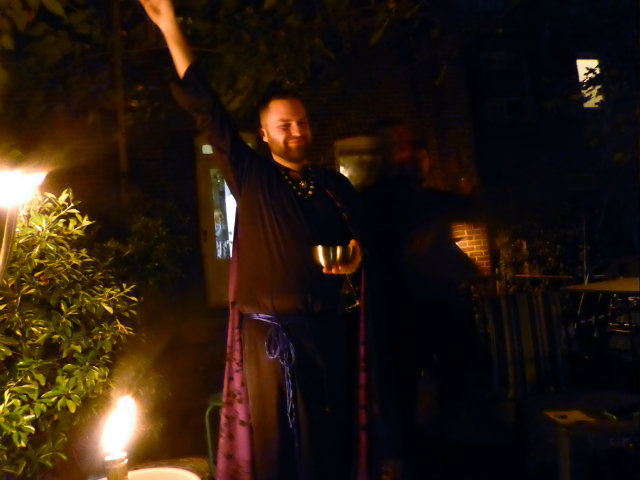 David Salisbury rings a bell to signal the end of the Dumb Supper and the beginning of a Halloween party. (Photo by Rachel Sadon)
After about half an hour of silent reflection, Salisbury rang a bell three times and announced the time of silence had ended. “Thriller” soon blared through the speakers.
While some witches resent the secular holiday traditions, most in attendance said it didn’t bother them and they happily mingled to Halloween tunes.
“I accept it,” says Audrey, who declined to use her last name. “I have been offended, though, by people who feel like [Halloween is] evil for children.”
As for misconceptions about the practice of witchcraft, Gould says putting spells on people is not what they’re about. “There’s no devil in Wicca. He’s Christianity’s problem.”
“It’s a much more simple religion than most people assume. It is Earth-based, honoring gods and goddesses, about harming none and taking personal responsibility,” she says. “We find majesty, reverence, and sacredness in what is right here. It revolves around nature.”
There are about 400 members of The Firefly House, which Salisbury describes it as a “pan-Pagan umbrella organization.” They hosts public rituals for several of the eight sabbats, or festivals, that commemorate the changing seasons. Samhain is always the most popular, so they have to cap attendance.
“For me, it’s New Years,” says Audrey, who practiced Wicca for about 10 years but now incorporates some of its elements with those of other religious traditions. “It’s not lighthearted. It is a very introspective time. You’re more aware of what you’ve lost in the past year.”