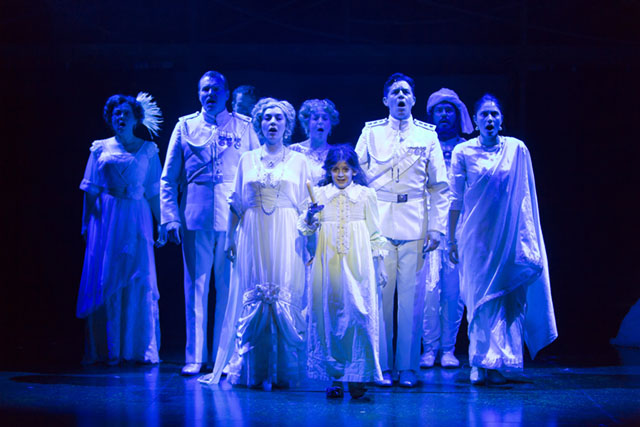
 Scott Suchman/Shakespeare Theatre Company)
By DCist contributor Allie Goldstein
Shakespeare Theatre’s The Secret Garden is a captivating tale of love, ghosts, and regrowth. Playwright Mary Norman adapted the story from Frances Hodgson Burnett’s ahead-of-its-time novel, which first appeared in installments in 1910 in The American Magazine. More than a century later, the magic of The Secret Garden still spellbinds—even as the musical plods predictably along its course.
A cholera epidemic in early twentieth century India is the domino that sets off the rest of the story, orphaning our 10-year-old heroine, Mary Lennox (Anya Rothman) and sending her to her uncle’s manor in Yorkshire. The sickness, which strikes Mary’s parents and servants down like lightning, also transforms half of the characters into spirits that roam the gardens and halls.
The stand-out spirit is Lily (Lizzie Klemperer), who was once the woman of the house. She first appears almost two-dimensional within her portrait but soon steps out of frame and into the longings of her left-behind relatives, carrying them through memories with her operatic voice.
Crippled by grief, many of the living characters of The Secret Garden seem more ghostly than the dead. Archibald Craven (Michael Xavier), the man of the house, is hollowed out by the loss of his wife—a loss that causes him to resent their son Colin, a healthy boy bedridden by his family’s hypochondria. Archibald’s brother Neville (Josh Young) is also sunken by Lily’s loss, though for him the pain is unrequited love.
Anna Louizos’s brilliant set design captures the essence of emptiness. As silhouettes of rooms and stairs glide across the stage, Misselthwaite Manor becomes a shapeshifting, expansive place in which people can carry out their lives in separate quarters. Outside the mansion’s walls, however, the frequent reconfiguration of the set feels thrilling rather than isolating. In the fresh air, the spirits step within the overgrown archways of the gardens as they quietly shift the set, opening up Mary’s world.
Daisy Eagan, who won a Tony for her performance as Mary when the musical debuted in 1991, returns to the stage as Martha, Mary’s maid. She brings a sense of mentorship to the role that seems to transcend the characters on stage. (“It’s almost as if I’m singing to myself as a kid,” Eagan noted in a pre-production interview.) It is Martha that hands Mary a jump rope and pushes her out the door.
As spring comes, the award-winning music and lyrics (by Lucy Simon and Norman, respectively) can get a little too serious (there is more than one song about welcoming the new season) and a little bit saccharine. More gripping are melancholy duets like “Lily’s Eyes,” sung by the brothers, and “How Could I Ever Know,” sung by Archibald and Lily.
True to its roots as (allegedly) the first children’s story to appear in an adult magazine, Director David Armstrong’s production is family-friendly fare and, like the original, it works on several levels. Children may connect with Mary’s more dramatic flourishes—her tantrums, her pouting and finger-pointing—as well as the thrill of finding the forgotten key for her backyard’s hidden world. But the story also has darker themes: depression, the cruel manifestations of grief, and the feeling of being utterly alone in a full house.
You won’t need to take a swim test for The Secret Garden’s deep end, however, since before long the family might as well be singing Kumbaya. Neville is the closest thing the story has to a villain, but his reckoning never comes. Even Colin, who has been tricked into spending his childhood in a bed, doesn’t seem to hold a grudge. Perhaps nature really does heal. Or perhaps it’s just hard to stay mad amidst the bloom.
The Secret Garden runs through December 31 at Sidney Harman Hall. Buy tickets here.