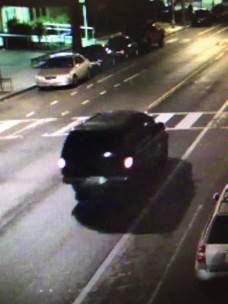
 MPD released a photo of the vehicle of interest in the case.
As 2016 traffic deaths in D.C. surpass last year’s count, police are investigating a hit-and-run crash that took the life of a woman this morning in Columbia Heights.
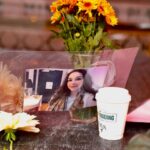
Police say that a dark colored SUV was traveling near the intersection of 14th Street and Parkwood Place NW when it hit Jacqueline Cole, who was crossing the street inside of a crosswalk, according to a release from the Metropolitan Police Department. Cole, 54, was deaf, according to WUSA 9.
The driver “fled the crash scene” after the incident took place around 6:22 a.m., according to police. Officials have released a photo of the suspected vehicle, asking for the public’s assistance in the case.
A little bit more than a year ago, Mayor Muriel Bowser and the District Department of Transportation released an action plan called Vision Zero to address traffic-related fatalities. The goal of the program is to reach zero deaths and injuries by 2024.
It’s initiatives range from the installation of enhanced traffic signals to providing grants to teach elementary school students how to safely ride bikes in the city, according to Terry Owens, spokesperson for DDOT. So far this year, most of the work has been focused on better data collection and evaluation, better interagency coordination, and physical improvements to roadways and intersections,” he said, nothing that “one area where the numbers are down is pedestrian fatalities.” There have been nine in 2016—the lowest since 2012.
Still, one of the easiest way to assess Vision Zero’s effectiveness is by looking at all traffic fatalities, says Greg Billing, executive director at the Washington Area Bicyclist Association. “By that measure, we’re not there yet.”
In fact, Billings told DCist, “we’re going in the wrong direction.” This year, there have been 28 traffic-related deaths in D.C. compared to 26 in all of 2015, according to police data.
More than 20 D.C. agencies are involved in the Vision Zero program, as well as non-profits like WABA. The organization recently hosted community safety sessions in Wards 1 and 7, where participants convened to talk about how streets are designed before going outside to assess nearby intersections first hand. “We had a good response from the communities,” he says. But there’s still a lot more work to be done.
In a couple weeks, DDOT is expected to release a progress report on Vision Zero, according to Billings, who believes there are “a number of items that haven’t seen any action yet.”
In addition to picking up the pace of implementation, Billings says all agencies must address traffic initiatives through a “vision zero lens,” which means making safety a priority.
There also needs to be proper evaluation for each strategy to make sure they are the best for improving traffic safety—”and if they aren’t, we need new ones,” he says.
This post has been updated.