Rachel Kurzius
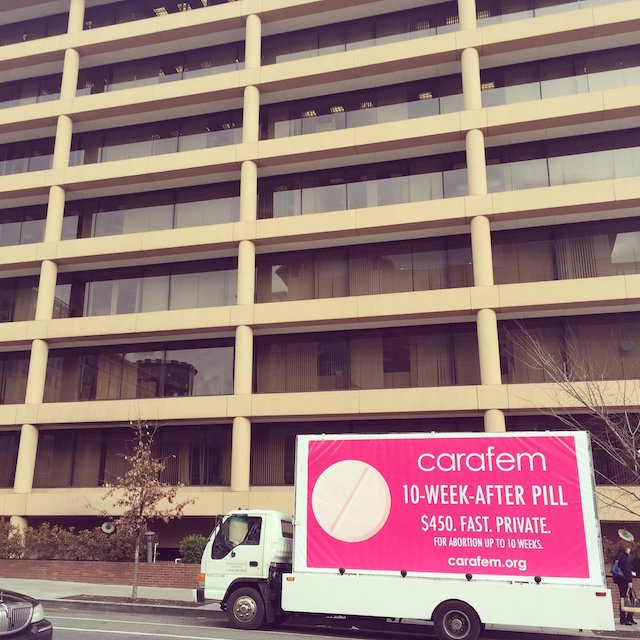 Image via Twitter.
A women’s health clinic in Chevy Chase is accusing Metro of censorship for rejecting its advertisements on the public transit system. Now, Carafem has a truck driving around D.C. with the original ad along with the words “Banned By Metro! See the abortion pill ad Carafem wasn’t allowed to run.”
Carafem wanted to get the word out about its services and, as it has in the past, reached out to Metro for a $23,520 ad campaign for the “10-Week-After Pill,” which the ad boasts is “$450. Fast. Private” over a Pepto pink background.
But, as The Washington Post reported earlier this month, Metro wouldn’t air the ads.
As Metro spokesperson Sherri Ly explains, the agency denied them for two reasons. First, it makes a medical statement, which guidelines only permit “as provided by or approved by government health organizations.” And secondly, “the ad attempts to influence members of the public regarding an issue on which there are varying opinions.”
Carafem thinks Metro is applying its guidelines unfairly. “We’re not talking about an issue—we’re talking about a medical procedure,” says Melissa Grant, vice president of Carafem. “Abortion is no different than any other medical provider sharing their services.”
Because Metro allows other advertisements from medical facilities like hospitals, “we feel that the message being suppressed by Metro is censorship,” says Grant. “Some medical procedures are acceptable, while others are not.”
Final determinations for ads are made by Metro’s Office of General Counsel, says Ly. It remains unclear, however, why an FDA-approved pill is an issue on which there are varying opinions, but say, a defense contractor’s ad about stealth drones isn’t.
Grant says Metro’s decision “perpetuates the idea that abortion is not acceptable, and we don’t believe that’s true. By being a loud and unapologetic voice about abortion, we’re normalizing it.”
Metro also says that its approval of Carafem’s first ad campaign, which declared “ABORTION. Yeah, we do that,” was a mistake made shortly after the December 2015 decision to close “WMATA’s commercial advertising space to any and all issue-oriented advertisements, including, but not limited to, political, religious and advocacy advertising,” says Ly.
That change in policy came after anti-Muslim activist Pamela Geller submitted a controversial ad to WMATA that would have depicted the prophet Muhammed. She previously won lawsuits when the transit agency resisted posting her Islamophobic ads.
Carafem says that their advertisement is entirely different. “Maybe some disagree with our message. That’s fine—our message isn’t for them,” says Grant. “But we just want people to know what services we offer.”
Now, the clinic is using a billboard truck to get out their message about their services. The first place the truck debuted the ad, along with its “Banned By Metro!” line? Right outside of Metro headquarters.
“Metro does not have a position on third-party advertising off Metro property,” says Ly.
The moving billboard has since been making its way on the city, and will continue to do so through Saturday. Davis says the “truck was quite a bit more affordable but it wont reach nearly as many people.” She says Carafem is still trying to figure out how to get its ads back on the Metro and isn’t ruling out legal action.
In the meantime, though, supporters are taking pictures of themselves with the truck as they see it on the streets, and posting it with the hashtag #10WeekAfterPill. Grant says the moving billboard has had “an overall warm welcome so far.”
carafem President @chrispurdydkt and Vice President Melissa Grant getting a selfie in before our #10WeekAfterPill truck hit the road! pic.twitter.com/LPa6OKAdF8
— carafem (@carafem) January 19, 2017