Rachel Kurzius
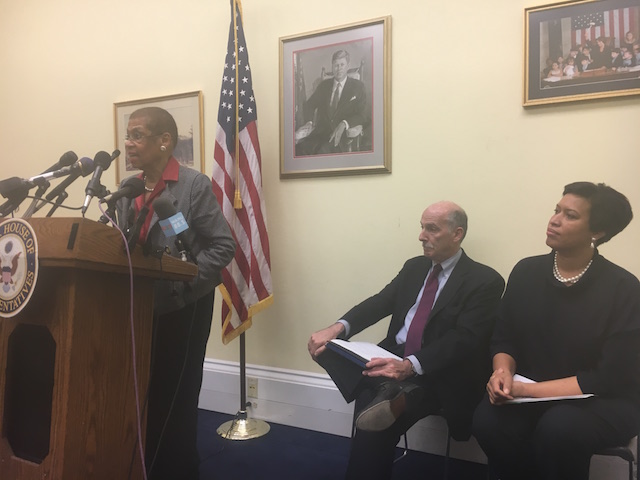 D.C. Delegate Eleanor Holmes Norton speaks at press conference on the Hill, alongside Council Chair Phil Mendelson and Mayor Muriel Bowser. (Photo by Rachel Kurzius)
Update: The House Oversight Committee has postponed its mark-up on a disapproval resolution for D.C.’s medical aid-in-dying legislation, which had been slated for Thursday morning.
The postponement, according to a source on the committee, is due to leftover business from Tuesday’s hearing and appears on an agenda for the meeting sent out on Wednesday.
It’s unclear when the mark-up will be rescheduled. Disapproval resolutions must be passed by both Congressional chambers and signed by the president within 30 legislative days.
Original: The House Oversight Committee is holding a mark-up for the GOP’s bid to block D.C.’s Death With Dignity Act on Thursday, but hey, just because it’s legislation passed by D.C. politicians elected by D.C. residents and will only apply to people in D.C. is no reason to get anyone from D.C. to weigh in.
When the disapproval resolution gets marked up later this week, members of Congress will have “none of the input the council had,” said D.C. Council Chairman Phil Mendelson, who characterized the discussion in the council over the legislation as “robust.”
D.C. Delegate Eleanor Holmes Norton invited Mendelson and Mayor Muriel Bowser to the Hill to give the District’s perspective. Four other representatives of the Wilson Building were there, too: At-large Councilmembers Robert White and Elissa Silverman, Ward 6’s Charles Allen, and Ward 3’s Mary Cheh, who introduced the Death With Dignity Bill, which would let doctors prescribe life-ending drugs to terminally ill patients. Most of the attendees, however, were local media and advocates on behalf of the policy.
Congress butting into the District’s business is commonplace, but most of the time, members exert their will using budget riders tucked into must-pass legislation. A disapproval resolution is “rare,” Norton said. Congress has only passed three since the process was established in the Home Rule Act of 1973.
It requires passage in both the House and Senate, as well as a signature from the president, within 30 legislative days to prevent a bill passed by the D.C. Council from taking effect.
House Oversight Committee Chair Jason Chaffetz tried to pass a disapproval resolution over D.C.’s Reproductive Health Non-Discrimination Act in 2015. While it was approved in the House, it was never taken up in the Senate.
That’s the outcome that Norton is hoping for with this disapproval resolution as well. Senator James Lankford (R-OK) and Congressman Brad Wenstrup (R-OH) introduced companion resolutions of disapproval on January 12.
Norton has already conceded that it will pass in the House on party lines, though she said it would be approved by “members who don’t even know what a surplus looks like.” Because she doesn’t have a floor vote, Norton won’t be able to vote against the resolution.
The fight will happen in the Senate, and Mendelson and Bowser’s offices have started reaching out, they said. “Things are happening all the time behind-the-scenes,” Bowser said. Compassion & Choices, an organization that advocates on behalf of medical aid in dying, was also present on the Hill and is working to prevent the passage of the resolution.
In a Washington Post op-ed, Chaffetz called the bill a “serious error” and pledged to “rage for the citizens of the District and ensure the seat of our federal government remains a place where the most basic right to life is protected for all residents.”
Norton said that residents would prefer Chaffetz rage “for their democratic rights” instead. Earlier today, Chaffetz floated having residential areas of D.C. retrocede into Maryland, which Norton scoffed at.
She added that the only relevant opinions on Death With Dignity were those of the council, which passed the bill on an 11-2 vote, and the mayor, who later signed it. “How I feel about the law is irrelevant,” Norton said. “My job is to protect the District’s home rule.” Norton said she would be telling her colleagues that the vote isn’t about whether they agree with Death With Dignity, but about the “District’s democratic right to pass its own laws.”
Mendelson agreed. “This is not a federal issue,” though he noted it was a complicated and controversial one that the council took its time to consider. He expressed frustration that while governing was about a “tapestry” of issues, Congress was “swooping in” to pick apart some D.C. policies without “addressing the whole tapestry.” He also said he was worried that Congress looked poised to intervene in a host of other local issues in a piecemeal fashion.
When asked about how President Donald Trump factors into the disapproval resolution, Norton said “We are pleased that he hasn’t reached out to be negative about the city, but frankly we have no idea how he feels about it. The last thing we want to do is raise something like this, about which he knows nothing, and where we think we have a good chance of keeping the bill from reaching his desk.”