Rachel Kurzius
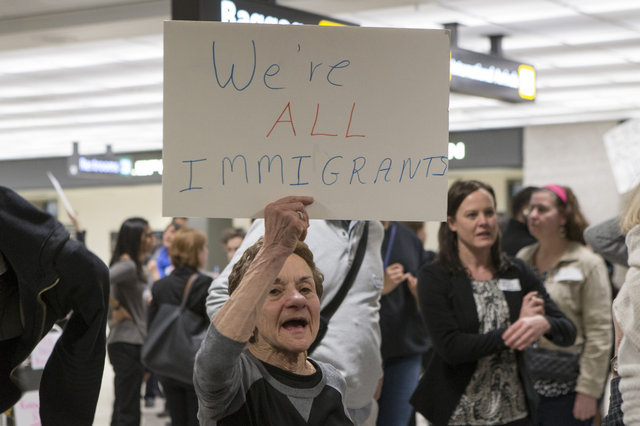 A protester at Dulles International Airport last Saturday. (Photo by Alex Edelman)
Last weekend, the American Civil Liberties Union received $24 million in donations, more than six times what it receives in an average year, as its lawyers won stays of Donald Trump’s immigration ban in courts across the country.
But closer to D.C., there was another non-profit working to fight the executive order in Virginia federal court.
Meet the Legal Aid Justice Center, which has been around for a half-century and has had an outpost in Falls Church for nearly two decades. It focuses on helping low-income immigrants in Virginia.
“When the executive order was announced, we were obviously very concerned for our client community,” says Mary Bauer, the non-profit’s executive director.
LAJC, along with firm Mayer Brown, filed the lawsuit Aziz v Trump, which secured a temporary restraining order from Judge Leonie Brinkema on Saturday. (Whether Customs and Border Protection is actually obeying the federal court order is another question, one which the commonwealth is seeking answers. A bevy of lawyers and lawmakers say that border officials are in contempt of court.)
The named plaintiffs in the lawsuit are Tareq and Ammar Aqel Mohammad Aziz, two young Yemeni green card holders slated to join their father, an American citizen, after arriving at Dulles International Airport last Saturday.
However, after the executive order, they weren’t permitted to enter the United States, and were stuck in the secondary inspection area at Dulles. The Aziz brothers were handcuffed and threatened into signing papers giving up their permanent legal residency, according to court filings.
By the time the court order came down, they were already on a plane back to Ethiopia. They were stranded for days at the Addis Ababa airport before getting deported to Djibouti, where they had previously been for about a month to finalize the paperwork for their immigrant visas “in what was an extensive legal process,” says Bauer.
“Now they’re hoping and waiting for an opportunity to come back to the U.S. to be with their dad,” she adds.
And it’s not just the Aziz brothers. LAJC believes as many as 60 others could have had similar coercive experiences. “We’re working hard to identify other people who were affected by this, particularly on Saturday,” says Bauer.
To fund their efforts, LAJC partnered with CrowdJustice, a funding site that is making its debut in the U.S. with the Aziz case.
“We’re promoting access to justice by enabling organizations like LAJC to draw upon the support of the community,” says Kip Wainscott, the head of legal partnerships at CrowdJustice. “We certainly view the judicial system as a really important and powerful mechanism for protecting rights and holding the government accountable. It shouldn’t just be the wealthy who use the legal system to vindicate their rights.”
LAJC originally set a goal of $15,000, which it quickly surpassed. Now, it’s more than half way towards its “stretch target” of $60,000 with more than 500 people donating to help the organization’s efforts to help their clients, identify new ones, and more broadly fight the executive order through litigation.
Bauer says small non-profits like LAJC are where “you can get a real bang for your buck, philanthropically. Donations of $25 and $50 make a huge difference to us.”
Since the launch of the CrowdJustice page, the commonwealth of Virginia has also signed on as party to Aziz v Trump.
“It brings the weight of the state to this cause, and that’s great,” says Bauer. “I’m proud this week to be a Virginian.”
Virginia Attorney General Mark Herring’s office told The Washington Post that the Aziz brothers will probably be allowed back into the U.S. “The government has moved quickly to make the case go away to avoid being subject to an order compelling it to produce information about its actions,” said Herring’s spokesman Michael Kelly in a statement.
But even if the Aziz brothers are granted entry, LAJC’s work is far from done.
“We are in this for the long haul,” says Bauer. “We know this is a time of unprecedented peril for the immigrant community. We are committed to litigating this case and getting our clients back. When there’s the next executive order or when there are unconstitutional immigrant raids, we will continue to be there to advocate for our immigrant brothers and sisters.”