Rachel Kurzius
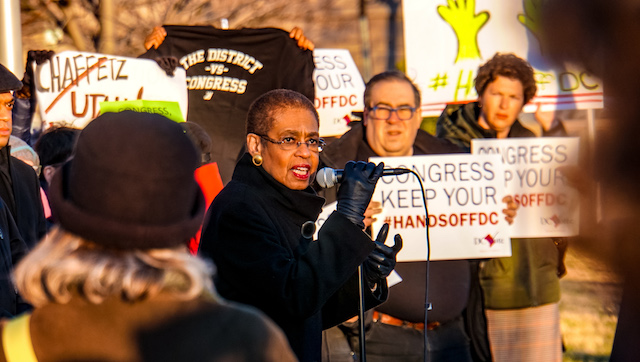 D.C. Delegate Eleanor Holmes Norton speaks at the Hands Off D.C. rally. (Photo by Ted Eytan)
With a deadline fast approaching, the Senate hasn’t yet made any plans to overturn D.C.’s Death with Dignity law.
While the House Oversight Committee passed a disapproval resolution on Monday night with intentions to bring it to a full House vote by Friday, its counterpart in the Senate has not scheduled a mark-up, according to Brittni Palke, the press secretary for the Senate Committee on Homeland Security and Governmental Affairs.
The chairman of the committee, Senator Ron Johnson (R-WI), said “It’s not going to happen,” when Wall Street Journal reporter Byron Tau asked him whether the Senate would join the House in trying to block the bill.
Under the Home Rule Act, all legislation passed by the D.C. Council and signed by the mayor must then undergo a 30 day review period before becoming law. If the House and Senate both pass a disapproval resolution and the president signs it, then the bill is nullified. The review period for D.C.’s medical aid in dying bill lapses on Friday.
The D.C. Council passed its Death with Dignity bill with a vote of 11-2, following more than a year of debate. In January, House Oversight Committee Chair Jason Chaffetz (R-UT), who has not exactly endeared himself to Washingtonians, pledged his intentions to overturn the law.
“Assisted suicide is not something we take lightly,” Chaffetz said at the time.
Two days later, Senator James Lankford (R-OK) and Congressman Brad Wenstrup (R-OH) introduced companion resolutions of disapproval for the Death with Dignity bill, one in the Senate and the other in the House of Representatives.
But D.C. Delegate Eleanor Holmes Norton has tried to frame the issue as one of local governance, rather than medical aid in dying. “How I feel about the law is irrelevant,” Norton said. “My job is to protect the District’s home rule.”
While legislators not voted for by Washingtonians often meddle in District affairs, disapproval resolutions are still rare. Most of the time, Congress uses the budgeting process or new legislation targeting the city to dictate policy on topics like marijuana, abortion, gun control, and needle exchanges.
Chaffetz used the disapproval resolution process in 2015 to try and block a bill that made it illegal to discriminate against someone in D.C. for their reproductive choices. It passed the House, the first time a disapproval resolution had been voted on in 20 years, but was never taken up in the Senate before the review period ended. In 2010, the Utahn attempted to use the process to block the District’s medical marijuana plan, but it never saw a vote.
Now, it looks like the medical aid in dying bill might go the same way: the deadline lapses before the Senate ever addresses it.
Norton said on Wednesday she is also trying to prevent the disapproval resolution from making it to the House floor, where she does not have a vote.
“Although we are close to accomplishing our goal of defeating this disapproval resolution and preserving the District’s local legislation, we are not counting our chickens quite yet,” Norton said. “We are keeping the pressure on House Republicans and reminding them that 24 of their House Members, including two Members of House leadership, are from the six states where medical aid is dying is legal.”
Chaffetz’s office has not responded to a request for comment, though conceded to Salt Lake Tribune reporter Thomas Burr that blocking the law looked unlikely.
.@jasoninthehouse close to conceding Round 1 loss on Death w/Dignity. Round 2 begins when it becomes law & we enter budget battle to win it. https://t.co/yW4wWgVnVR
— Eleanor H. Norton (@EleanorNorton) February 14, 2017
As Norton points out, the battle isn’t necessarily over if the disapproval resolution fails. After the GOP failed to stop the Reproductive Health Non-Discrimination Act, for example, they turned to the appropriations process in an attempt to block funding.
Either way, D.C. officials expect to see even more meddling this Congressional term.
This post has been updated to reflect that the 2015 attempt to block D.C.’s Reproductive Health Non-Discrimination Act was the first time in more than 20 years that the House voted on a disapproval resolution, though Chaffetz introduced one in 2010 to try and block medical marijuana in the District.