Rachel Kurzius
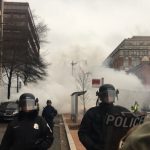
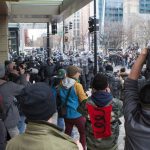
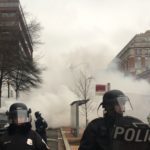
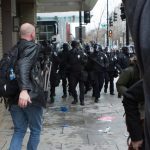
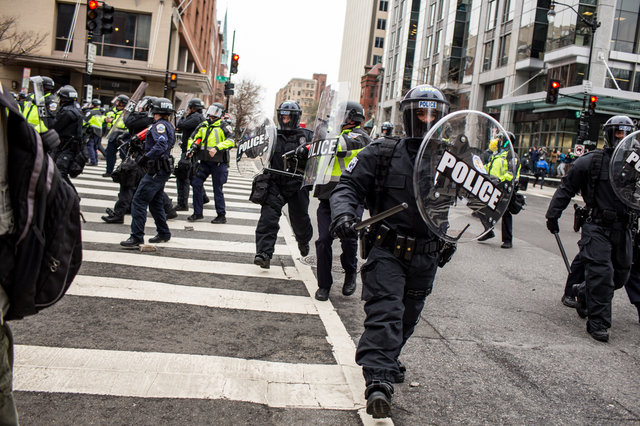 D.C. Police on Inauguration Day. (Photo by Scott Heins/Gothamist)
A D.C. government agency wants an independent consultant to investigate D.C. Police conduct on Inauguration Day, when MPD arrested 230 people during a series of protests.
New reports released by the Office of Police Complaints monitor MPD’s actions during the weekend of January 20, including both Inauguration Day and the massive Women’s March the following day.
The agency’s monitors observed the indiscriminate use of nonlethal weapons like pepper spray without adequate warning, and the arrests of people who did not commit crimes on Inauguration Day.
The OPC’s concerns about D.C. Police largely stemmed from the Franklin Square area, where clashes between law enforcement and protesters continued throughout much of the day. During a number of black bloc demonstrations in downtown D.C., some protesters smashed windows and set fires.
However, OPC says that MPD did not follow police procedures in place for what happens when a protest turns violent—to warn protesters before arrests begin. “When MPD corralled people, at 12th and L Streets, [the protesters] were not allowed to leave,” the report says. “In addition, there is no indication in witness reports, nor any observations by OPC monitors, that any warnings were given either before or after the police line cordoned off those who were later arrested.”
It says that the police didn’t do a good job distinguishing the probable suspects of vandalism from the rest of the people gathered, like journalists, legal monitors, and medics. “It is clear from OPC monitors, and multiple other sources, that those committing the acts of vandalism and violence were dressed primarily in all black, yet many of those held and arrested, were visibly wearing items that identified them as not being associated with these protesters.”
Ultimately, 214 people were indicted on charges of felony rioting—a charge that carries a maximum of 10 years behind bars and a $25,000 fine. Lawyers and legal observers have characterized the mass felony charges as a departure from recent practice in D.C.. The U.S. Attorney’s Office of D.C. dropped the charges against journalists and several others who had been arrested.
The report also questions the use of nonlethal weapons during the day. It says pepper “spray was deployed to move the crowd, without warnings, and in many instances it was used on people who were simply standing in the wrong place.” In many cases, the report says, “a verbal command to step back should have preceded the use of the weapon, and that would have been sufficient to move the crowd.”
The day after the arrests, some of the protesters filed a class action lawsuit over alleged false arrests and excessive force. The American Civil Liberties Union of D.C. said it was “concerned that law enforcement may have violated demonstrators’ rights” due to the corralling, pepper spray, and long processing times for arrests.
“The Metropolitan Police Department stands by its assertion that our officers acted responsibly and professionally during Inauguration Day,” MPD spokesperson Rachel Reid said in an emailed statement. “In response to the riots, the men and women of MPD made reasonable decisions during extremely volatile circumstances.”
That day D.C. Police dealt with crowd control for supporters of Donald Trump, as well as a series of planned and spontaneous protests. One group, DisruptJ20, had the message “No peaceful transition” and planned a dozen blockades at inaugural security checkpoints.
MPD has the mayor’s support. “The Mayor believes our police officers acted properly and professionally in stopping violence, protecting bystanders and arresting violent perpetrators who were armed with hammers, metal pipes and other weaponry,” said Kevin Harris, Mayor Muriel Bowser’s director of communications, in an email.
In the report, the Police Complaint Board recommends the appointment of an independent consultant with “adequate resources to fully and independently review all of the planning, procedures, and activities employed by MPD, especially with respect to the events that occurred in the area of Franklin Square Park.”
MPD has not respond when asked whether it would provide information like body-worn camera footage to such an investigator, though Reid said “We will take the Office of Police Complaints suggestions into account.”
Bowser’s office did not commit to an independent review, either. “”The Office of Police Complaints already exists as an independent entity designed to assist in oversight and improve accountability within MPD,” said Harris. “We value their input and would work with them on whatever tools they thought were necessary to perform their duties.”
The report also details a series of “positive police interactions” that day, like MPD providing traffic control for protesters crossing I-395.
The OPC’s monitoring of police during the Women’s March “commends MPD for the manner in which it worked with Women’s March organizers to facilitate their exercise of First Amendment rights.” The event had zero arrests.
However, it took issue with photos of officers wearing the event’s “pink pussy hats,” which led to headlines like “D.C. Police Are Wearing Pink Hats At The Women’s March & It Sends A Powerful Message.“
That is precisely the problem, according to OPC. “As the pink hats are likely viewed as support for the Women’s March and its political message, officers in uniform wearing the hats give the impression to the public of political support while on duty, which is a violation of MPD’s guidance on permitted and prohibited political activities,” the report says.
Inaguration Protest Monitoring Report FINAL by Rachel Kurzius on Scribd