 Rachel Sadon
 (Photo by Victoria Pickering)
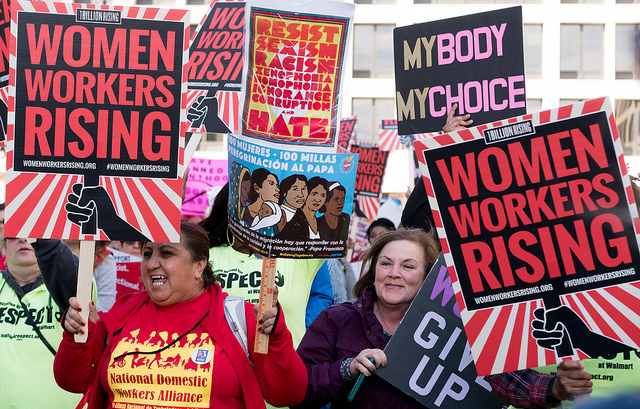
The “Day Without A Woman” could also have been accurately, if less succinctly, been described as the “Day That Spawned A Thousand Think Pieces About The Point And Privilege Of A Women’s Strike.” Instead of just noodling on such topics, a group of seven Washingtonians worked to make it more inclusive, creating a fund to help women and gender nonconforming workers offset lost wages or childcare costs as a result of participating.
“Ultimately it comes down to people and communities taking care of each other at a time when there don’t seem to be guarantees that social safety nets will persist,” says Sarah Mathews, who came up with the idea and worked on it with five other women and one person who identifies as agender. “We need to take care of each other and make sure that political participation is viable for everyone.”
So far, they’ve raised close to $5,000 for a Grassroots Solidarity Fund and are continuing to accept donations and requests for relief until March 13. Then, they will distribute the funds to people who demonstrate a need (organizers will have a conversation with everyone that puts in a request and check on any information they provide, but Mathews says they are also just accepting “that there’s an element of good faith to all this.”)
Many of the critiques of the Day Without a Woman have been centered around the idea that it is only for those who have the economic privilege and resources to strike. Organizers seem to have tried to forestall that criticism, offering other ways to participate—wearing red and not engaging in unpaid labor—but the charge stuck in some circles.
“The message should be privileged woman, you should strike and participate. Not you should strike but you should feel guilty about it because there are some people who aren’t able to,” Mathews says.
“That being said, I am very glad we did what we could,” she continues. “Active resistance generally cannot be for one group of people or a few groups of people. Everyone who is impacted needs to be included.”
It was a bit of an 11th hour effort, Mathews admits. She had been thinking about doing something along these lines, but couldn’t figure out a good logistical way to make it work. On the day before the strike, the lightbulb went off: they could use Venmo to both take donations and disperse them.
So the group, which is majority people of color and about half LGBTQ, sprang into action and started putting the pieces together to make it a reality. It launched just before midnight struck on International Women’s Day.
Their priority right now is to close out the process. They’re still taking donations and working with labor and other groups to publicize the fund to workers who may wish to request financial relief. Any leftover funds will be donated to Casa Ruby, Calvary Women’s Services, and Ayuda.
After that, Mathews says that “at a minimum” they plan to create a how-to resource for what they did, so it could be replicated easily by other groups in the future.
For more information, see the Grassroots Solidarity Fund.