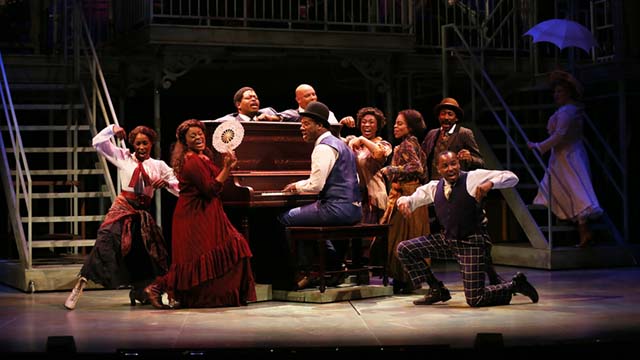
 (Carol Rosegg)
Tears streaming down their faces, a chorus of mourners in Ford’s Theatre’s production of Ragtime cry out for a day of peace, pride, and justice for all Americans. The act draws to a close as the entire cast, rocked by the senseless death of an innocent black woman, cries, “We’ll never get to heaven ‘till we reach that day.”
We’re not there yet.
Ford’s Theatre made the decision to produce Ragtime, the stirring musical from Terrence McNally, Stephen Flaherty, and Lynn Ahrens based on the American epic novel by E.L. Doctorow, more than 16 months ago. But there’s an almost eerie relevance to their choice given the current political climate and persistent racial tensions in America—and that connection seems to have sparked a fire in the show’s cast.
Director Peter Flynn’s Ragtime feels urgent, passionate, and high-stakes; Flynn smartly dresses his cast in modern clothing for the show’s final minutes, further driving that contemporary connection home. Its towering, multi-level set adds to its scope and theatricality.
Ragtime brings together a group of everyday characters living their lives at the turn of the century and weaves their stories throughout those of larger-than-life figures like anarchist Emma Goldman, activist Booker T. Washington, and robber barons like J.P. Morgan. Three aspects of the American experience are seen through the lens of the original characters: a wealthy white family whose members go through varying degrees of social awakening, a black family torn apart by tragic circumstances, and an immigrant family struggling to get by in an unforgiving new country.
With such a wide swath of characters, Ragtime could stand to lend a few of them a little more complexity. Mother, for example, is rather one-dimensional in her saintliness, though actress Tracey Lynn Olivera presents a rich portrait of her inner life with the blockbuster ballad, “Back to Before.” Yet any shortcuts the storytelling might take are made up for in complex performances.
Kevin McAllister’s rich baritone is a perfect fit for the role of pianist Coalhouse Walker Jr., but he also invests a tragic vulnerability into his characterization of the righteous, rage-driven man. Gregory Maheu ably shows how Younger Brother grows from a silly, celebrity-obsessed, and easily-influenced youth to a brave young man fighting for change. Finally, the show’s formidable chorus, most of whom double in smaller roles, inspire goosebumps and even tears as their harmonies lift many a musical number to new heights.
One of Ragtime’s most moving songs in this production (which gives 2009’s Broadway-bound take at the Kennedy Center more than a run for its money) is “New Music.” The song uses the modern, syncopated style of music as a metaphor, representing the passionate love demonstrated between Walker and the charming new mother, Sarah (Nova Y. Payton, as pristine-voiced as always). Pitiable here is the old-fashioned Father (James Konicek), who is unable and unwilling to look beyond his privileged circumstances and embrace the change the era is bringing. “Why can’t I sing it too?” he asks the audience.
The historical pageantry of Ragtime reminds us that we are still living in such days of injustice. It’s a not-so-gentle nudge towards anyone like Father, resistant to a diverse, rich, blended America, insulated in their own bubble. It’s a warning that their limited worldview means they’re missing out on something truly special.
Ragtime runs through May 20 at Ford’s Theatre. Tickets ($20-$73) are available here.