 Rachel Sadon
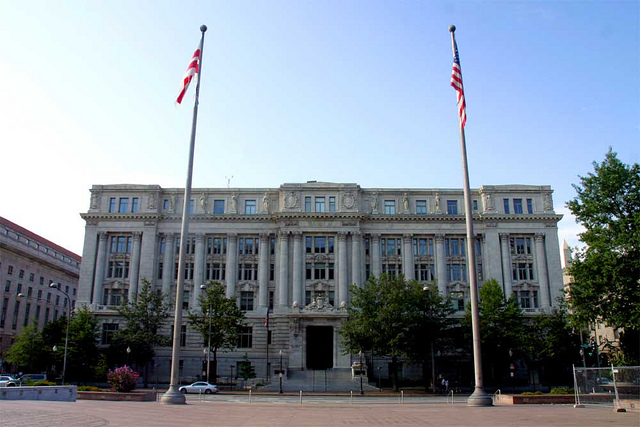 Legislators at the John A. Wilson Building will have to decide if they will implement tax reforms as passed three years ago. (Photo by David Gaines)
When the D.C. Council passed tax cuts and other major reforms back in 2014, the conservative Daily Caller headlined its story: “Hell Freezes Over.” Now, it would seem, a surprisingly happy marriage of progressives and business groups is thawing out.
Nearly 100 social justice-oriented organizations are asking the mayor to delay a huge round of tax cuts, which will be triggered by the city’s rosy finances. They are arguing that the $100 million in cuts automatically slated for the 2018 budget should instead be spent on housing, transit, and education, particularly given the looming possibility of drops in federal funding.
A bit of history, for those who have only vague memories of a fight over the so-called “yoga tax” and an overridden veto.
The D.C. Council passed tax reforms in 2014 based on the recommendations of the D.C. Tax Revision Commission. It created two new income tax brackets (lowering the burdens for those making $40,000-$60,000 from 8.5 percent to 6.5 percent and the group from $350,000-$1 million from 8.95 to 8.75 percent); made standard deductions and personal exemptions more generous; raised the threshold for the estate tax; and dropped the business tax from 9.975 percent to 8.25, among other changes.
Even the Daily Caller had grudging praise: “The Council has succeeded in making the D.C. tax system more competitive and lowering the burdens on some of those who need it most. It’s not often that one gets the chance to praise the D.C. City Council, but hats off to them.”
Some of the cuts were paid for immediately by changes to the tax code. The extension of sales taxes to certain businesses got the most attention thanks to a coordinated campaign decrying the inclusion of gyms and health clubs as a “yoga tax.”
But the vast majority, to the tune of $155 million, would only be enacted once citywide tax revenues hit certain thresholds. Of that amount, $25 million is already in place.
As of the beginning of this year, though, D.C. is on track to reach revenues that would automatically trigger most of the remaining cuts, to be enacted in the beginning of 2018.
They include raising the personal exemption and standard deductions and knocking the business income tax down (for a full breakdown, see this comprehensive list from the Tax Foundation).
But progressive advocates now say those things should be put on hold as the city faces down a major affordable housing crisis, education needs, Metro infrastructure issues, and whatever unknown cuts to federal funding and the federal workforce that Republicans have in store.
“It’s not that we don’t support those tax cuts. We just don’t think that they are so important that they have to come before everything else … Let’s put the tax cuts in more slowly, at a pace that doesn’t compete with other things that are really important,” says Ed Lazere, who sat on the commission that informed the tax changes and serves as the director of the left-leaning D.C. Fiscal Policy Institute. “Our revenues are growing a lot, but when we use all our growing prosperity to fund tax cuts, it’s really a lost opportunity to address the challenges that our growing prosperity is itself creating.”
That position is backed by groups like Bread for the City, Legal Aid DC, the Washington Interfaith Network, and dozens of others that signed a letter imploring city leaders to put the automatic tax cuts on hold and spend surplus funds from last year’s budget.
“At a time when there’s such disparity between folks who are wealthy and folks who are living in poverty, we think it is really vital that [the tax surplus] goes to help people’s most basic needs. And we think that housing is a basic need,” says Jesse Rabinowitz, an advocacy specialist as Miriam’s Kitchen, which is also a signatory.
The groups are particularly concerned about the effect of federal policy changes on the city. Under an outline of President Donald Trump’s budget, the city would stand to lose over $100 million, even without factoring in a number of key programs, according to estimates from the mayor’s office.
“This budget will force our city to make tough choices about programs that not only promote growth, but enable us to support our most vulnerable residents,” Mayor Muriel Bowser said last week. About $17 million in housing programs and more than $15 million in education are among the funds on the chopping block, according to preliminary estimates.
“We will get federal cuts—we just don’t know how much,” Lazere says. “If we know we’re losing federal government money to pay for services that residents rely on, it only makes sense at we should be holding on to our own money.”
But many members of the business community disagree.
“I think you can make an argument for spending more on affordable housing and education, but that we have fiscal distress in our future is not the reason why,” says Yesim Sayin Taylor, the director of the D.C. Policy Center, which is housed within the business-focused Federal City Council. “If we have a lot of fiscal risks, we should not really spend more—especially on education, which is structural and will come year after year.”
Gerry Widdicombe, who led the D.C. Tax Revision Commission and served as the Downtown D.C. Business Improvement District’s director of economic development until January, argues in an op-ed published in the Washington Business Journal that though the worry over federal funding is real, it doesn’t justify a slowdown in the tax cuts.
“The District’s exposure to federal economic activity and its significant dependence on federal funding is exactly why the District should continue to invest in tax reform and other strategic economic development investments,” he writes, saying that the city could instead use its rainy day fund to weather a Trump-related storm.
Taylor also notes that some of the tax cuts benefit the communities that advocates are trying to help. An increase in the standard deduction, for example, has a disproportionate impact for low and middle-income families. And lowering the business tax will have a disproportionate impact for small businesses, which can’t take advantage of loopholes the way that large corporations can.
“Undoing those are not necessarily a good trade off,” she says.
Speaking on The Kojo Nnamdi Show two weeks ago, Bowser said that she hadn’t made a decision about the tax cuts yet, and her spokeswoman said that remains the case. Her proposed budget will be released on April 4.