By DCist contributor Mikka Macdonald
At 5 a.m. this past Saturday morning, when most of my friends were still fast asleep, I was getting ready for the Gunpowder Keg Ultramarathon.
An ultramarathon is any foot race longer than 26.2 miles and is typically run over trails. In the D.C. metro area, local running groups like Virginia Happy Trails Running Club and the Baltimore Road Runners Club hold the events, as do companies such as North Face and Salomon.
Compared to the traditional road race, ultras are usually less concerned with finishing times. That’s because the range in terrain and unpredictable race environments means average times vary from course to course and year to year. Instead, a shared goal is just to cross the finish line.
Runners prepare for a race by building their physical endurance, sure, but also by learning how to listen to their body’s needs, when to hike or walk if necessary, and how to keep down their heart rate. Participants come from a wide array of demographics in terms of race, age, gender, and fitness level, but the majority has got at least one thing in common: they’re kind of nuts.
I’ve been running ultras since 2013. These years have included a handful of 50Ks, one 50 Miler, and one ill-fated attempt at a 100 Miler. Why commit yourself to doing one of these events at all? For the challenge. For the love of trails. For the endorphins. For the post-race beer.
The Baltimore Road Runners Club’s Gunpowder Keg Ultra goes through Maryland’s Gunpowder State Park. I entered this specific race because I know that I calm down on the trail. It’s an escape from the D.C. noise and traffic—trees don’t forget to use their turn signal.
7:30 a.m.: Overexcited and mediocrely hydrated, I arrive at the check-in desk next to the starting line of the Gunpowder Keg Ultra. The race hosts a 50K and a 25K race on the same 25K loop, and against my better judgement, I receive my race number from the 50K pile.
7:35 a.m.: Overheard from a pair of very fit 30-somethings: “What did you bring to drink?” “I have a case of IPAs and little bit of whiskey.” “I meant for during the race.” “Oh, whatever you brought.” He’ll be okay.
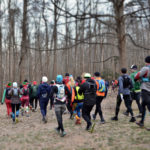
7:45 a.m.: There are about 100 participants, and they start to huddle near the starting line. The age representations in the crowd: 38 percent of runners are in their 30s, 29 percent in their 40s, and 37 percent in their 50s, according to data from the race. Fewer than five percent of the participants are in their 20s. The gender split is roughly 60 percent male, 40 percent female.
8:00 a.m.: Race director Bart Rein gives us the rundown on the race, specifying how runners need to tell aid station volunteers their race number so they know where to look, just in case something happens to you. Aid stations that provide food and water to passing runners are about three to four miles apart on this course. The volunteers keep track of the race participants, and help anyone who may need to quit. This should worry me more, but I’m too full of adrenaline to think about something going wrong.
8:01 a.m,: Overheard from a pair of runners behind me: “It’s gonna be hot, it’s gonna be hard. Safety first.” I can’t tell if this makes me anxious. Nope, I’m too excited to be anxious.
8:05 a.m.: And we’re off!
8:10 a.m.: A clean-shaven man—who looks like he should be running for Congress—shouts out: “Hey folks! Only 49 kilometers left!” Groan. Aaannnd, his polls just plummeted.
8:45 a.m.: The first major aid station! The table is overflowing with food: cookies, soda, M&Ms. I take a salt tablet because I know that it won’t make me sick in a few miles. Everyone’s body is different, and mine apparently hates me.
9:40 a.m.: When’s lunch?
10:02 a.m.: As I get to another aid station, a race volunteer shouts out to a runner: “What’s your number?” “202-12 …” “I mean your race number!” Unrequited love.
11:00 a.m.: I’m running with two guys: one looks 60, one looks 30. Three different fitness levels and body shapes between us. Trails equalize. This is grand.
11:30 a.m.: I finish lap one! Twenty-five kilometers down. An aid station volunteer asks me,“Are you going to take on another lap to hit 50K?” I look towards the parking lot, where finished 25K runners have already cracked open the booze. Me: “Ah … yes.” I trot past the group of happy runners as they wave their stouts, cheering me on.
11:31 a.m.: I’m 100 meters into lap two! I can still hear the group of beer-drinking runners behind me. I’m pretending to be unfamiliar with the notion of regret.
12:00 p.m.: It’s lunchtime! I am miles from the closest Chipotle burrito (I can’t stop thinking about one with brown rice, chicken, fresh tomato salsa, and guacamole). I open a GU packet (a single serving of calorie and vitamin-dense gel) while I slow my run down to a jog. The flavor is less enjoyable than the salsa-stuffed burrito I’m fantasizing about, but it’s close enough.
12:50 p.m.: I think I just saw a deer prance over a brook! Am I so dehydrated that I’m hallucinating? Guy running in front of me: “Hey look, deer!” Turns out I’m fine. Close call.
1:00 p.m.: This is the best moment of my life, I feel wonderful!
1:02 p.m.: The time has come for me to assume fetal position and die.
2:00 p.m.: After downing some Gatorade and a salt tablet, I start to feel better. A rendition of James Brown’s “I Feel Good” begins to play in my head. I start to hum along.
2:20 p.m.: I remember a quote by Jenn Shelton, a Patagonia-sponsored marathoner and ultrarunner, about long races: “You experience a lifetime of experiences… the highest and lowest you’ve ever been.” I think she was talking about a 100 Miler, but hey, the sentiment remains.
2:58 p.m.: I hit the last aid station. A mile and a half to go.
3:02 p.m.: I can’t do this. My heart rate just spiked. Breathing. Oh my gosh, we’ve been running for over 30 miles. I didn’t realize how exhausted I was. I can feel myself losing control of my pulse. Breathing. Calming down. Don’t stop. I can do this.
3:12 p.m.: I can hear the finish line. I run towards it.
3:14 p.m.: “GO, GO, GO!! WOOO!!!!” People I don’t know are cheering for me. I like these strangers. I cross the finish line. I collapse.
3:17 p.m.: Someone offers me an ice pop. I eat three more while sitting next to the finish line. “YEAH, FINISH STRONG!!” I am exhausted, happy, joyous. “WOOOOO!!!” I eat another ice pop and cheer in the finishing runners.
3:18 p.m.: A runner crosses the finish line, in obvious pain. He folds down into the grass, and throws cold water on his face. He’s silent for a few beats and then, without opening his eyes or sitting up, he hollers out: “So! Which ultra are we doing next?”