 Rachel Sadon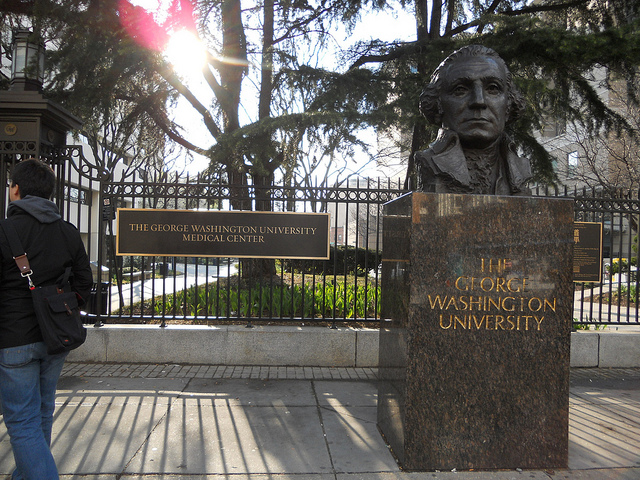
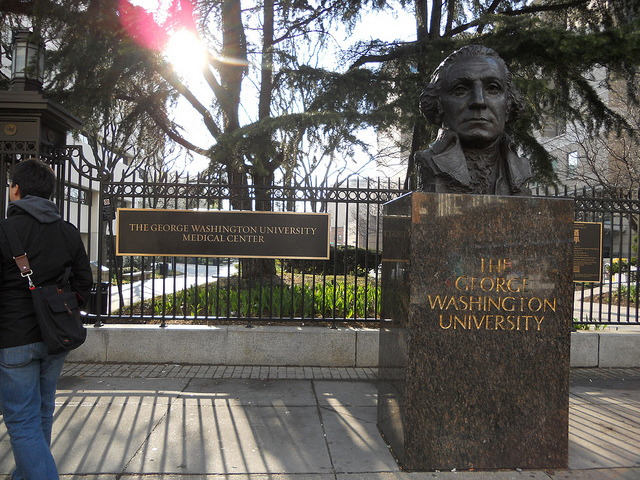 (Photo by Bianca Bueno)
After a two-year organizing effort and a recent National Labor Relations Board ruling in their favor, George Washington University resident advisors are voting to unionize on Wednesday. If successful, they would set a national precedent as the first unionized RAs at a private university.
“The news of the NLRB recognizing GW’s resident advisors as statutory employees—not just participating in an extracurricular activity, that they are employees and they have rights—is monumental in itself,” says Celeste Aguzino, a former RA and one of the organizers of the campaign.
GW hires about 110 resident advisors each year to live in the university dorms. They receive free housing (valued at around $12,600) and a stipend of $2,500 in exchange for spending about 20 hours a week on coordinating programming, advising students, and other duties.
A group of students filed a petition to unionize two years ago, arguing that the pay scale is unfair and their contracts are too vague, prompted by the addition of new requirements and a series of firings they deemed arbitrary.
“It led to a conversation and doing some research, thinking what are ways that students have have more of a say in the system,” says Aguzino, a senior. “In talking to resident advisors and hearing their grievances, it was more than the money. It was the housing and job security, the arbitrary responsibilities, the lack of personal rights, and lack of respect from management.”
When organizers turned to the idea of forming a union, they found a model at the University of Massachusetts Amherst, where resident advisors unionized about a decade ago. But because it is a public university, they were able to do so under state laws that govern public-sector employees. There is no precedent for a union of resident advisors at a private university.
In December of 2016, the group filed a petition to form a union and be represented by Service Employees International Union Local 500, which represents 20,000 educators, caregivers, and advocates in the region, including GW’s part-time faculty. The university almost immediately announced it would oppose the effort.
“The university does not believe that it makes sense to apply a federally regulated system of collective bargaining to students who are participating for a period of time in a program as part of their educational experience,” Dean of Students Peter Konwerski told RAs in a letter.
The university echoed that argument before the NLRB, saying that introducing a union would make RAs less effective at serving residents and that the role is primarily part of the RA’s academic life rather than an economic relationship.
The National Labor Relations Board rejected the claim.
“Plainly, the RAs are not providing these services voluntarily—the RAs unquestionably receive something of value in exchange for their services,” wrote regional director Sean R. Marshall. “I do not doubt that when current and former RAs reflect on the time they spent as RAs, they believe the experience was educational and was instrumental in their future career accomplishments. However, the same can be said for many of one’s life experiences, whether they are educational, social, religious, or occupational. Employment experiences can simultaneously be educational or part of one’s personal development, yet they nonetheless retain an indispensable economic core.”
Marshall drew heavily on an earlier ruling at Columbia University that allowed teaching assistants to unionize, which also found that the graduate and undergraduate students who serve in those positions meet the standards of an employee.
“There’s a lot more recognition by the NLRB that there are huge groups of people who are doing work for the university system and should be recognized as working for them,” says Christopher Honey, the communications director for SEIU Local 500, which also represents the adjunct faculty at GW and American University. Following the Columbia decision, graduate students at AU also voted to join the union last month.
George Washington University can still appeal the NLRB ruling, which otherwise paves the way for RAs across the country to unionize.
The university is still weighing its options in terms of a possible appeal, according to a university spokesperson. “Fundamentally, we believe this is a peer-to-peer mentorship program versus an employment program,” says Candace Smith.
In a statement posted online, GW said that “while the university will continue to cooperate with the NLRB in this process, the university continues to believe that the NLRB’s union election process should not be applied to students in our residential life program, which is an integral part of the educational experience of our undergraduate students.”
The Association of College and University Housing Officers-International backed GW’s position, saying in a statement that unionization “devalues the student communities that we are striving to foster on our campuses.”
Organizers of the drive, though, say that a clearer and fairer contract would enable RAs to do their jobs better and with more clarity about what the role entails.
After Amherst’s RAs unionized, they came to “a rigorous 26-page contract that outlines different responsibilities and penalties, through a negotiation between two sides,” says Frank Fritz, a volunteer with the union effort. “Compare that to GW’s [current contract]: it’s four pages, with typos.”
This post has been updated with comment from GW.