 Rachel Sadon
 (Photo by Darwyn)
After recording the largest per-capita increase in the homeless population in the country in 2016, the city saw a 10.5 percent drop in the annual point-in-time count this year.
“We know that it is possible to end homelessness in Washington, D.C. These results show that our efforts to prevent homelessness and connect more residents to safe and affordable shelter are paying off,” Mayor Bowser said in a release. “We still have more to do, but we have made significant progress over the past two years, and we will continue this work until every D.C. resident has a safe place to call home.”
The city’s fact sheet paints a fairly rosy portrait. All the key categories saw decreases, some quite significantly from 2016, with the exception of the number of people who were “unsheltered” on the night of the count (and the report explains that was likely because the 2017 count occurred on an unseasonably warm night).
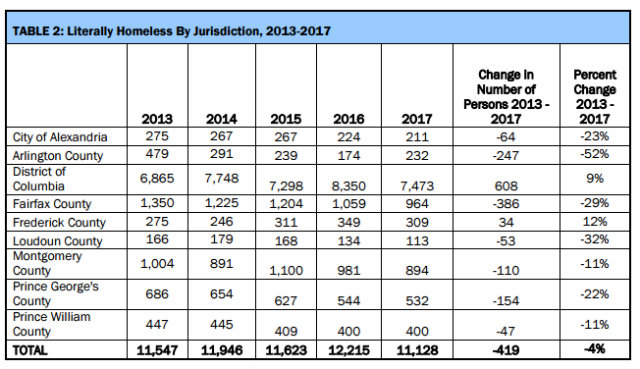
But despite the significant decrease from 2016 to 2017, D.C.’s homeless population hasn’t even returned to 2015 levels, and over a five year stretch, homelessness is up 9 percent. For every 1,000 Washington residents, 11 are homeless.
 (Courtesy of MWCOG)
In the region as a whole, seven of the nine jurisdictions recorded decreases from 2016 to 2017, with the largest total decrease in D.C. and the highest percentage change in Loudoun County, according to a comprehensive report of point-in-time findings compiled by the Metropolitan Washington Council of Governments. Arlington County saw a 33 percent uptick, while Prince William County’s count was unchanged.
“Data collected this year confirm what each jurisdiction has observed in practice, that the single greatest barrier to ending homelessness in our communities is the diminishing number of affordable and available permanent housing opportunities for the lowest income households,” the report reads.
Across the region as a whole, children represent almost a third of the homeless population, according to MWOCG.
Of D.C.’s total homeless population of 7,473 homeless people, more than half are in families and 2,281 are kids. While the percentage of D.C. families experiencing homelessness in 2017 decreased by 22 percent from 2016, it is still up by 23 percent from five years ago.
Addressing the family homelessness crisis has been among the city government’s highest priorities since 8-year-old Relisha Rudd disappeared from the family shelter at D.C. General in 2014. After significant revisions to a proposal put forth by Mayor Muriel Bowser, the D.C. Council passed a plan last year to close the dilapidated facility and replace it with smaller shelters in six wards. Though it remains a major achievement, D.C. General is unlikely to close before the winter of 2020, and when it does, the new shelters will only be replacing beds in the shelter system—not adding them. Meanwhile, the city has also still not inked a land deal for the planned shelter site in Ward 1, which would replace a shelter in north Columbia Heights.
The affordable housing crisis is reflected in even longer views of homelessness data. Between 2007 and 2016, D.C. was third behind New York and Massachusetts in terms of the absolute increase in the homeless population—and far and away the highest in terms of percentage (191 percent; Massachusetts was second at 92 percent), according to a report from the Department of Housing and Urban Development.
Trending in the opposite direction, though, is veteran homelessness. Thanks to a concerted push on both the local and federal levels, the District has seen a steady decrease in the number of veterans experiencing homelessness, falling 43 percent.
2017 PIT Report by Rachel Sadon on Scribd