

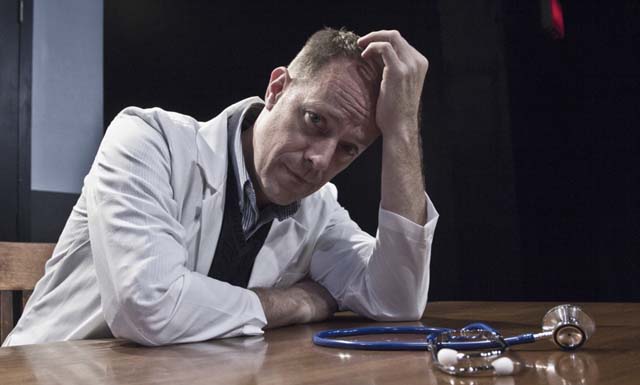
 Michael Milligan, actor and playwright. Photo by Allan Nowakowski
It seems like everyone has a horror story about healthcare. But in the pitched political battles over the system, personal stories can get lost in the fog of legislation and data. Michael Milligan has been on a quest to dig them back up since his 2013 premiere of Mercy Killers, and with his new companion piece Side Effects. Both of them are produced in repertory by Taffety Punk Theatre Company, where he paints a grim but important picture of just how bad it is.
On the surface, the subjects of the two shows couldn’t be further apart. Mercy Killers focuses on Joe, a barely middle class Rush Limbaugh-listening auto mechanic in rural Ohio. Side Effects observes Paul, a doctor who likes fine whiskey and may someday make it to the upper middle class.
Joe struggles to help his cancer-stricken wife as they drown in bills and forms and doctor visits, while Paul laments the despair he feels working in a system seemingly more interested in extracting profit than curing diseases. These are uncomfortably personal stories, and Milligan, who plays both characters, puts the rawness of their pain on full display.
His spark for Mercy Killers was similarly personal. One night, after Milligan finished up in a show at the Folger, a friend showed up at the stage door, homeless, desperate, and facing enormous medical bills without insurance. Milligan took him in and did his best to help.
“It was a complete shock to me, and that whole experience broke my heart open and made me start asking questions,” said Milligan. “In another country, I might have just walked into a doctor’s office and the proof that he could get medical care was that he’s a human being.”
He wrote Mercy Killers soon after, which won the Fringe First award at the 2013 Edinburgh Fringe Festival. He took the show around the world for the next four years, performing in church basements and libraries but soon graduating to medical schools, political rallies, and even the Minnesota state legislature.
Part of the secret to his success was his commitment to a minimalistic (and inexpensive) experience. As a one-man show, Mercy Killers was easy to put on anywhere from a living room to a main stage, which let it reach audiences it never would have otherwise (doctors don’t often have access to stages). His populist commitment allowed it to resonate with people outside of sometimes-insular theater communities who could still appreciate the slices of their lives they saw in Joe. Before long, it also led to his next idea.
“To keep overhead low, I’d often stay with the people who hosted me for performances, so I ended up spending a lot of time with doctors and nurses,” said Milligan.
That time eventually resulted in Side Effects, a follow up aimed at physician burnout and based on a composite of stories told to him by healthcare workers on the road. Milligan felt that their experiences tend to get overlooked, which is a shame given sobering statistics like a suicide rate for American doctors that is double the national average.
Joe and Paul might exist in completely different environments, but they resonate because Milligan lays bare the humanity in their struggle against a profoundly inhuman system. When Joe rails against the corrupt bastards who forced him to divorce his wife so she could meet the Medicaid income cap, it doesn’t sound all that different from Paul lamenting the impending loss of his father’s practice thanks to a monolithic hospital system. By the end, they don’t seem all that different after all.
Milligan intends to write a third entry to form a trilogy in the image of the old Greek tragedies. He’s also codifying the effort under a new company called Poor Box Theater. What won’t change is his commitment to accessibility and bringing his message to anyone and everyone wants to hear it.
“I don’t want a theatre that’s going to charge $50 a ticket, because that’s not what this is,” said Milligan. “This is more like medicine.”
Mercy Killers and Side Effects will be performed in repertory at the Capitol Hill Arts Workshop through June 3rd. $15. Buy tickets here.


