Rachel Kurzius
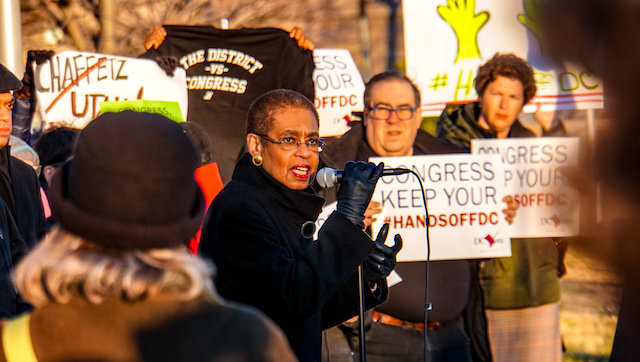 D.C. Delegate Eleanor Holmes Norton speaks at the Hands Off D.C. rally in February as the House Oversight Committee votes to pass a disapproval resolution over the Death With Dignity Act. (Photo by Ted Eytan)
The Trump budget blocks the District from spending its locally raised funds to implement its Death With Dignity law, the latest salvo in a fight between the federal and local governments over the measure.
“What began as this debate about the merits of the bill has really expanded to being a fight about autonomy and District sovereignty and the will of the people who live here,” says Ward 3 Councilmember Mary Cheh, who introduced the law.
She is one of many D.C. politicians and advocates who say they will fight to implement the law, which allows physicians to prescribe life-ending drugs to people with terminal illnesses that give them less than six months to live. The D.C. Council passed it with a vote of 11-2 after more than a year of debate.
Already, the law has survived an attempt from House Oversight Committee Chair (for now) Jason Chaffetz to block the law through the disapproval resolution process, much to the chagrin of local officials and activists.
“When I put my John Hancock on that law, it should be the law of the land,” said Mayor Muriel Bowser at a rally in February against Congress meddling in D.C. affairs. But that’s not how it works. Under the Home Rule Act, all D.C. laws must go through a 30-day review period on Capitol Hill. Most of the time, nothing happens and a month later the bill becomes law. But if both the House and Senate pass a disapproval resolution and the president signs it, the bill is nullified.
While Chaffetz got the House Oversight Committee to vote for overturning the law, the deadline lapsed in February before the full House or Senate voted on the measure. Even as advocates for D.C. celebrated their victory, they readied themselves for the budget process, where opponents said they’d fight the measure.
And just as promised, on page 29 of the budget it reads “None of the funds made available by this Act may be used to carry out the Death with Dignity Act of 2016 (D.C. Law 21-577) or to implement any rule or regulation promulgated to carry out such Act.”
To implement the law, the District needs to update its electronic medical filing system so that doctors can track the prescriptions of the lethal medications, which’ll require funds. The law also requires yearly evaluations of the program.
However, Cheh says that she and others are brainstorming “a way to deal with those reports so we could not run afoul of funding limitations. I’m pretty confident that we can construct this in a way where we don’t have to spend any funds.”
Bowser has said she could use funds from her current budget to update the electronic system before a new budget goes into effect. The Department of Health is on record saying the system will be up and running by September 30.
But Cheh would still prefer that D.C. and its Hill allies get rid of the limitation altogether. D.C. Delegate Eleanor Holmes Norton says that there’s a “decent chance of prevailing and leaving intact D.C.’s Death with Dignity Act in the upcoming appropriations process.” She points to their success in defeating the disapproval resolution by “exerting pressure on the 24 House Republicans, including two House Republican leaders, who are from states where medical aid in dying is legal.” Physicians can legally provide life-ending drugs to patients with terminal illnesses in six states.
That’s not the only thing that D.C. is blocked from spending its local funds on in the budget—as in years past, add abortions for low-income women and creating a tax-and-regulate market for cannabis to that list.
Chaffetz introduced a disapproval resolution over D.C.’s Reproductive Health Non-Discrimination Act in 2015. While it was approved in the House, it was never taken up in the Senate. Then, Republican efforts to block funding for the bill during appropriations last year were ultimately unsuccessful.
The Reproductive Health Non-Discrimination Act had powerful backers in the form of pro-choice groups. Death With Dignity has the group Compassion & Choices, which helped pass the bill in the District.
“We are urging members of Congress to respect the will of two-thirds of District residents who support this law and to respect the right of their elected officials to make public policy approved by their constituents,” Charmaine Manansala, national director of political advocacy for Compassion & Choices, said in a statement. “Terminally ill adults in D.C. like Mary Klein should have the same right to access this end-of-life care option as dying adults in other authorized jurisdictions.”
Now, Trump’s budget is not going to pass in its current form. It’s more of a wishlist from the administration. What happens next is that the House Appropriations Committee will issue its own budget, which could either have a rider about Death with Dignity in its draft, or a member could offer one as an amendment.
That rider could either block funding, as this budget does, or repeal the law altogether. Indeed, due to Congress’s power over the District, members could repeal the law at any time.
“In a sense, we’re never out of the woods,” says Cheh. “But if we could get [Death With Dignity] implemented, I think it would be much, much more difficult for them to have a straightforward rider” repealing the law.
Updated to reflect that the budget does not prevent D.C. from spending its local funds on needle exchanges, though a provision prevents the use of federal funds on needle exchanges in D.C. or anywhere else.