Rachel Kurzius
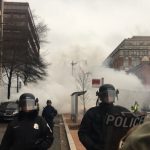
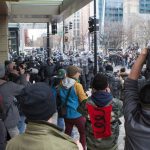
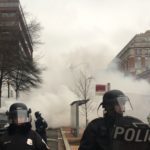
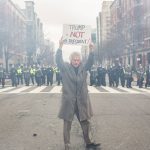
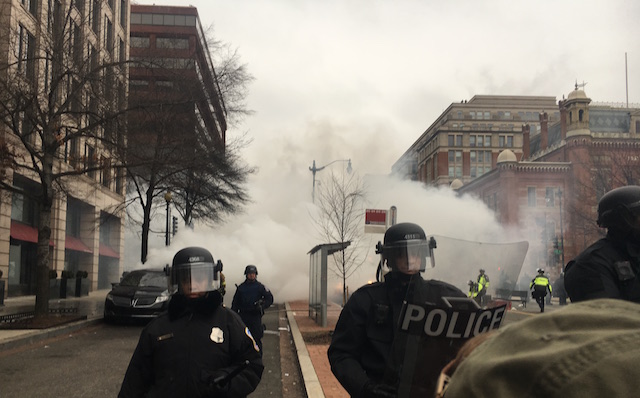 The scene near Franklin Square on the afternoon of Inauguration Day. (Photo by Rachel Kurzius)
It looks like the public will get a more thorough look at what happened on Inauguration Day between D.C. Police and protesters.
The fiscal year 2018 budget passed by the D.C. Council last week includes $150,000 for the Office of Police Complaints to review Metropolitan Police Department decision-making and policies that led to the arrest of more than 200 people on Inauguration Day and the use of chemical irritants like pepper spray.
On January 20, police and protesters clashed downtown (and, to a much lesser degree, by the National Mall) throughout the day. Smashed windows and a limousine set ablaze, among other incidents, resulted in more than $100,000 in damages to buildings, property, and vehicles, and minor injuries to six officers, according to the U.S. Attorney’s Office for D.C.
MPD Chief Peter Newsham said at the time that he was “very, very pleased” by his officers’ handling of the situation.
However, civil liberties groups have been critical of how D.C. Police dealt with some protesters. The American Civil Liberties Union of D.C. said it was “concerned that law enforcement may have violated demonstrators’ rights” by detaining individuals who weren’t involved in illegal activity, using pepper spray “without justification on people who were not breaking the law or who had already been detained,” and by holding people outside for up to eight hours without access to restrooms or food.
The day after the inauguration, dozens of protesters filed a civil lawsuit against MPD alleging false arrests and excessive force. Currently, more than 200 people arrested on or related to that day face multiple felony rioting charges and decades behind bars.
A report from Office of Police Complaints, a D.C. government agency independent of MPD, called for an independent consultant to investigate D.C. Police conduct. OPC monitors observed the indiscriminate use of nonlethal weapons without adequate warning, and the arrest of people who visibly did not commit crimes. Additionally, the report says that MPD didn’t follow its own procedures for what officers should do if a protest turns violent.
“The Metropolitan Police Department stands by its assertion that our officers acted responsibly and professionally during Inauguration Day,” MPD spokesperson Rachel Reid said in an emailed statement when the OPC report was released. “In response to the riots, the men and women of MPD made reasonable decisions during extremely volatile circumstances.”
Now OPC will make its own determination, barring changes to the budget before it’s sent to the mayor’s desk.
“When we put out our report on the inauguration, one of our primary recommendations was that we need to do a more thorough, complete analysis with what happened on Inauguration Day with respect to protesters,” says OPC executive director Michael Tobin. “I think that’s something the community needs and the police department needs, so we can move forward and look at what, if anything, we can do better next time.”
Tobin says OPC needed the $150,000 because “OPC dos not have enough internal resources to conduct the kind of report I think is necessary.” The money will largely go toward hiring subject matter experts to assist in drafting the report, with an emphasis on experts in use of force, crowd control, protest management, and enforcement of civil rights.
“Those are the main areas that need to be reviewed, in addition to polices that MPD has in those areas and the training they MPD has been conducting,” says Tobin. He doesn’t expect any issues obtaining documents or other information from them. MPD directed requests for comment to OPC.
Council Judiciary Committee Chair Charles Allen says the money was allocated because “OPC’s review found some things that were very troubling.” Allen wants the scope of the review to extend beyond Inauguration Day to the entire weekend, including the Women’s March the following day.
“I also want them to highlight what parts of this worked, and the places where our public safety teams did a good job,” Allen says.
The OPC released reports about both Inauguration Day and the Women’s March in February, and included “positive police interactions” in addition to concerns. Some of those included explaining police procedure to a civilian, providing traffic control for protesters near I-395, and giving people directions.
“Primarily the report is gong to be regarding the events in Franklin Square and some of the entrance points on the side of the Mall,” says Tobin of OPC. “It may very well be recognized that MPD did great work overall. It’s going to require a more detailed look at the Franklin Square park area.”
The final details have yet to be worked out, because the drafting of the report won’t begin until October 1 at the earliest, when the funding from the budget becomes available.
Some groups critical of MPD call the budgeting for the review a positive step, but question what impact it will have on the police department. “The question is less, ‘Did the police do anything wrong?’ but ‘What are we going to do to make sure we protect civil liberties in the District?'” says Eugene Puryear, an organizer with Stop Police Terror Project D.C. “And I don’t know if an OPC report is going to answer that question.”
Tobin says that OPC’s “main mission is to help MPD do their job. We can help MPD improve operations on crowd control and other issues that come up on a regular basis in the nation’s capital.”