 Photo via Facebook
When I saw the headline on Wednesday morning, I knew it was bound to misrepresent my neighborhood.
“River Terrace is a modest jewel tucked away in NE Washington,” reads The Washington Post’s title for an article about the Ward 7 community I have called home for 30 years.
The neighborhood sits along the Anacostia River, across from Kingman Island and the RFK stadium complex that’s slated to be developed by the city.
My grandparents purchased my family’s three-bedroom rowhouse about 50 years ago. It’s been a place to call home for four generations of relatives who’ve survived D.C. during bouts of violence, drug abuse, and now, gentrification.
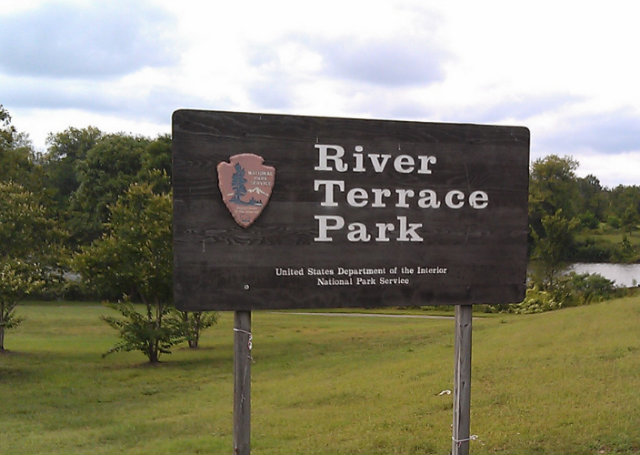
As The Post points out, River Terrace Park provides residents with “exceptional quality-of-life benefits—green space, fresh air, shade under the trees, a playground and water vistas.” The park also connects pedestrians and cyclists to the Anacostia Riverwalk Trail, which was all dirt and gravel when my brothers and I used it to navigate our way to the Anacostia roller-skating rink as kids.
The Post’s main selling point: River Terrace is one of the few places in D.C. where you can buy a home for less than $300,000.
While communities generally love to be lauded, it’s different when a newspaper decides to sell your neighborhood in its real estate section.
It’s especially concerning to longtime black Washingtonians who’ve watched residents in neighborhoods like U Street go from being 90 percent African American in 1970 to 30 percent in 2010. Meanwhile, the District as a whole lost its “Chocolate City” moniker about five years ago when black folks were no longer the majority as rents costs and home values increased.
These days, people who are looking to purchase affordable houses in D.C. are searching in neighborhoods that lie east of the Anacostia River, in Wards 7 and 8. And real estate agents promoting these neighborhoods may not always provide a full scope of the communities—both the things that make them truly special and those that make them less desirable places to live.
And according to River Terrace residents, myself included, that’s how The Post’s article failed.
One thing it doesn’t mention is the neighborhood’s “history of activism—or history at all,” said Malissa Freese, an event coordinator who’s lived in River Terrace for 11 years and recently became the president of the community organization.
Freese is one of many people who responded to the article after I linked to it in a neighborhood group chat. “River Terrace has a rich heritage and it is not touched upon,” she said.
A couple of years ago, residents created a community website, which includes the neighborhood’s history. Here’s an excerpt:
When home sales began in 1937, River Terrace was advertised as “a restricted residential neighborhood.” The deed for each house included racially restrictive covenants that forbade the sale, lease, rental, or occupation of River Terrace homes to “negroes or any person or persons of negro blood or extraction.”
In April 1949, River Terrace’s first black residents endured name-calling and vandalism of their property: “Two hours after a Negro family moved into a row house in a Northeast Washington white neighborhood [River Terrace], the house was stoned twice and a trash fire of undetermined origin was discovered in the back yard.”
Undeterred—despite being treated as second-class citizens—black families continued to buy homes in River Terrace. By 1951, River Terrace had both “white and Negro families living in the more than 500 dwelling units there.”
Eventually, all of the initial white owners in River Terrace sold their homes, and frequently at a financial loss.
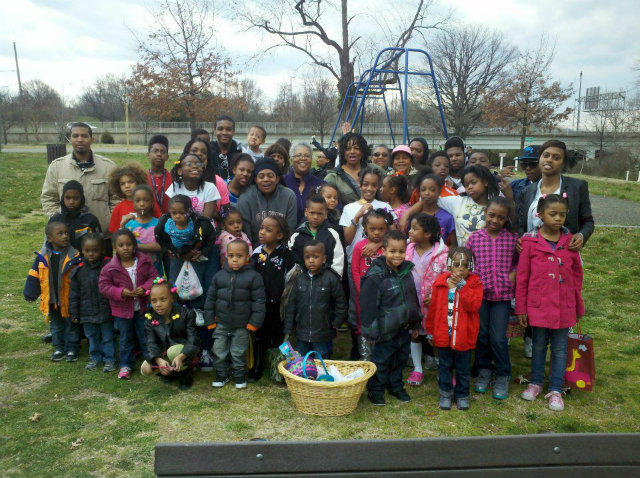 Neighborhood children after participating in the community’s annual Easter Egg Hunt (Photo via Facebook)
Although 90 percent of River Terrace residents are African American, The Post didn’t speak to one of them.
“As a native Washingtonian who left the city for college and grad school, and came back to a city that looks very different from my youth, I love that River Terrace retains some of that old D.C., ‘Chocolate City’ charm,” said Kendra McDow, a pediatrician who’s father grew up in the neighborhood.
Even Michael Magenheimer, the sole white resident who responded in the group chat, noticed the omission of River Terrace’s black history.
“I know that the strength of the community is built on its history as a historically black neighborhood, and all that comes with it,” said Magenheimer, a clinical psychologist who’s lived in the neighborhood for less than two years. “You can’t live in River Terrace without acknowledging the depth of its history as a black neighborhood, it’s what makes River Terrace, River Terrace.”
In addition to an accurate portrait of the community’s racial makeup, many residents said they would have liked the article to delve into the political and social activism of residents, as well as their professional diversities. They also wanted places of worship highlighted—because those things are what makes it a special place to live.
“What amazes me most about ‘The Terrace’ is everyone’s sense of responsibility to and love for our neighborhood,” said Cinque Culver, a resident who helped lead a fight to save the community school from closing (the city ultimately shuttered, remodeled, and reopened it for special education students, the majority of whom don’t live in the neighborhood).
Culver’s grandmother, Delores Thompson, has lived in the community for more than 60 years. “It has been a beautiful place to raise our family,” Thompson said. “My neighbors, their children, and now some of our children’s children’s children all remain close and connected here in River Terrace.”
Personally, I was baffled that the article listed the neighborhood’s transit options as the “glossy red DC Streetcar” and X1 and X3 buses—neglecting to mention the U4 or X2 Metrobus routes, which service the neighborhood far more frequently.
Is that because the X2 is arguably one of the worst Metrobus experiences in town, which isn’t a good selling point for the neighborhood?
For grocery options, the article named Safeway at the Benning Park shopping plaza, one of only two grocery stores in the entire ward, quickly followed by mentions of Whole Foods and Giant on H Street NE—which are not walking distance from the community.
And The Post’s take on crime in the neighborhood goes back just six months to include two assaults and one robbery—not far back enough to mention the double homicide that took place last year, causing longtime community members to gather in the streets to call for safety and healing.
“But the story was written not within the context of who is here, but from the perspective of who is coming,” said Brandon Frazier, a public affairs consultant who lives in River Terrace with his wife Jaime, a consumer safety officer with the FDA.
After purchasing his home three years ago, Frazier said he “practically yelled from a megaphone to my friends to buy homes here.” But for them, he said, it may be too late.
Justin Tanner, a real estate agent who’s been selling in River Terrace for years, told The Post that the first home to break $300,000 was in the fall of 2015. And in the past 20 months, 10 homes “have crossed that barrier.” He predicts that within the next year, prices will climb to the $400,000 mark.
But that’s still lower than the average selling price of homes in the District. According to Redfin, the median price for a two-bedroom home is $620,000 and a three-bedroom is $663,000.
While the article “fell woefully short,” it did “send a message that River Terrace is the newest best affordable area with few obstacles for buying low and selling high,” said Elaine Hart, a legal administrator, who’s lived in the community for 16 years.
In her words, the article is “a neatly packaged ad for who is coming.”