 Rachel Sadon
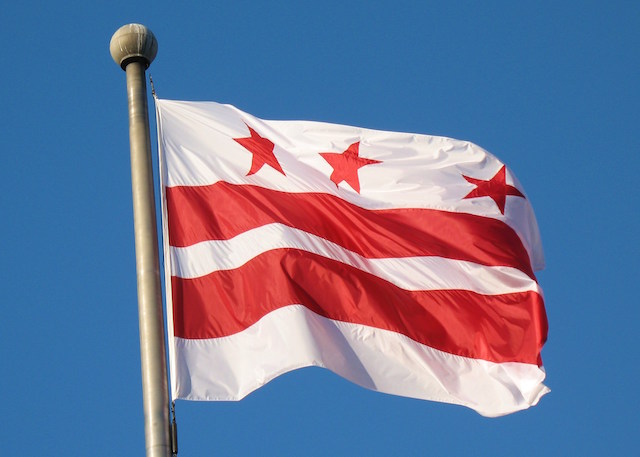 Photo by Mr.TinDC.
Welcome to the State of Washington, Douglass Commonwealth, where a Legislative Assembly passes bills and the executive office is run by Governor Muriel Bowser.
That was the vision, anyway, after a Constitutional Convention convened last year with hopes that a Hillary Clinton win combined with a strong Democratic showing in the House and Senate would pave the way for D.C. statehood.
“Obviously, some of the wind was taken out of our sails,” says At-large Councilmember David Grosso, who is now leading the charge to make one part of that vision a reality in the short-term: the names and titles. “These are the terms that were agreed upon in the constitutional process. Why not move forward and see if we can’t codify this?”
Under a bill Grosso introduced today, D.C. would stand for Douglass Commonwealth, the mayor’s title would become governor, the D.C. Council would be renamed the Legislative Assembly of Washington, D.C. and councilmembers would become representatives, while the chairman of the D.C. Council would be renamed the speaker.
“We act like a legislature; we are the legislative assembly. The chairman acts like a speaker of the house, and the mayor does act like a governor. It’s not like we don’t do these jobs,” Grosso says. “We have been acting as a state while being called a city for so long that I think it would be good for us to be named for what we actually do.”
Fellow At-large councilmembers Elissa Silverman, Anita Bonds, and Robert White and Ward 1’s Brianne Nadeau co-introduced the bill.
There’s some precedent for the move.
While the Home Rule Act does place restrictions on the D.C. Council’s powers (it can’t tax non-resident income, for example), the law doesn’t explicitly prohibit title changes. One of the legislative body’s first acts, in fact, was to rename Advisory Neighborhood Councils to Advisory Neighborhood Commissions. In 2004, the city also renamed the Office of Corporation Counsel to the Office of the Attorney General for the District of Columbia. Former Mayor Anthony Williams, who championed that move, says he’s in support of the changes that Grosso has proposed.
The At-large councilmember is well aware that adopting the signifiers of a state doesn’t actually give D.C. the rights that 78 percent of Washingtonians voted for in the 2016 statehood referendum, but he sees it as a step in that direction.
Statehood activists largely seem to agree.
“I don’t see any real drawback. It helps respect what the voters voted for,” says Josh Burch, the executive director of Neighbors United for DC Statehood.
It might even help change how outsiders view the local government, which essentially fulfills the roles split elsewhere between the city, municipality, and state.
“There’s a lot of people out there, among the many awful reasons that people oppose statehood, that oppose statehood because they say a city can’t be a state. Which is total bullsh*t, but there’s a perception behind that,” Burch says. “This helps control the narrative. It is a semantics thing. Our mayor would still have the same powers while being called the governor, but that helps with the perception. Politics is perception.”
Mayor Muriel Bowser understands that well.
“Though Governor Bowser has a great ring to it, she is more concerned with District residents having full access to our country’s democracy,” spokesperson LaToya Foster tells DCist via email. “She supports [the legislation], but plays down the title. Statehood is what matters most to her. Democracy and full representation for the residents of the District is her number one priority.”
The bill has been referred to the Committee of the Whole, where Grosso has cautiously high hopes for it. “We’ll see if [Chairman Phil] Mendelson has the time to take it up … I hope he’ll move forward with a hearing.”
Should it make it through the local legislative process, Congress will have the opportunity to weigh in, as they do with all D.C. law—which is, of course, part of the underlying problem for most Washingtonians.
Legislators elected to represent other states routinely meddle in all manner of city affairs. The past few week offers up a representative sample; from deadly serious efforts (yes, plural) to change D.C.’s strict guns law to the almost comically ridiculous assault on a recently passed law regulating flushable wipes.
While D.C. has a larger population than two states and pays more taxes than 22 of them (and more per capita than all of them), Washingtonians still don’t have a vote in the House or the Senate to rebuff those attempts.
“Some people say that it’s just too big a leap to go from a city to a state. They don’t dig into the real issue, which is that that we are already operating as the most fiscally prudent and sound state in the country—but we don’t have two votes in Congress,” Grosso says.
A statehood bill for D.C. was introduced in the U.S. Senate in May, but it isn’t expected to go anywhere.
Grosso’s bill, though, stands a reasonable chance. Should it become law, advocates see the new names as a new weapon to wield in the long, uphill battle for statehood.
“We want to make sure that if people are starting to adopt the language of governor and legislature, that it’s in the vein of talking about D.C. statehood,” DC Vote’s advocacy director Bo Shuff tells DCist. “This is an opportunity for us to talk about the fact that we have a governor, sort of, with an asterisk.”
Washington D.C. Preferred Terms Establishment Act of 2017 by Team_Grosso on Scribd
This post has been updated with former Mayor Anthony William’s support.