 Rachel Sadon
 (Photo by Darwyn)
The thing about the years that William Mann lived on the streets that he wants people to know about is just how exhausting it was. Every decision, every difficulty was compounded by the fact that he rarely got a proper night’s sleep.
“When you haven’t been able to get that REM sleep, that deep sleep, beyond the point of 48 hours, you appear crazier than what you actually are. But it’s due to sleep deprivation,” Mann says. “You might be able to cat nap, you might be able to get on a Metro train and rest, but you couldn’t get that main healing sleep.”
Even something as simple as remembering to take a bag he’d placed down could get lost in a cloud of exhaustion-induced fogginess. Finding permanent housing wasn’t something Mann could begin to think about.
“It was just day-to-day survival, making it from one day to the next,” he says. “You don’t realize the level of trauma you’re under.”
For the chronically homeless, taking medication on a regular basis without a medicine cabinet, securing identification documents when things are constantly going missing from shelters, keeping track of applications while sleep-deprived, getting sober while surrounded by other addicts, and holding down a job without a closet or a shower can each be next-to-impossible. For many years, in order to be placed in a home, the chronically homeless were told they needed to regularly achieve the next-to-impossible.
In 2008, the equation for help was reversed. Instead of placing a raft of requirements before providing shelter, D.C. adopted a “housing first” policy, following a model pioneered by the non-profit Pathways to Housing.
“With chronic homelessness, in particular, we know what the solutions are that work,” says Department of Human Services director Laura Zeilinger. “What works for people is supportive housing, and offered in a housing-first approach, meaning that access is not pre-conditioned on other behaviors.”
That approach has been borne out in both hard data and moving anecdotes.
Citywide, the success rate for those who have been placed in permanent supportive housing, the program that comes with the most intensive set of services, is more than 90 percent. Advocates speak emotionally of seeing keys handed over to people who had been homeless for decades, who were considered to be consigned to a fate of sleeping on the streets.
As the District approaches a decade of implementing housing first policies, the number of chronically homeless people, defined as being homeless for at least one year or four times in the past three years and having a mental or physical disability, has declined by nearly 33 percent.
But there are also still about 1,500 people living on the streets; 1,500 people whose life expectancy is cut short, on average, by 20 years; 1,500 people for whom the crisis remains acute.
Can the city continue to find homes for them as family homelessness remains a priority, as critical federal support is on the chopping block, as housing becomes increasingly expensive? Advocates are surprisingly optimistic. Many believe the city can even accelerate the successes seen in the past few years.
“When we say we’re going to end chronic homelessness, people think that’s unrealistic,” says Jesse Rabinowitz, an advocacy specialist at Miriam’s Kitchen. “But when we see people who have been homeless for years moving into housing and the numbers going down year after year, it shows it’s possible.”
The change in the approach to the city’s homelessness crisis can be witnessed in the bustling basement dining room at Miriam’s Kitchen, a nonprofit that provides short-term assistance to the homeless while advocating for long-term solutions.
Back in 2007, the year before D.C. began implementing a “housing first” approach, Adam Rocap started as a social worker at Miriam’s. So many people would routinely show up for breakfast that the facility strained to physically accommodate them all. “We always had to plan if the dining room is full, how are we going to have bags of food that we’re going to serve outside to make sure we can keep feeding people,” he recalls.
Worse, though, was that food was one of the only things that he and other social workers could truly offer their guests.
“Most of the housing programs that were out there had big sobriety requirements or requirements of needing to take medicine or a lot of rules, so I couldn’t effectively refer people,” says Rocap, now the non-profit’s deputy director. “I had very little solution besides ‘I can get you on a bunch of waiting lists for programs that probably aren’t a good fit. So let’s try to figure out how to make your lives marginally better.’”
Christy Respress tells a similar story about the early years of her career. After two years of doing outreach work in the District of Columbia, she was only able to see a handful of homeless people actually exit homelessness.
Eventually she found her way to Pathways to Housing in New York City, which was pioneering a new way of doing things: giving people experiencing homelessness housing as a precursor to psychiatric care, employment help, or substance abuse counseling as opposed to the last step. Research would soon prove that the model, developed by Sam Tsemberis in the 1990s, was significantly more effective than the prevailing options and came with significant cost savings (a Denver study conducted in 2006 found that it saved $31,545 per participant in emergency care costs).
By 2004, D.C.’s Department of Behavioral Health had taken notice of what was happening in New York. They asked Respress to come back to D.C. and try to implement the model here.
For four years, Pathways to Housing DC worked to prove itself and the approach to the community. At first, Respress says, it was difficult to get other nonprofits to refer clients to Pathways, so they did their own direct outreach to people on the street.
When she and her team explained what they were offering “people said yes. It wasn’t hard to fill those first spots,” Respress says. They helped 55 people leave homelessness in that first year. As of today, Pathways has seen more than 700 people get housed in D.C., with an 85 percent success rate.
In 2008, under Mayor Adrian Fenty, the city put local tax dollars toward permanent supportive housing, totaling more than 1,200 units in three years, in addition to rental assistance programs that come with fewer services. Advocates believed the city was making meaningful progress toward ending chronic homelessness. As Vincent Gray came into office, though, federal dollars started drying up, the city’s economy was hit with the effects of federal budget sequestration, and advocates questioned his administration’s commitment to making up the shortfall.
Strong investments in ending homelessness returned as Mayor Muriel Bowser made ending homelessness a clear priority, with the twin realities of a booming local economy and a worsening affordable housing crisis on her hands. This year’s budget includes $6.5 million in funding for 274 units of permanent supportive housing and 185 units for targeted affordable housing (essentially a voucher program focused on the homeless that comes with fewer wraparound services than permanent supportive housing).
D.C. also developed a new coordinated entry system that drastically simplifies and standardizes the process of applying for assistance across the city. According to Zeilinger, the city has housed nearly 3,000 people since it was implemented in 2015.
That work is reflected in the steady declines in chronic homelessness seen in the annual point-in-time count.
A word about the count: it has flaws. It was created in the early 1980s (national standards were enacted in 2005) with the goal of an annual, accurate count of the homeless population. Volunteers fan out across the city each year during a single night in January, searching for people to survey. It is conducted around the country—allowing states not only to measure their own progress, but to compare it nationally.
The idea is that in the heart of winter, more folks will seek come inside and seek shelter (D.C. is legally mandated to guarantee shelter on freezing nights), and will therefore be easier to find and count. However, that creates for fluctuations during unusual weather years, like the warm spells that are becoming increasingly frequent, and does not account for people waiting out winter nights in cars or on couches. Nonetheless, it’s the best measure out there, and the years-worth of data clearly show downward aggregate trends.
So does the dining room at Miriam’s Kitchen. At a recent dinner service, the room was still bustling, but there was plenty of room inside—and social workers feel they have more to offer than just a hot meal.
“I can now say I’d really like to work with you on housing. The good news is there are a bunch of different housing programs out there and they’re different and I can help you get matched to the right one for your unique needs,” Rocap says. “The part that still feels the same is the amount of housing that’s available is still so vastly smaller than the need… there’s just not enough resources” to help everyone who asks for it.
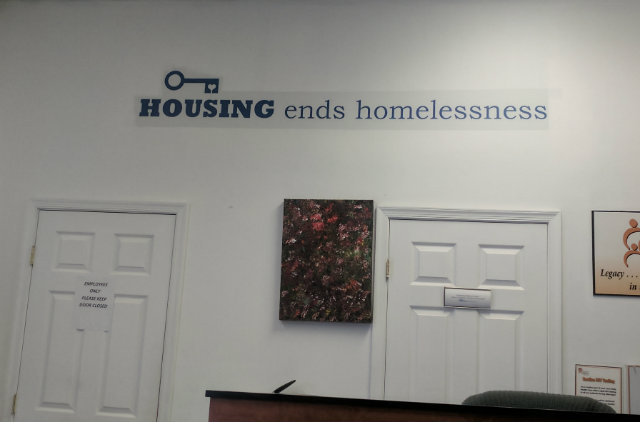 A sign at the Pathways to Housing DC office. (Photo by Rachel Sadon)
Housing provided the stability that Mann needed to be able to understand and manage his bipolar disorder. “I have the security of a home. This has allowed me to focus on things beyond day-to-day survival,” he says. He founded a community initiative, The Eco Project, to help beautify the neighborhood.
But there was a long gap in time, about six months, between when Mann started the voucher process and when he actually had a roof over his head.
Part of the delay in getting the homeless housed can be chalked up to bureaucratic hurdles like getting the proper documents and waiting for housing inspections. Increasingly, though, the waits are stretching longer and longer because it is getting harder to find housing that comes in under the cost of what vouchers can cover.
“It’s not impossible yet,” Respress says. “We’ve not stopped, but it’s getting more challenging. There may be 10 college students looking to rent the same apartment as a person with a subsidy. We’re fighting for that same unit that is affordable for anybody.”
The dwindling affordable housing supply also means that more Washingtonians are being priced out each year—some of them to the streets. Ending chronic homelessness means preventing the next generation from becoming chronically homeless in the first place (the city acknowledges that homelessness will never reach absolute zero; the goal is for episodes to be brief and non-recurring).
The housing crisis has also triggered an even larger family homelessness crisis, one which has at times taken the spotlight and energy off of chronic homelessness. City officials have struggled to respond to an uptick in family homelessness of 46 percent between 2012 and 2016.
“D.C. is in the middle of both a homeless crisis and an affordable housing crisis and they’re both deeply connected,” Rabinowitz says.
While the mayor’s budget makes historic investments in those issues, he and others argue it doesn’t go remotely far enough to solve the twin crises (Miriam’s was among a group of progressive non-profits that argued the city should have delayed tax cuts and invested the money in social services, education, and transportation instead).
Zeilinger, for her part, is very satisfied with the investments the city made. “We were cautious to ask for what we were certain we can spend,” she says. “We want to be cautious about requesting more resources than we can expend because those [would go to] other services and supports that are needed also.” Even if, for example, funding was made available for thousands of vouchers, there simply isn’t the housing stock to absorb the demand.
No matter how one views the D.C. government’s financial commitment, it seems all-but-certain that it will be more important than ever in the years to come.
“It is certainly clear that the most recent [federal] budget request scales back investments in very significant ways in affordable housing,” Zeilinger says. “[That] can severely impact our pipeline in terms of housing development.”
Cuts to other federal programs could also drastically curtail the number of vouchers available. At Pathways, for example, about 55 percent of the subsidies they utilize come from local sources; the remaining 45 percent are federal.
One of the other most critical, and vulnerable, federal programs for solving chronic homelessness is Medicaid. Providing healthcare and supportive services is a critical piece of the permanent supportive housing model. And crippling Medicaid would also saddle already-struggling Washingtonians with healthcare bills that could easily plunge them into homelessness.
Despite these looming challenges, and the fact that progress has been slower than initially outlined in Bowser’s Homeward DC plan (it calls for an end to chronic homelessness by the end of this year), advocates are still confident that the city is on its way toward ending chronic homelessness.
“Ten or 15 years ago, I would’ve said ‘no.’ But these last few years, we’ve really come together,” Respress says. She believes it is even possible that the city could end chronic homelessness by 2020.
Zeilinger demurs repeatedly when asked when she thinks D.C. might reach that place, calling it irresponsible to make such a projection before the modeling is updated with data from the first year of implementing the Homeward DC plan.
But it’s clear, she argues, that the city is on the right path. Even as the District has simultaneously focused on family homelessness, which decreased 22 percent from 2016 to 2017, it hasn’t come at the expense of gains in ending chronic homelessness.
And even as the threat of federal funding cuts worries advocates and city leaders, their optimism comes from the fact that a lot of the work and implementation happens on a local level.
DHS is making targeted efforts to address things big and small that advocates say impedes progress. They are actively working to engage landlords, for example, about their concerns in renting to someone with a subsidy. “We’re trying to create as many reasons as possible to open their doors,” Zeilinger says. The agency is also working with the private sector to set up a sort of insurance fund to mitigate any potential risks for building owners.
“We’re making major investments in the solution that we know works. We’re bringing together a team of people who understand what it takes to solve this problem, with the right kinds of accountability and support,” Zeilinger says. “The political will is unwavering, really unbelievable by the mayor, and the council has been a very strong partner in appropriating resources.”
Having a solution, one that is nearly universally agreed upon, is the key.
“On the simplest level, the solution to homelessness is housing,” Rocap, the deputy director of Miriam’s Kitchen, says. “We often try to make it more complicated than that but … if you really listen, people are saying I don’t want to be homeless; I want housing.”
Without housing, Mann says, “I would have died alone on the streets.”
Want to learn more about the issue or how you can help? Pathways to Housing hosts an open house twice a month. We’ve also put together a guide to volunteering with service providers.
DCist is one of seven D.C.-based news outlets dedicating a portion of our coverage on June 29 to a collaborative news blitz aimed at uncovering barriers and solutions to ending homelessness. See more at DCHomelessCrisis.Press