 Julie Strupp
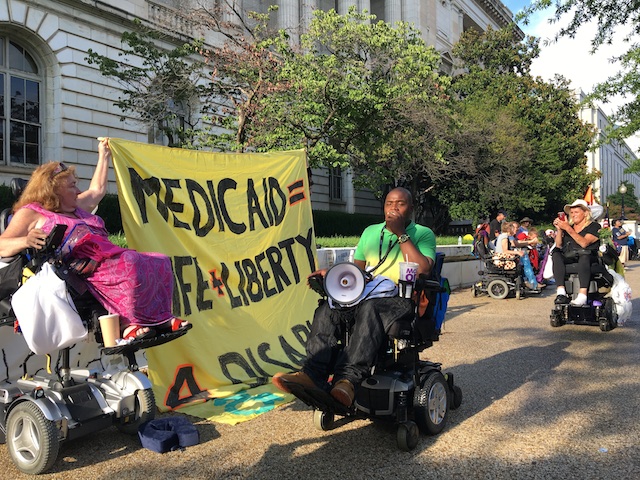 Members of ADAPT, a disability rights group, protest in front of the Russell Senate Office Building. (Photo by Julie Strupp)
Since the beginning of June, U.S. Capitol police have made nearly 500 arrests of protesters rallying against cuts to the Affordable Health Care Act.
Each round of mass arrests might have earned significant coverage in a different time, but they have registered as barely a blip in the frenetic news cycle. Still, a prominent disability rights group says they’ve won Herculean battles before, and they’re nowhere near giving up this fight.
Yesterday afternoon, following the Republican vote to advance their repeal and replace health care bill to a debate, Capitol Police arrested 95 people. Sixty-four of them were members of ADAPT, a formidable grassroots coalition that has been fighting for disability rights since the 1970’s. While a variety of protesters and activists groups have been showing up at the Capitol, ADAPT members have made up the vast majority of the arrests for protesting health care repeal over the past two months.
“I’m here all week, I’m going to spend my time making my voice as loud as possible,” says ADAPT member Daniel Kleinmann who was among the most recent round of arrestees. “It was very distressing to hear John McCain come back from receiving exceptional medical care, which he requires to live, to then deny fellow Americans exceptional medial care, which they also require to live.”
Since Sunday, undeterred by the rain, ADAPT members have been camped out in front of the Russell Senate Office Building.
On Tuesday, DCist found them holding signs and chanting, “Save our liberty, don’t cut Medicaid” and “don’t kill us, kill the bill.” A few protesters carrying mock gravestones straggled in from a nearby die-in in front of the Capitol building, organized by the progressive lobbying group MoveOn. Drivers honked in support of the activists, and Pennsylvania Senator Bob Casey Jr. came by with stacks of pizzas in a gesture of solidarity.
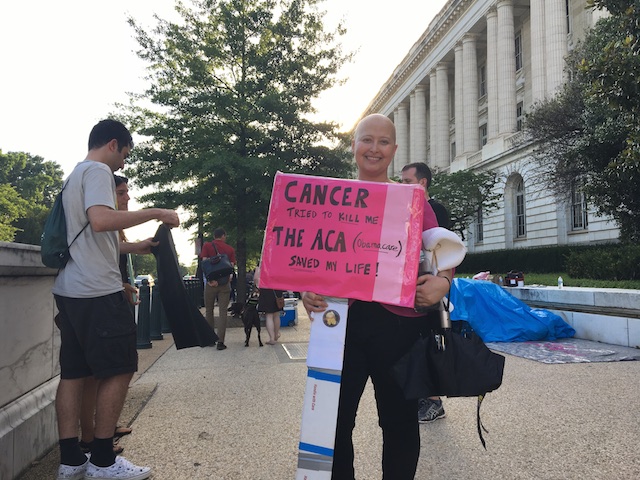 D.C. resident Cristina Villegas, a current breast cancer patient, says Obamacare provisions incentivize doctors to reach out to patients to make sure they come in to do physicals every year. Her doctor caught her aggressive cancer in an early stage, and she credits it with saving her life. (Photo by Julie Strupp)
“We’re living out here through a lot of rainstorms. We got soaked [Monday] night,” says Nancy Salandra, a Philadelphia resident who has been a member of ADAPT for 25 years. “Down here over the last 24 hours, all kinds of people have come up to us, thanking us [on behalf of] their kids with disabilities.”
Salandra works at a center where many of her disabled clients depend on Medicaid. She says many citizens with disabilities would lose access to assistance care that allows them to live independently if the Republican health care bill goes through as it’s currently written. Due to federal regulations, they would be forced to live in a nursing home instead, which is typically much more costly for taxpayers.
“Without services, if you have a child with severe disabilities, families break apart. The stress on families is too difficult. Moms and dads need respite care, they need counseling, they need services for their children and programs to keep them alive and well. This will force parents to put them into institutional living because they’re unable to give them the medical care they need at home,” says disability rights activist Fran Fulton. “If this bill were to go through, this means the care for people in nursing homes would go down even more.”
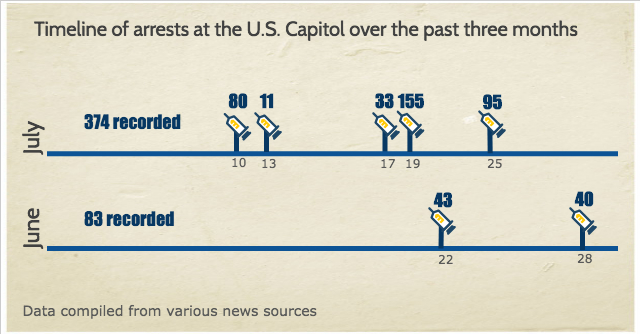 Infographic by Julie Strupp
Since the beginning of May, Capitol Police say 494 people have been arrested in the U.S. Capitol building for “Crowding, Obstructing, or Incommoding,” and we were able to account for 457—all of which were health care repeal protesters in the months of June and July. Most were members of ADAPT, but other arrestees included eleven clergy members.
ADAPT activists report they have also sometimes been charged with “Disruption of Congress,” and Capitol Police has not yet responded provided data about how many people have been charged with this offense in the past few months.
“We generally come up here and make noise, and escalate when we’re refused…if we don’t feel like we’re being heard, we will make our presence known,” says Kleinmann, who was also arrested with ADAPT at the FDA building this spring. “We’ve turned up our ante on this. We pride ourselves on being unpredictable, and sometimes police handle that poorly.”
Footage of protesters with disabilities, many in wheelchairs or using medical devices, being dragged out of the U.S. Capitol sparked outrage earlier this month, but less has been reported about the activist group behind the action.
ADAPT began in Denver, Colorado back in 1974, and since then chapters have sprung up in at least 30 states around the country, including in Washington, D.C. They’re strictly grassroots (“If you try to sue us, you’ll find there’s no one to sue,” Kleinmann says) and don’t have official leaders per se, yet have been successfully lobbying for a variety of health and accessibility issues in the past several decades.
One of their first successes was getting McDonalds to make their restaurants wheelchair-accessible before it was federally mandated. ADAPT members still stop by en masse on their way to protest for an “ADAPT steak” (aka a McDonalds hamburger) in gratitude.
“We didn’t ask to be put on Medicaid, let’s just make that clear. We didn’t ask to be disabled. We were born with a disability and Medicaid was there to take care of us when we were born, because a lot of us were supposed to die,” says ADAPT member Latoya Maddox. “I had childhood epilepsy and a bunch of other stuff that goes on with my body that I can’t help. [Medicaid] is not a luxury, it’s a necessity. It helps us live our lives as civilized citizens.”
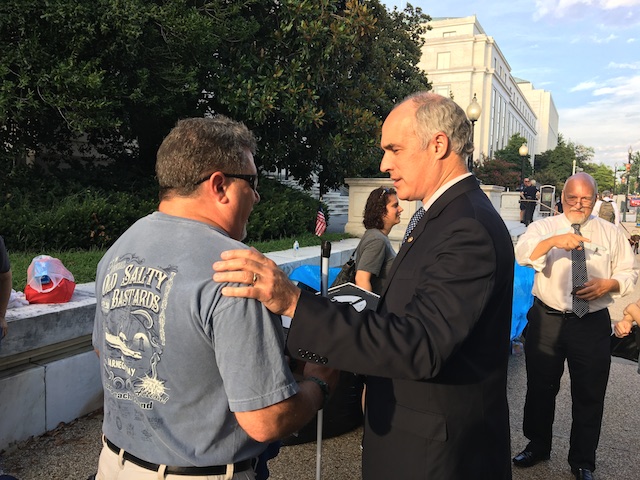 Pennsylvania Senator Bob Casey Jr. came out to with stacks of pizzas for ADAPT protesters Monday night. Casey has a history of supporting disability rights. (Photo by Julie Strupp)
Don’t underestimate people with canes and wheelchairs: physical disability doesn’t stop ADAPT members from engaging in civil disobedience. In fact, that’s kind of their modus operandi. One ADAPT member, an older woman with a traumatic brain injury who uses a wheelchair and is affectionately called “Spitfire,” said Tuesday she has been arrested for protesting 82 times over the years. (“It’ll be 83 times if I’m arrested tomorrow,” she chuckles.)
It was this group that convinced the federal government to make public buses wheelchair-accessible—sometimes by physically lying in front of them in protest—and they’re in full fight mode right now.
“I’m fighting for my rights, I don’t want to be put in a nursing home. I have my own home, but if Medicaid gets taken away I won’t be able to get back into it without proper services,” says Michelle McCandless, another ADAPT member. “I want to work. I don’t sit around the house, I tutor children and help people find resources. At one time I was homeless, so I’ve come a long way. I don’t want to wind up in a nursing home and wind up dead like many of my friends have.”
 Members of ADAPT camp out in front of the Russell Senate Office Building in protest. (Photo by Julie Strupp)