 Rachel Sadon
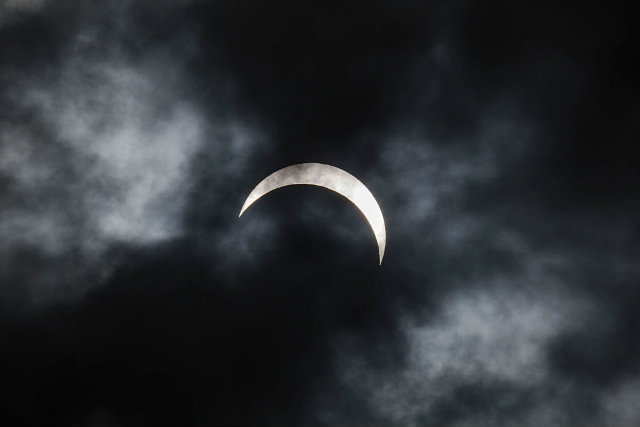 An eclipse sweeps through Indonesia on March 9, 2016. (Photo by Ulet Ifansasti/Getty Images)
The likely traffic caused by hundreds of thousands of eclipse tourists has been described in apocalyptic terms. Towns that normally have a few hundred or thousands of residents are expected to balloon by tenfold or more. So what happens if you forego the full experience and just stay put in D.C. on August 21?
In short: a partial eclipse from 1:17 to 4:01 p.m., with a peak of about 81 percent of the sun covered at 2:42 p.m.
If looking through safe solar eclipse glasses or through a pinhole viewer, Washingtonians will be able to see the moon gradually moving until it blocks about four-fifths of the surface. It will likely make the day seem slightly hazier than normal around the peak, but the city won’t experience anything near the blackout conditions associated with a total solar eclipse.
“The sun’s light is very powerful. At 82 percent, it is still bright enough to light up the whole sky,” says Rebecca Ljungren, an astronomy educator at the National Air and Space Museum, adding that it’s not until 90 or 95 percent coverage that there are major changes. “[In D.C.] you shouldn’t see that many changes in our environment.”
In fact, if you forget the eclipse is happening that day, Washingtonians probably wouldn’t even notice.
“If you have been paying attention to the sky for the last hour, you’ll know something is up is up,” Ljungren says. “But it’s a very slow change, and a very slight change.”
Eclipse lovers say that anyone outside of “the path of totality” (free band name alert) misses the truly unusual, otherworldly aspects. Edwin Turner explains in Scientific American:
You will not see anything particularly spectacular unless you are in the path of totality, where the sun is 100 percent covered by the moon—and you will want to be as close to the center of that path as possible to get the maximum duration of the eclipse (which is just a few minutes at best). The standard astronomical way of describing eclipses is highly misleading in this respect. It simply states the maximum fraction of the sun covered by the moon as seen from some location. So a total eclipse is 100 percent, but over a much wider area of the world, the moon will cover a smaller fraction, say, 95 percent or 80 percent or 40 percent or whatever.
A reasonable person might conclude that an 80 percent eclipse is 80 percent as interesting/spectacular as a 100 percent eclipse. That is completely wrong. As one illustration, it gets about 10,000 times darker when the moon covers the last 1 percent of the sun’s surface!
Turner describes some of the other effects for those in the eclipse’s direct path as a noticeable temperature drop, strange gusts of wind, and the highly unusual color of the sun’s glow.
“Someone said that it is like suddenly being in some sort of CGI of another world or maybe like a drug-induced hallucination that feels (and is) totally real,” he writes.
There’s actually something of a live preview of what things will look like in D.C. happening tonight, albeit in the eastern hemisphere, which will see a partial eclipse. Space.com explains the relationship between the two events:
Both eclipses are, of course, related. A solar eclipse can occur only when the moon is at a node of its orbit. (The nodes are the two points where the moon’s path on the sky crosses the sun’s apparent path through the stars, known as the ecliptic.) During the solar eclipse the moon will be crossing the ecliptic from south to north. But a half orbit earlier, at full moon, it will cross the opposite node from north to south, encountering the Earth’s shadow along the way.
All this is a fine example of how an “eclipse season” works. An eclipse season is when the sun (from our perspective here on Earth) is close enough to one of the moon’s nodes to allow for an eclipse to occur. During the season, which lasts a little more than a month, whenever there is a full moon a lunar eclipse will occur and whenever there is a new moon a solar eclipse will occur.
The closest point to D.C. to see the total eclipse, according to this handy Vox illustration, is 380 miles southwest, in South Carolina. Meanwhile, Nashville is the largest city in the eclipse’s path.
One thing that D.C. does have going for it, though, is the National Air and Space Museum, which is hosting programming at the museum’s two locations, the Archives, the National Zoo, and at one point along the National Mall. They’ll be handing out eclipse glasses and offering viewers a chance to take a peek through safe solar telescopes. At the museum itself, guests will have a chance to make their own pinhole viewers and view the eclipse from the observatory, while screens throughout the building will be streaming a live broadcast from Missouri.
Even though it’s only a partial eclipse, people using some kind of viewer (the Smithsonian has ordered 150,000 glasses) will be able to see the change happening in the sky. “It’s going to be an exciting event regardless,” Ljungren says.
Here’s your obligatory note and very scary NASA article warning about looking at the sun with naked eyes at any point other than the total eclipse (again, which D.C. will not see at any point, so don’t go staring at the sun sans protection).
Naturally, there are also streaming options. Slooh.com will be broadcasting from Stanley, Idaho and the National Air and Space Museum will be livestreaming from Liberty, Missouri, among others.
This is being billed as a “once in a lifetime event,” but that is a bit of a misnomer. While another total solar eclipse won’t go from coast to coast of the United States until 2099 (the last time it happened was in 1918), solar eclipses occur every year and a half. Much of the eastern United States will next see one in April of 2024.
This story has been updated to better reflect what conditions at the peak will look like.