By DCist contributor Courtney Calvin
Imagine if you could understand someone not just by what your eyes see in the physical world, but how your mind interprets this person. Would couples communicate better if they could wear their true feelings on the outside like an aura? What would this look like?
Artist Edvard Munch (1863-1944) envisioned how his subjects showed their “true colors,”—, and you can see this at work in Edvard Munch: Color in Context, a new exhibition at the Smithsonian National Gallery of Art.
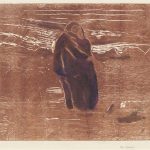
A selection of 21 prints considers the choices, combinations, and meaning of color that fascinated early 20th century spiritualists. Informed by popular manuals that explained the science of color and by theosophical writings on the visual and physical power of color, Munch created works that are more than just strikingly personal—they are charged with specific associations.
“In his art, Munch was concerned with human matters that preoccupy us and have come to the fore in human society since the ‘60s: sexual liberation, human identity, and relationships and tensions between the sexes,” says Jonathan Bober, Andrew W. Mellon Senior Curator of Prints and Drawings at the National Gallery of Art.
One of the most important private collections of Munch”s art outside of Norway rests with the Epstein Family Foundation, which is donating it to the National Gallery of Art on the condition that the museum demonstrates its commitment to and appreciation of the art by developing a thematic exhibition every five years.
“I didn’t want to just show an exhibition of Munch highlights or works that were simply familiar, the masterpieces, but to create a series of more focused, thematic exhibitions,” says Bober.
Curatorial assistant Mollie Berger had studied color and its relationship to philosophy for her master’s thesis and helped to focus the exhibition on Munch’s relationship to color. A common theme in Munch’s work that comes out in both color and composition is the relationship and tension between man and woman. When juxtaposed, his figures never seem to be looking at each other or in the same direction, but off in different directions.
Munch’s contemporaries would have ascribed specific feelings to the colors, and he would have been familiar with those feelings, says Bober. In most of the prints, the woman is a warm reddish orange or brown while the man is a cool light green or blue in “Man’s Head in Woman’s Hair.” “That brown was associated with the auras and the emotions of selfishness and self-absorption, and the green was more susceptible and emotionally open,” says Bober.
In “Encounter in Space,” although the man is in a reddish hue and the woman is a bluish green, the figures seem to be floating by one another on different wavelengths. Munch is said to have been fascinated by and suspicious and fearful of the power of women, says Bober.
One of the most intriguing pieces in this exhibition of mostly color works is the single black and white print, “Self-Portrait.” It shows Munch’s head with an X-ray of his arm resting along the bottom of the composition. Munch was concerned with the human condition, so it was important to have the artist himself, says Bober.
The absence of color is a statement about color. The print also addresses pseudo-religion and the spiritualist reactions to scientific discoveries like the X-ray, discovered in 1895, the year he created this work. The X-ray revealed the limitations of human senses and furthered theosophical notions that there are forces beyond what can be perceived. “It is proof of a specific interest of Munch in the invisible world and how it was represented,” says Bober.
Munch is also known for depicting humans as anxious, vulnerable, and suffering emotionally, as in “The Scream” (not a part of this exhibition). That highly commercialized image has helped make Munch a cultural celebrity and attracted attention to this show, says Bober. Indeed, several of the prints are in a similar artistic style and invoke feelings similar to “The Scream”: “Crowds in a Square” and two “Anxiety” prints were created at the same time.
“That human aspect, the interest in interpersonal matters … resonates especially in our time with our mores and questions about mores,” says Bober. “We continue with upheaval and doubt.”
Edvard Munch: Color in Context is on view through January 28, 2018 at the National Gallery of Art, West Building Ground Floor.