 (Courtesy President Lincoln’s Cottage)
Here are some things most people think when they hear the name Abraham Lincoln: He was tall and wore a big hat. He was president during the Civil War. He looked like Daniel Day-Lewis. Daniel Day-Lewis looks like him. Daniel Day-Lewis played him in a movie and won an Oscar. He was a Republican (sorry, Donald). He was shot and killed at Ford’s Theatre.
Here’s something most people don’t know about Abraham Lincoln: He loved comedy—watching and practicing it. He’d be right home in the era of streaming stand-up specials. Perhaps he’d even have one himself.
It’s that sillier side of Lincoln that inspired the Two Faces comedy series, entering its second year at President Lincoln’s Cottage in Petworth on September 27 with the first of three performances this fall in partnership with DC Improv. Next Wednesday’s show will feature local military veterans, and the October performance will be aimed at children. November’s theme has yet to be announced.
As with many things in the 2010s, the Two Faces comedy series got its start thanks to a podcast. Chris White, DC Improv’s director of creative marketing and a self-professed “ big-time presidential history nerd,” welcomed Erin Carlson Mast, executive director of Lincoln’s Cottage, for an episode of DC Improv’s The Other Side commemorating the 150th anniversary of Lincoln’s assassination at the hands of John Wilkes Booth during a performance of the comedic play Our American Cousin. “Lincoln might have died laughing,” White says in the intro.
A year or so later, Mast and Callie Hawkins, the cottage’s director of programming, decided to act on an idea they’d had for years: hosting a series of comedy performances, each loosely based on an aspect of Lincoln’s life or the cottage. White proved the perfect partner, Hawkins said.
The name of the event series, according to the cottage’s Jenny Phillips, comes from a particularly humorous Lincoln bon mot from before he was president. During the infamous 1858 presidential debates, Lincoln’s opponent Stephen Douglas accused him of engaging in two-faced politics. The future president offered a quick retort: “I leave it to my audience: If I had two faces, would I be wearing this one?”
But the shows draw from more than Lincoln’s personality. One last year featured first-generation immigrants, a nod to the 1864 Act to Encourage Immigration, which Lincoln sent through Congress in an effort to bolster the war industries. This year’s veterans showcase ties in perfectly with one of the original functions of the cottage, which served as Lincoln’s presidential summer home while also hosting an encampment of Union soldiers on the front lawn.
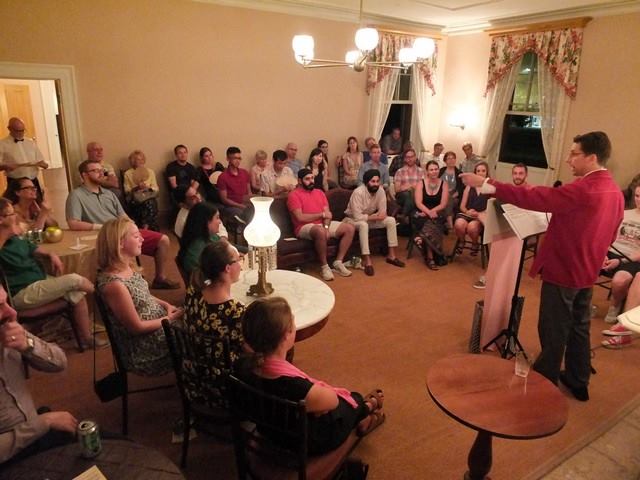 Visitors to President Lincoln’s Cottage enjoyed one of last year’s comedy shows at the historic site.
Last year’s shows attracted a diverse audience, according to Hawkins—young people interested in comedy, history nerds who described the combination of Lincoln and comedy as ideal, frequent cottage visitors who attend all of its special events. Some in that latter group needed some time to adjust to the comedians’ unfiltered perspective, but Hawkins said she wants the performers to operate free of censorship.
White admits the venue’s mix of couches, period chairs and traditional tables is “unconventional,” but ultimately well-suited to the spirit of the event.
“You’re doing a show in Abe Lincoln’s living room, and not a bar,” White said. “The crowds are a mix of people who are curious about the comedy, and people who love history. It’s a different, but very good, vibe.”
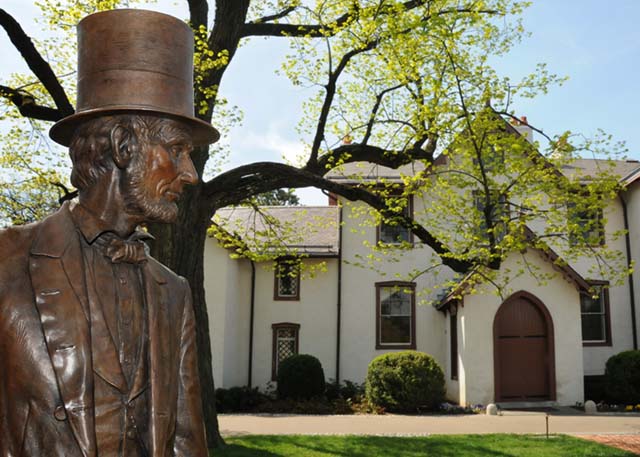
The 1840s-era Gothic revival house on the grounds of the former Soldiers’ Home (now known as the Armed Forces Retirement Home) also served as a summer residence for Lincoln’s predecessor James Buchanan and two of his successors, Rutherford B. Hayes and Chester Arthur. Lincoln is said to have drafted the Emancipation Proclamation there. The cottage was designated a national landmark in the 1970s and a national monument by Bill Clinton in 2000; it opened to the public in 2008.
White finds the comedians through his venue’s connections, while the cottage offers its space and coordinates other logistics. Hawkins wants the events to drum up interest for the cottage’s other programming, including guided tours, a series of Cottage Conversations and an annual Ideas Forum, and to offer a window into Lincoln’s humanity.
“We want to use comedy in the same way Lincoln did—as a way to diffuse difficult times,” Hawkins said. “Lincoln really understood that laughing was healing and healthy. We want to help people who may need it today.”