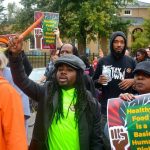
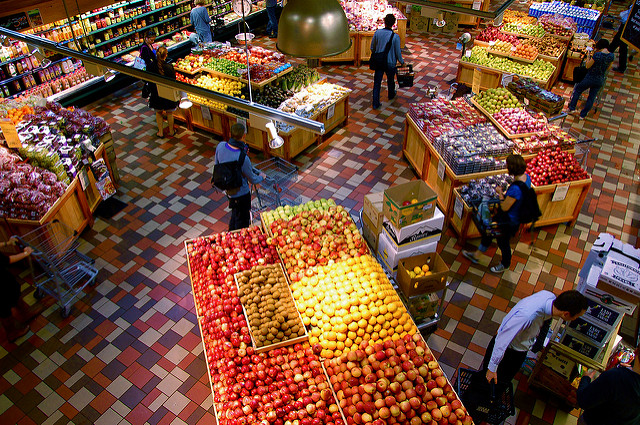
 Residents in Wards 7 and 8 are walking to demand the number and quality of grocery stores similar to those west of the Anacostia River. Photo by Lauren Parnell Marino
When 26-year-old Dominique Hazzard heard that people in cities like Austin have walked to protest the lack of food amenities in their communities, she thought “that would be perfect for D.C. to highlight the situation for people in Ward 8.”
The Anacostia resident tells DCist that she pitched the idea to her employer, DC Greens, which is now organizing a “Grocery Walk” in Southeast on October 14.
Studies and reports continuously show how communities in Wards 7 and 8 are food deserts. Most recently, D.C. Hunger Solutions reported that out of 49 D.C. grocery stores in 2016, Ward 7 had two full-service grocery stores and Ward 8 had just one.
At both Safeway stores in Ward 7, residents have had to contend with decaying food, poor customer service, and lengthy waits to check out, among other issues.
The numbers and anecdotes are out there, but Hazzard says the walk will allow such disparities to be seen in another light. “I want people to really be able to picture what this grocery gap looks like,” she said.
She’s planning for about 250 people to raise carrots in the air and some participants to carry heavy grocery bags as they walk to downtown Anacostia from the nearest grocery store, a Giant in Congress Heights about two miles away. It’s currently the sole grocery store for more than 70,000 people in Ward 8.
“I know they’ve heard about it, but some people think ‘oh it can’t be that far,’” Hazzard said. “I have a car and a credit card to get food delivered, but almost half of the people in my community don’t have a car… I really want people to understand what it’s like to take that walk or 40 minute bus trip.”
Ward 8 Councilmember Trayon White will participate in the walk and give remarks during a rally at the end.
“We want to show through solidarity and community that we are serious about creating food options, grocery stores, community gardens, and co-ops for equality and affordable food options for the residents of Ward 8 and Ward 7,” White said, pointing to health disparities between D.C.’s white residents and black residents—many of whom reside east of the Anacostia River.
“We have to change the education of our community and also give them better options to eat, because eating is life,” White said.
The Grocery Walk is going to “make a powerful statement,” said Ward 7 Councilmember Vincent Gray, who also plans to attend. “It will show that people care about these issues, and people want to have the same conveniences that other people in the District of Columbia have—they want to be able to shop in their own communities rather than having to go elsewhere, in some cases outside of the District of Columbia, in order to shop.”
Access to healthy food is “a basic human right,” said DC Greens Executive Director Lauren Shweder Biel. She started the organization in 2009 and it now runs the city’s Produce Plus program, among other initiatives.
The inaccessibility of options in Wards 7 and 8 “is a public health crisis really because you have folks who are suffering from diet-related chronic illnesses and don’t have any healthy food in their neighborhoods and that’s something that’s really criminal,” Biel said.
Two stores, German-based grocer Lidl and locally-owned Good Foods Market, are slated to open in Ward 8 in 2018, according to White.
Gray said that he’s in talks with grocers to come in Ward 7, and he’s recently introduced two bills at the D.C. Council that will give business owners tax breaks and other financial incentives to set up shop in Wards 7 and 8.
“You have to have entrepreneurs feel like if they do this, they’re going to be financially successful at it,” he said, in response to apprehension by companies who feel like east-of-the-river residents won’t be able to sustain their businesses.
In the meantime, Gray has been working to ensure that the existing grocery stores in Ward 7 are in good condition. After surprise visits to the two Ward 7 Safeways—where he found spoiled meat, decaying produce, long lines, and empty shelves—he spoke with the grocery stores’s officials. Since then, he said residents have reported that the offerings and customer service have improved, and Safeway also has a new security contractor to reduce theft and create safer environments for shoppers.
Hazzard said the city should also be more innovative in their approaches to bringing healthy food options east of the river, especially among small business owners and current residents. DC Greens and DC Central Kitchen, for instance, piloted a program with Grubb’s in Anacostia in which the organizations supplied 3 months of extra produce to the store because the owner was wary of whether he could turn a profit on large supply of fruits and vegetables.
“What they needed was somebody to come in and assume that risk for them,” Hazzard said. The produce did sell, and Grubb’s has since expanded its produce section without the subsidy.
“That’s a model that the city can take” Hazzard said.
While working to attract nationwide grocery chains, she said investing in local stores is worthwhile because they’re already attached to communities and more likely to stay there, if given a boost.
“I see all these corner stores and all that’s in there is snacks,” she said. “They used to be grocery stores, and now they can be again.”
The Grocery Walk is taking place on October 14 at 10 a.m. Participants will leave Giant (1535 Alabama Avenue SE) and walk to the United Black Fund (2500 Martin Luther King Jr. Avenue SE).
Previously:
Report: Wards 7 And 8 Have Three Grocery Stores For 149,750 People
Report: More Than 11 Percent Of D.C. Is A Food Desert
Amazon Adds Restaurant Delivery Service To D.C., But Not To Some Areas That Need It Most
Some Meal Delivery Companies Stop Short Of D.C. Residents Who Need Them Most
Data Desert: New Stats Could Help Address D.C.’s Food Access Challenges
Report: Life Expectancy In D.C. Differs Greatly By Race