Rachel Kurzius
 (Photo by David Gaines)
When news broke that the D.C. Council unanimously passed emergency legislation to allow dogs on restaurant and bar patios, after reported instances of the Department of Health enforcing the long-held ban, the responses could largely be separated into three main categories.
There were the people who praised the decision, folks who found the idea of pups on patios gross, and those wondering why the issue constituted an “emergency.”
Whether you want dogs hanging out at outdoor cafés or not is really a matter of taste, but we can help to clear up what, exactly, emergency legislation is and how it functions in the District.
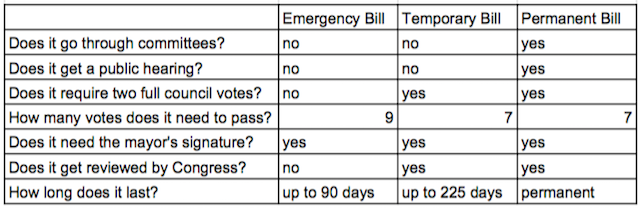
It is one of three kinds of bills that can be introduced at the D.C. Council, which also include permanent legislation and temporary legislation. Those three categories don’t necessarily speak to how important an issue is, but instead what it takes to pass the bill and for how long it will be enacted.
“‘Emergency’ is a vestige-y term of art that dates from the District charter and all it implies is that it is of brief duration and was approved by a supermajority,” says Josh Gibson, the D.C. Council spokesperson. “It does not indicate urgency.”
Emergency legislation does not require hearings, public notice, two full D.C. Council votes, or Congressional review. On the other hand, though, it only lasts 90 days and needs nine votes, rather than seven, to pass. The mayor still must sign it into law.
Compare that to permanent legislation, which is much more of a rigamarole.
Once it’s introduced at the D.C. Council, the permanent bill gets directed to a committee, like the Committee on Education or the Committee on Human Services, for instance.
From there, the committee chair decides whether or not to schedule a public hearing, which requires advanced notice. After the hearing, there’s a mark-up, where committee members can introduce amendments and decide whether to vote for the bill to move forward to the Committee of the Whole.
We’re not done yet. The Committee of the Whole can further debate and amend the bill before voting on it. Then, if approved at the Committee of the Whole, it goes to first reading. If a majority of councilmembers vote for it, a second reading is scheduled at least 14 days later. Members of the D.C. Council can still futz around with the bill at second reading before voting again.
If it gets a majority of votes at the second reading, it goes to the mayor for her signature. Is that it? Nope. Still more.
From there, thanks to D.C.’s odd relationship with the federal government, the bill must be submitted to Congress for approval, and wait 30 legislative days for most legislation, and 60 days in instances of changes to the criminal code.
But 30 legislative days doesn’t necessarily equal a month, because days only count when Congress is in session. During that time, federal legislators can try to quash the legislation altogether using a disapproval resolution, a process that requires both chambers to pass legislation blocking the bill, which then requires the president’s signature.
If the bill makes it through those required legislative days without the successful passage of a disapproval resolution signed by the president, then presto! We’ve got permanent legislation ready to be enacted in the District, with no expiration date.
Temporary legislation lies somewhere in between emergency and permanent. It doesn’t go through any committees, but it does get two readings by the full council and undergoes Congressional review. It can last for up to 225 days.
If the “Dining With Dogs” bill was introduced as permanent or even temporary legislation, there’d be no way for people to bring their pups out during the fall.
“The council faces a lot of difficult issues, but this bill was a no-brainer,” said Ward 1 Coucilmember Brianne Nadeau after the passage of the Dining With Dogs bill on Tuesday. And that’s generally what emergency legislation does: easy come, easy go.
So how often does the council use emergency legislation? So far this legislative session, the D.C. Council’s 22nd, 126 of the 513 bills introduced have been on an emergency basis, amounting to nearly 25 percent of the total, according to the council’s Legislative Information Management System.
In the previous five full council periods, percentages range from a high of 35.5 percent of total bills introduced as emergency legislation during the 21st council period and a low of 27.5 percent in the 17th period.
Previously:
No Bones About It: D.C. Council Unanimously Passes Emergency Bill To Let Dogs On Patios
There May Be Changes To Dog Ban On Bar Patios After Health Dept. Crackdown Has Folks Barking Mad