 Rachel Sadon
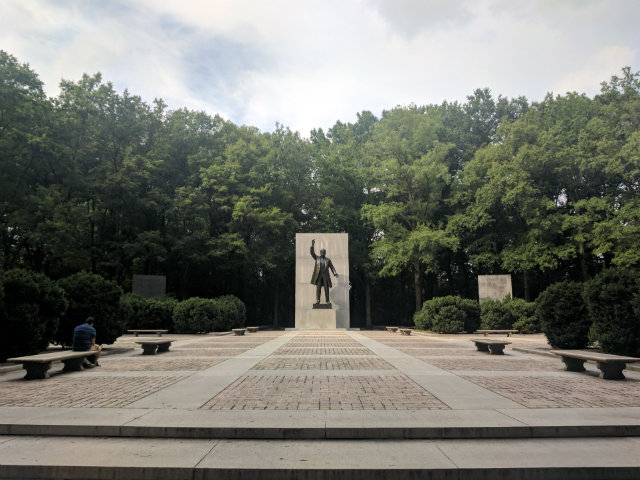 Theodore Roosevelt Island is turning 50. (Photo by Rachel Sadon)
On his very own island, an expanse of restored forest with criss-crossing trails running through it, Teddy Roosevelt stands nearly 20 feet tall. His arms are raised in an oratorical flourish, though one might be forgiven for mistaking him for a wizard in the midst of casting a spell over the place.
Indeed, there’s a magic to the place, a peaceful, car-less sanctuary that is celebrating its 50th anniversary as a “living memorial” to the 26th U.S. president. At 88 acres, it is the biggest presidential memorial in the District of Columbia, and one particularly suited to a man often called the “conservation president.”
“It is a refuge in the middle of the city. We don’t really have anything else like it,” says Nicole Goldstein with the Friends of Theodore Roosevelt Island, which has arranged a day of celebrations and activities on Sunday along with the National Park Service and the Theodore Roosevelt Association.
President Roosevelt’s great-grandson, Tweed Roosevelt, and two scholars will give remarks at a 2 p.m. ceremony, but the day will also feature a bird watching walk, tours of the island, a Roosevelt reenactor, games, exhibits, and some of Teddy’s favorite foods (fried chicken and Indian pudding).
Before it became a monument to Roosevelt, though, the island had a long and storied history, some of it tragic, some it almost comically colorful.
Native Americans originally used the land as fishing grounds before the Nacotchtank Indians, decimated by European diseases, relocated to the island—then called Anacostine or Analostan—before merging with a neighboring tribe. It is believed that Captain John Smith was the first European to visit the site.
The island eventually passed hands into the family of George Mason (who conceived the Bill of Rights) and his son, John Mason, made dramatic changes to the landscape. They cleared forest in service of building a plantation and mansion, which was the site of many a high society party before some catastrophic investments ended in the bank foreclosing on the land, then called Mason Island.
A few years later, a promoter built a huge grandstand for thousands of people to watch the ascension of a balloon, and then a series of owners used the island as farmland—growing peaches, asparagus, and roses, among other crops.
During the Civil War, the island briefly served as the camp and training grounds for the first regiment of African American soldiers. After the war, it became a refugee camp for freedmen and women arriving to Washington, D.C., but with more than a thousand people and few resources, conditions deteriorated quickly. Sojourner Truth spent time on the island and eventually conditions improved before the remaining population was relocated.
By 1865, the land was returned to its owner, William Bradley, who found the site in disrepair and instead of returning it to farmland, rented it out for recreational activities—including a jousting tournament.
After Bradley’s death, the island was more or less abandoned and apparently attracted gambling and other illegal activities, though at some point it also housed icehouses for the Great Falls Ice Company. In the late 1880s and early 1890s, the Columbia Athletic Club rented the site and built a raft of new facilities: a track, tennis courts, a clubhouse, and shooting range, among them. A young Theodore Roosevelt was himself a member.
In 1898, during the Spanish-American War, the government got permission to test explosives, and in 1902 Samuel Pierpont Langley and Alexander Graham Bell used the site to test out a huge hexagonal kite. By this time, the island was overgrown and its remaining structures were in shambles. A variety of proposals to make improvements fell through, and the Washington Gas Light Company purchased the property.
The Roosevelt Memorial Association so successfully lobbied for the piece of land at the Tidal Basin be used for a memorial that officials decided it would be a good spot to honor Jefferson instead, according to Goldstein.
The Association then switched gears, purchasing the island in 1931 and Congress officially renamed it Roosevelt Island the following year. The renowned landscape architect Frederick Law Olmsted, Jr. was hired, and he developed the vision of reforesting the island with native plants.
It took another 30 years for the memorial plans to be approved, but eventually it was developed as a plaza designed by architect Eric Gugler with a statue of artist Paul Manship serving as the centerpiece. Work was completed in 1967, which brings us to its present day use and the memorial’s 50th anniversary.
The island has more than 2 miles of contemplative trails surrounded by restored forestland, a fitting tribute to a president who doubled the number of National Parks during is his time in office. According to the Theodore Roosevelt Association:
As president, Roosevelt provided federal protection for almost 230 million acres of land, an area equivalent to the entire Eastern Seaboard from Maine to Florida. He sat aside 150 national forests, the first 51 federal bird reservations, five national parks, the first 18 national monuments, the first four national game preserves and the first 24 reclamation, or federal irrigation, projects, designations that were bitterly opposed by commercial interests.
The main event will take place on October 29 from 2-3 p.m., with speeches from Teddy Roosevelt’s great grandson and several scholars, but talks, walks, kid’s events, refreshments, and more are planned all day. See the full schedule of events here.
This story has been updated to reflect that the anniversary event will take place on Sunday, rather than Saturday