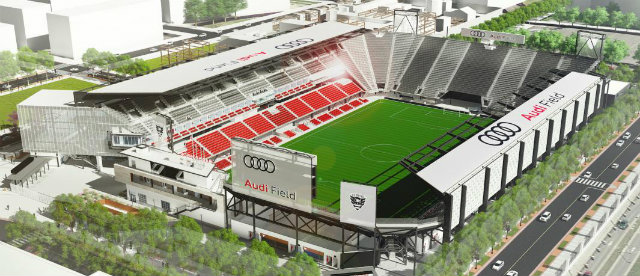
 Audi Field, slated to open in mid-July. (Image courtesy of DC United)
July is shaping up as a very big month for D.C. United—maybe the biggest in the club’s 22-year history.
The team is just weeks away from moving into Audi Field, its gleaming new home on the Anacostia. It’s a long-awaited moment for a once-mighty organization fallen on lean times. Its residence at the decaying RFK Stadium dragged on nearly a decade longer than desired, forcing the Black-and-Red to tighten the belt dramatically and play a soccer version of “Moneyball” for the past several years.
United’s owners say they’re spending some $250 million on the new venue on the Southwest riverfront, which—combined with the approximately $150 million the city spent on the project—would make it the most expensive soccer-specific stadium in American history.
It’s slated to make its debut with a visit from the Vancouver Whitecaps on July 14, the start of a busy stretch of eight games at United’s new home between opening day and Labor Day, then another seven in the season’s final months this fall.
D.C. also seems ready to wash away years of irrelevance on the field, reportedly drawing closer every day to securing the services of iconic English striker Wayne Rooney in a deal that would make him the highest-paid player in team history.
So United, which set the standard for American professional soccer back in its late-90s heyday, finally appears ready to thrust itself back into the local and national spotlight.
Depending on who you ask, however, the club is either about to pull off this historic summer in near-magical fashion with a bare-bones budget and skeleton crew of a staff or is sleepwalking into a critical moment in its existence.
Many close to the team—hard-core fans, journalists and MLS insiders—are worried. They express concern that United may be walking a tightrope, understaffed and overworked at a pivotal juncture. They speak of front-office turnover, of surprising shortcomings in the new facility, and of an ownership group out of touch with the fanbase. These sources were granted anonymity because of the privileged and confidential nature of the information involved.
 The original rendering of United’s new downtown stadium (left) and Audi Field (right). (Images courtesy of DC United)
Audi Field sits on prime real estate, a downtown site close to Nationals Park and the rapidly gentrifying Navy Yard and Waterfront neighborhoods. That alone may ensure its success, considering similar MLS cases in Toronto, Portland, Oregon, and downtown Los Angeles. However, some of the site’s quirks have thrown a wrench or two into the works.
Originally billed as a fully enclosed venue with a capacity of 25,000, design changes were necessitated by the relatively small footprint the stadium occupies at Buzzard Point. The presence of an adjacent Pepco facility has required an easement under the stadium to allow the power company access to subterranean wires, forcing the venue’s entire east grandstand to be erected above and around it.
The most obvious design change was the loss of that striking full roof, replaced by a pair of far smaller overhangs that extend over the east and west grandstands.
That’s created an unforeseen issue, one flagged by three sources familiar with the situation, which could inhibit Audi Field’s ability to host big, nationally televised events like U.S. national team games.
“The sun points directly into the cameras,” said one source, who went on to suggest that it will be difficult to broadcast evening games for most of the summer due to the position of the sun. In views of the stadium currently available via the club’s own live construction cameras, the east grandstand, where the commentary booth and main camera sit, appears completely drenched in sunshine, at least as late as 7 p.m., when the construction feed cuts off.
(After publication, a United representative told DCist that the club does have some camera positions available for use on the west side of the stadium as well.)
 Late-afternoon sunshine beats down on the east grandstand of Audi Field last week at 6:45 p.m. (Image via Turner Construction)
The club announced just last week that they were changing the start times for five matches in July and August, pushing four back a full hour and one a half hour to 8 p.m., ostensibly due to D.C.’s notoriously hot and humid summers. Yet the timing of the announcement is peculiar; the warm weather in the District isn’t anything new. Three sources independently confirm that pushing the start times back is a way of addressing the stadium’s issues with the setting sun. Incidentally, four of United’s home games slated for national broadcast—two on ESPN and two on Univision—are mid-day or early afternoon broadcasts, when the setting sun won’t be an issue.
A United spokesperson declined to be identified or to comment specifically on the potential broadcast issue, simply saying that the club is always looking for ways to make the fan and player experience inside the stadium better.
Organizationally, it’s no big secret that United has long run a lean and mean front office. On purchasing the club in 2012, new owners Jason Levien and Erick Thohir were quick to pare down staff, cutting loose a bevy of long-time employees. Missing the revenue streams that come with a modern stadium while playing at RFK, the club has sought to limit its losses until moving into a new home.
Yet even as the team draws closer to its debut at Audi Field, that turnover continues. The club lost three upper-level employees in the past few months, departures that two industry veterans describe as red flags.
Troy Scott, senior vice president of stadium development and operations, left for a position at the Baltimore Orioles. He’ll be joined there by Scott Lewis, United’s now-former vice president of marketing. Roy Tewell, the club’s vice president of ticketing, departed for the Pittsburgh Pirates.
Tewell, when reached via e-mail, was entirely positive about his experience at United, noting that he left the organization on extremely good terms, under his own choice, and with the full support of the organization. Scott, who could not be reached for comment, is from the Baltimore area and reportedly jumped at the opportunity to work closer to home.
A source familiar with United’s front office suggested that Lewis’ departure was in part driven by frustrations with a thin marketing budget, which was made clear to both the club and also league officials.
“It just sounds like there wasn’t really a budget. Even going into the new stadium, it sounds like there haven’t been a lot of resources available to promote it and push it,” said the source.
United’s apparent frugality has grated on some at MLS headquarters in New York, prompting pressure on the club to spend more to effectively capitalize on the buzz created by their new stadium. “They don’t want the building to be open and be empty or be an embarrassment,” the source continued.
A United representative suggested that while the timing of the most recent departures is unfortunate, the club has already filled two of the three positions; Steve Smith, a former ticket executive with the Montreal Impact, will take over Tewell’s role, while Scott’s chair will be occupied by a yet-to-be-announced candidate.
The marketing position has been added to the responsibilities of the club’s vice president of communications, Lindsay Simpson. The club representative added that merging the communications and marketing positions “was something that was always in the plans,” also noting that United are in the midst of rolling out their marketing campaign for Audi Field, ads that you’ll see on buses, cabs, on television, billboards, and the like.
Depending on who you ask, losing top talent to baseball is either a fact of life for an MLS team like United, or another reason for concern. MLB organizations can usually offer better pay, but with 81 home games a year compared to soccer’s 17 to 25, baseball’s schedule tends to be far more of a grind for employees than soccer’s. Those who spoke to DCist for this story were particularly surprised to see high-ranking staff leave D.C. United so close to the eagerly awaited opening of Audi Field.
Swaths of the team’s fanbase are also less than thrilled as that big moment looms. Earlier this year United selected only one of its three main supporters’ groups, the Screaming Eagles, as an official partner at Audi Field, sparking disgust among the Barra Brava and District Ultras groups.
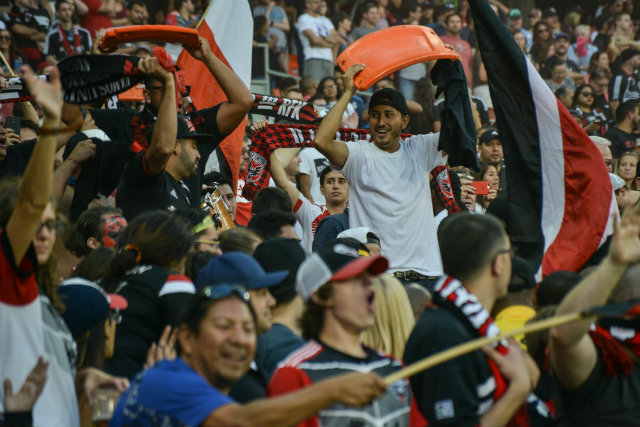 Members of the District Ultras at last fall’s RFK farewell match. (Photo by Pablo Maurer)
Even the pursuit of Rooney, the England national team’s all-time leading scorer and a name that’s expected to goose ticket sales before his acquisition has even been completed, has drawn more mixed reviews than you might expect.
Is the former Manchester United man seen as the crowning addition to coach Ben Olsen’s roster, or a tent-pole attraction to fill up the new stadium? ESPN commentator Taylor Twellman turned heads with an animated rant about the situation during a recent MLS broadcast.
“This is about the franchise of D.C. United, who for the last 10 years has spent ZERO-POINT-ZERO. ZERO-POINT-ZERO,” said the former MLS player turned analyst. “This is a franchise that has multiple people doing multiple jobs. Do they have the infrastructure? Do they know what’s coming when a mega-superstar shows up? Or is this just a band-aid?
“Because in all seriousness, in the metropolitan area of D.C. United, D.C. United is irrelevant, it’s non-existent. So in order to revive the franchise, you’ve got to [sign Rooney], because you haven’t done anything for the last 10 years.”
Some point to United’s ownership, who—fairly or unfairly—have long been perceived by fans and other observers of the team as looking to flip the club at a profit once Audi Field opens. News broke this spring of a potential change in ownership, with current majority investor Erick Thohir slated to sell his 78 percent share in the team to minority owner Jason Levien, who would in turn assemble a group of additional investors.
Two sources familiar with the situation, though, maintain that there have been other overtures for the team, including investors who were seeking to significantly upgrade the stadium’s current design.
It’s unclear where the club currently sits as far as an ownership change. Should the club be sold, it would presumably change hands at a significant profit. A stipulation in United’s agreement with the District of Columbia, which itself spent some $150 million on infrastructure and land costs for the stadium, states that the club would owe the city a 15 percent share of the net profit of any sale involving a majority interest in the club.
In April, Bloomberg reported that billionaire pharmaceutical and biotech mogul Patrick Soon-Shiong—a part-owner of the Los Angeles Lakers who recently bought the LA Times and the San Diego Union-Tribune—was interested in buying a majority stake in United in a deal that valued the club and its facilities at half a billion dollars.
A spokesperson for D.C.’s Deputy Mayor for Planning and Economic Development commented that such a potential ownership change is still a hypothetical and declined to comment further on the possibility.
Is D.C. United ready to open a whole new era in its history? Or will the team squander its fleeting chance to reintroduce itself to the city that once adored it. Either way, it promises to be a hot summer at Buzzard Point.