 (Photo by Keith Ivey)
In the District, the Democratic primary is more often than not tantamount to the election itself. Still, that doesn’t necessarily mean that voters are paying all that much attention, especially in a year without a presidential election or a marquee local race. Most of the races don’t appear to be particularly competitive, but low-turnout elections can make things less predictable than they might appear. So get out there and vote. It’s okay if you haven’t yet registered, because D.C. allows for same-day registration (note, though, that the primary is closed, so if you are registered as a Republican, you will only be able to vote for the GOP candidates and on ballot measures). But first, read on …
Mayor
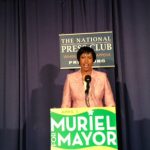
There’s been a lot of talk about the lack of competitiveness in this year’s mayoral race, but incumbent Mayor Muriel Bowser is in fact facing two challengers in the Democratic primary: James Q. Butler, a current advisory neighborhood commissioner in Ward 5, and Ernest Johnson, a native Washingtonian and real estate professional who ran for mayor back in 2010 (he took home 317 votes that year, about 0.24 percent of the electorate).
Butler is a former lawyer who was disbarred in 2009 after facing more than 100 complaints of misconduct. In interviews, he’s blamed another lawyer at his practice for the shady dealings, saying that he did not have appropriate “internal controls.” The D.C. Bar Clients’ Security Fund paid out more than $650,000 to his clients as a result of the malpractice. Still, Butler appears undeterred in his quest to be mayor. His goals center around housing and policing, though he’s also thrown out some less conventional ideas like having each non-profit in the city “adopt a homeless person.”
Johnson faces his own challenges. He hasn’t been able to raise much money for his campaign, and he’s never held elected office. But he’s lived in Columbia Heights for 51 years and believes simmering resentment over gentrification could help oust Mayor Bowser.
“There’s no reason we have to have an elitist society where everybody lives in $5,000-a-month condominiums, drinks $20 coffee and eats $12 honey buns,” he told WAMU. “I think we can do a little better than that.”
Bowser, for her part, is generally polling well across the city and has managed to raise more than $2 million for her reelection campaign. Still, her administration has been embroiled in controversy after controversy over the last year, including a massive graducation scandal. — Natalie Delgadillo
Recommended reading: Two Long-Shot Candidates Are Challenging D.C. Mayor Muriel Bowser In The Democratic Primary
Initiative 77
When D.C. increased the minimum wage to $15 an hour by 2020, there was one exception: tipped workers, whose wage would only increase to $5 in the same time frame. They’re still supposed to get at least $15 hourly on average, with tips making up the difference (legally, employers must supplement wages if they don’t hit the minimum).
But the Restaurant Opportunities Centers United, calling for “one fair wage,” got Initiative 77 on the ballot for the primary election this year (Democrats, Republicans, and Independents alike can vote on this puppy).
The fight over the measure has been bitter.
Proponents say that wage theft is widespread, and the current system is far too complex to meaningfully enforce—sometimes, employees don’t even know they’re not getting the money they should, or they fear retaliation for speaking out.
But opponents, led by the National Restaurant Association and the Restaurant Association Metropolitan Washington, say the measure would be catastrophic for D.C.’s restaurant scene, leading to closures and fewer hours for workers.
They’ve taken to the phrase “Save Our Tips,” implying that the measure would end the practice of tipping. That isn’t part of Initiative 77. However, the argument goes that customers, knowing that workers are already getting $15 per hour, wouldn’t tip. In the states that’ve already gotten rid of the tip credit, that has not happened. Still, opponents say comparing D.C. to those states isn’t quite apples-to-apples.
If the measure passes, it’ll become law. However, the D.C. Council can change laws passed by ballot initiative, and given that 10 members of the council have already voiced their opposition, it certainly isn’t out of the question. —Rachel Kurzius
Recommended reading: WAMU’s Guide to D.C.’s Initiative 77, City Lab’s look at how D.C.’s War Over Restaurant Tips Will Soon Go National, our look at the voices not included in the debate, City Paper’s long-form look at the initiative.
Chairman
This race is sponsored by the letter “P.” The battle for the most powerful position on the D.C. Council has been called a “proxy fight” and a battle over “principles and pramatism.” Above all else, it interrogates the idea of progressivism.
Chairman Phil Mendelson, who has held the position since he won a 2012 special election, has long been known as a measured wonk, one who deftly restructured the mayor’s plans to build replacement shelters for D.C. General and shepherded paid family leave through the Council. He’s joined the leftiest flank of the left-leaning legislative body on a number of issues, including the passage of a number of labor laws designed to strengthen worker protections.
But he’s also called for a moratorium on bills that put a burden on businesses, frustrating some of those same allies who say that the council should press onward.
Enter Ed Lazere, whose liberal bona fides include more than five years at the D.C. Fiscal Policy Institute, a think tank that conducts research and advocacy on behalf of lefty priorities. Lazere has differentiated himself with stands on Initiative 77 (he’s pro) and taken the Council to task for giving tax benefits to developers around Union Market.
Still, both of them are claiming the exact same mantle of “proven progressive leader.” — Rachel Sadon
Recommended reading: Washingtonian’s 3 Issues to Watch in DC’s Council Chair Race, District Dig’s The Pragmatist, and WAMU’s In Fight To Lead The D.C. Council, A Battle Over Principles And Pragmatism
At-large
Anita Bonds has been a fixture on the dais since 2012. She also chairs the Committee on Housing and Neighborhood Revitalization and recently backed controversial legislation to reform the Tenant Opportunity to Purchase Act.
Bonds is being challenged by two men less than half her age, both of whom have been reticent to speak too harshly of the politician they seek to unseat.
Marcus Goodwin is a real estate professional who names the affordable housing crisis as his top priority.
Longtime progressive activist Jeremiah Lowery, meanwhile, names “transformative solutions” to addressing housing, education, education, childcare, inequality, and climate change as his priorities.
In the general election, you’ll find independent Dionne Bussey-Reeder challenging Elissa Silverman for one of the seats reserved for non-Democrats. — Rachel Sadon
Recommended reading: The Washington Post’s 2 millennial men running to unseat D.C. Council member Anita Bonds
Ward 1
Four years after Brianne Nadeau unseated the incumbent, Jim Graham, she is facing her own eager challengers. Among the ward-level races, this is the only one where things look competitive.
ANC commissioner Kent Boese, former judge Lori Parker, and architectural drafter Sheika Reid have all thrown their hats in the ring, each taking aim at Nadeau for what they claim are sub-par constituent services.
While in office, Nadeau has proposed legislation to provide financial assistance to longtime businesses facing rising rents, expand the city’s immigrant services fund permanently, mandate that D.C. employees be trained in stopping street harassment, and give Scandanavian-style baby boxes to D.C. parents.
Kent Boese, the chairman of Advisory Neighborhood Commission 1A, told DCist last year that his work in getting things done as an ANC commissioner mirrors what he’d achieve as a councilmember, focusing on community engagement, constituent services, oversight, and keeping public spaces like Columbia Heights’ central plaza in good working order. He might well have the best commercial of the campaign.
Sheika Reid and Lori Parker have both appealed to constituents by focusing on their backgrounds as native Washingtonians (Parker has lived in Ward 1 for two decades; Reid grew up in Columbia Heights but had been living in Capitol Hill until just a few months before announcing her candidacy).
In speaking with DCist last year, Parker named her priorities as ensuring prompt constituent services, introducing legislation to support the “long-term stability” of residents and businesses, and promoting community engagement.
The 26-year-old Reid has sought to appeal to millennials in addition to long-time residents. “The average age in the ward is 31. I’m 26. I’m able to connect with a wide majority of people in the ward across the socio-economic spectrum,” Reid told DCist last year, also noting that she speaks Spanish fluently. She might well have the most controversial campaign tactics of the bunch: stickering public spaces and apparently putting fake parking tickets on cars.
The winner will go on to face Greg Boyd, known best for his Twitter trolling as Beltway Greg, and Jamie Sycamore, a sign language interpreter, in the general. — Rachel Sadon
Recommended reading: Responses from Brianne Nadeau, Kent Boese, and Sheika Reid to Greater Greater Washington’s survey (Lori Parker declined to take part).
Ward 3
Mary Cheh is running unopposed.
Ward 5
As Ward 5 Representative, Kenyan McDuffie didn’t exactly have big shoes to fill. In 2012, McDuffie’s predecessor Harry Thomas Jr. was convicted of stealing $350,000 from taxpayers, forcing the ward to hold a special elections. McDuffie has been serving ever since, and there have been rumblings for a while now that he might try to mount a campaign for mayor. Nothing doing this time around; he’s seeking reelection for his own seat.
McDuffie has authored criminal justice reform legislation, including a bill that aimed to keep children out of the juvenile justice system, as well as the Neighborhood Engagement Achieves Results Act, which redirected some offenders toward mental health professionals.
McDuffie is facing four challengers in the primary: Bradley Thomas, LaMonica Jeffrey, Gayle Hall Carley, and Nestor Djonkam. Only two have managed to raise any money: Advisory Neighborhood Commissioners Gayle Carley and Bradley Thomas, neither of whom has come close to matching McDuffie’s more than $150,000 in campaign contributions.
Carley’s main platforms surround education, where her campaign website says she wants to “advocate for volunteers to tutor in Ward 5 schools struggling with low reading and math scores,” public safety, and affordable housing. Thomas similarly prioritizes education, employment, affordable housing and public safety. As well as being a current ANC commissioner, he was appointed to the Child Fatality Review Committee by Mayor Adrian Fenty and served a three year term. —Natalie Delgadillo
Ward 6
After one term in office, Charles Allen is facing primary challenger Lisa Hunter. Allen, formerly the chief of staff to previous Ward 6 Councilmember Tommy Wells, spent much of his first term in office on the council’s more progressive wing: he opposed the Pepco-Exelon merger, advocated on behalf of carbon pricing, introduced public campaign financing laws, co-introduced the family leave bill, pushed for high schoolers to have the right to vote, and passed legislation to set up the Books from Birth program. He also voted with the majority of the council to exempt renters of single-family homes from the Tenant Opportunity to Purchase Act. Allen has declined to say yes or no to Amazon in D.C. until he sees what the mayor’s office has offered in the former of incentives, though he has come out against the tech company placing its new headquarters in Reservation 13.
Hunter is a former Obama campaigner and staff who claims she’s to the left of Allen. When asked if Amazon should come to D.C., she has a straightforward “no.” Unlike Allen, she supports Initiative 77. She’s also criticized his Alabama roots (somewhat bizarre for someone who similarly grew up outside the District), and her campaigning has been dinged as over-the-top by some, including The Hill Is Home’s “resident curmudgeon” Tim Krepp, who accused her of having a “nasty social media presence.” Hunter says she’s just speaking hard truths.
Whoever wins the primary will face Republican Michael Bekesha in November’s general election. —Rachel Kurzius
Recommended reading: The D.C. Line’s Combative rhetoric marks challenge to Ward 6 incumbent, Capitol Hill Corner sums up a Ward 6 candidate forum, 730DC interviews Lisa Hunter
D.C. Delegate
Because D.C. doesn’t have too much formal power on Capitol Hill, much of the delegate’s role involves utilizing soft power and developing relationships with members who can actually vote on the House floor and in the Senate.
Eleanor Holmes Norton has been D.C.’s delegate for nearly three decades, most of the time serving in the minority and trying to defend against meddling from other members. At this point, she’s a District institution. She’s even enshrined on the Ben’s Chili Bowl mural.
Kim Ford, her primary challenger, says it’s time for some new energy. D.C. Attorney General Karl Racine, her most prominent endorser, agrees. Ford says her experience in the Obama administration makes her uniquely qualified to advocate for the District on the federal level.
But Norton has made it clear that she will not give up her seat without a fight. In a press release for a fundraiser last Friday at former DNC Chairwoman Donna Brazile’s house, Norton said, “D.C. residents have become so accustomed to my winning, they forget I can—and must—raise funds, too.”—Rachel Kurzius
Recommended reading: The Washington Post’s Eleanor Holmes Norton, seeking 15th term, faces Democratic challenger in D.C. primary
D.C. Democratic State Committee
The short version: “Democrats Moving Forward #Resist” is the more establishment group, and “DumpTrump-Dems4Action” represents the leftier wing. WCP compares it to the Hillary Clinton and Bernie Sanders wings of the party. — Rachel Sadon
Recommended reading: Washington City Paper’s Two Teams Vie for Control of Democratic Party Politics in the District