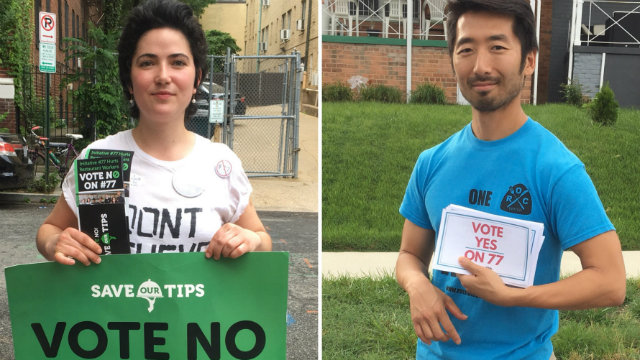
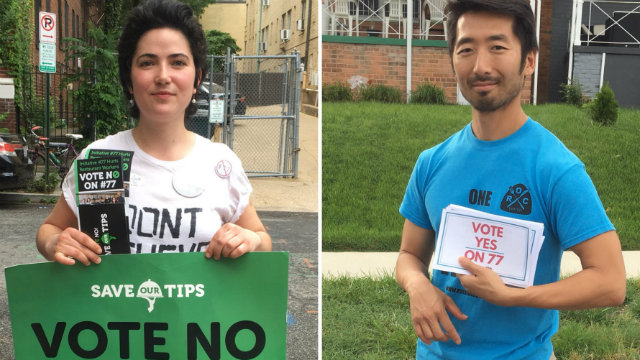
 Campaign volunteers for and against Initiative 77 fanned out across D.C. today to try and sway voters. (Photos by Martin Austermuhle / WAMU)
By WAMU’s Martin Austermuhle
Voters in D.C. on Tuesday approved Initiative 77, the ballot measure that eliminates the tipped wage paid to restaurant servers, parking attendants and nail salon workers, and will instead require that their employers pay them the full minimum wage directly.
With 128 of 143 of precincts reporting at just past 9 p.m., 55 percent of D.C. voters pulled the lever for Initiative 77, while 45 percent opted against. At 9:40 p.m., the Associated Press called the race for the “yes” vote.
The initiative gained majority support in every ward in D.C., spare wards 2 and 3, which narrowly voted against it. The percentage of voters supporting Initiative 77 was highest in wards 5, 7 and 8 — which contain the lion’s share of the city’s black population. The measure next heads to Congress for a 30-day review, but the D.C. Council — most of whose members opposed the initiative — could still tweak or overturn the initiative altogether.
In what was an otherwise low-key primary election, Initiative 77 spurred passionate debate between restaurant owners and servers who said it was a solution in search of a problem and progressive groups that argued it was a means to lift the economic prospects of all tipped workers.
“I was a server for many, many years. So having experienced both sexual harassment and the complicated nature of working in the restaurant industry, it just felt incredibly important that we do our best in terms of policy to make sure that people who are working at the less fancy, less expensive restaurants really have an opportunity to raise their standard of living,” said Sylvia Fabela, who voted for the initiative on Tuesday morning in Ward 3.
Currently, workers at restaurants and nail salons are paid $3.33 an hour and are allowed to collect tips on top of that. If those tips don’t raise their pay to the prevailing minimum wage, now $12.50, their employer has to make up the difference. Under Initiative 77, the tipped wage will be incrementally phased out through 2026, after which employers will have to pay all their employers the minimum wage directly, which by then will be more than $15 an hour.
A pair of anti-Initiative 77 groups, Save Our Tips and NO2DC77, raised almost $350,000 to fight the initiative, much of it coming from the National Restaurant Association, the Restaurant Association of Metropolitan Washington and some local restaurants and national chains. The initiative was opposed by Mayor Muriel Bowser and a majority of the D.C. Council, and restaurant owners ranging from José Andrés to nightlife mainstays like the Black Cat said the measure would raise the cost of operating bars and restaurants in D.C., and possibly force some to close or scale back on hours for staff and hiring.
It was the voices of restaurant owners and servers that weighed on some D.C. voters who had to decide which way to vote on the initiative.
“I understand the notion that it would give everyone an earnable wage,” said Celeste Woolfork, who voted late in the afternoon in Ward 4. “But I talked to my servers to find out how they feel about it, and a lot of them are concerned about what will actually happen with the tips. They think that their earning potential could do down.”
But the Restaurant Opportunities Center, a New York-based labor rights group that worked to have Initiative 77 put on the ballot and then spent $270,000 to promote it, said that the transition away from the tipped wage would not be as dramatic as opponents claim, pointing to the seven states that currently do not have a tipped wage. They also said a large part of the opposition came from workers at high-end restaurants who don’t represent the full range of tipped workers.
“This was really hard. I ended up voting yes because I think there’s a lot of people who are not in the restaurants where they’re making $20 to $30 an hour,” said Karen Wolf-Branigin, a Ward 3 voter.
The initiative next heads to Congress for the 30-day legislative review required for all D.C. laws. And though the measure was approved by voters, the Council can still tweak it — or outright reverse it. In 2001, the Council voted to overturn a voter-approved initiative that imposed term limits.
But a representative from ROC said it would fight any attempts to overturn Initiative 77. “[We] will call on Council members to respect the will of voters and allow 77 to take effect,” they said.
This story originally appeared on WAMU.