 Mikaela Lefrak
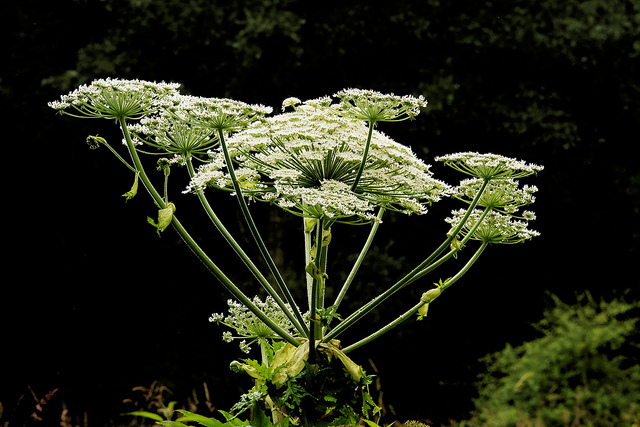 It looks pretty, but beware: hogweed sap can cause burns, scarring, and even blindness. (Photo by Bill Kirby1)
“Giant hogweed” sounds like something out of a failed Herbology experiment at Hogwarts, but it’s real, dangerous, and has made its way to Northern Virginia.
Crews from the Virginia Cooperative Extension identified and removed an invasive hogweed plant from between two buildings on Alexandria’s Martha Custis Drive on Thursday. Earlier this week, scientists from Virginia Tech found about 30 of the plants in Berryville, Virginia, about 60 miles west of Washington. It was one of the first times hogweed’s been located in the state. The scientists said the weeds appeared to have been planted as ornamentals in 1970s by a now-deceased landowner.
The weeds appeared to have been planted as ornamentals in the 1970s by a now-deceased landowner, according to Jordan Metzgar, the curator of the Massey Herbarium at Virginia Tech.
It might sound odd to plant a weed as an ornamental plant, but hogweed is rather lovely, in a leafy, Seussian, can-permanently-damage-your-eyeballs sort of way. Here’s what you need to know about hogweed, and how to protect yourself.
Where did it come from?
Giant hogweed is native to regions bordering the Black Sea, like Russia and Georgia. Europeans began to import it as an ornamental garden plan in the 1800s. The first record of the plant in the United States is from 1917, when it was identified in a New York garden. According to a report on poisonous plants by the Virginia Cooperative Extension, a joint project of Virginia Tech and Virginia State University, hogweed has since been reported in Maryland, D.C., North Carolina, Washington, Oregon, all new New England states, and some states in the Midwest.
How do I identify it?
Hogweed likes to grow in moist soil alongside roads, stream banks, fallow farmland, fence and tree lines, and, apparently, the spaces in between buildings in Washington area suburbs.
From June through August, it grows white flowers in a 1- to 2.5-foot wide umbrella shape. (If you’ve ever seen carrot or parsley flowers, they look a lot like that). They have wide, lobed leaves that hit 5 feet in diameter, and hollow stems marked by purple-red blotches and white hair. A hogweed plant can grow to up to 18 feet when fully developed.
Young hogweed looks a lot like other plants in this area, including wild parsnip, poison hemlock, Queen Anne’s lace, and angelica. But none of them grow as big as hogweed does, or have hogweed’s reddish stems with white hair.
I want to touch it. What happens if I touch it?
Don’t touch it! Hogweed sap contains a phototoxin called furocoumarin. After being exposed to sunlight, the sap can cause skin rashes, blisters, and dark scarring that can last years. If the sap touches your eyes, it can lead to blindness.
Whoops, I already touched it. What should I do?
Wash your skin with water and soap immediately, and don’t expose that area to sun for 48 hours. Also, try to listen a little better next time, would you?
So can I go outside ever again?
Yes, please do. Despite some news reports, hogweed is not spreading rapidly through the D.C. metro area. The plant is more common in more northern states like New York. And while hogweed does produce seeds prolifically, they can only travel a few feet by air.
“It’s not quite the death sentence that it’s made out to be,” Metzgar said. “You’re probably more likely to be run over by a car tonight than you are to see giant hogweed.”
How do I remove the plant?
Don’t use a mower or weed wacker to cut it down yourself – according to University of Maryland scientist Nevin Dawson, those tools can create “uncontrollable sprays of the toxic sap.”
“The moral of the story,” Dawson wrote in a report, “is to approach this plant with extreme caution and a full set of protective gear, including long sleeves, pants, and eye protection.”
If you live in Maryland, you can report hogweed sighting to the Plant Protection and Weed Management department of the University of Maryland. Virginia’s Department of Conservation and Recreation has a web form and phone number for reporting hogweed, and you can also contact your local Virginia Cooperative Extension office.
I prepared a specimen of the giant hogweed from Clarke County yesterday! Look at the giant leaves–very distinctive! The Clarke County population is not spreading and you’re very unlikely to see giant hogweed in Virginia. Check the ID guide for help: https://t.co/P76XkyrFMM pic.twitter.com/ekaipXcDMq
— VT Massey Herbarium (@MasseyHerbarium) June 20, 2018
This post originally appeared on WAMU. It was updated with comment from Jordan Metzgar.