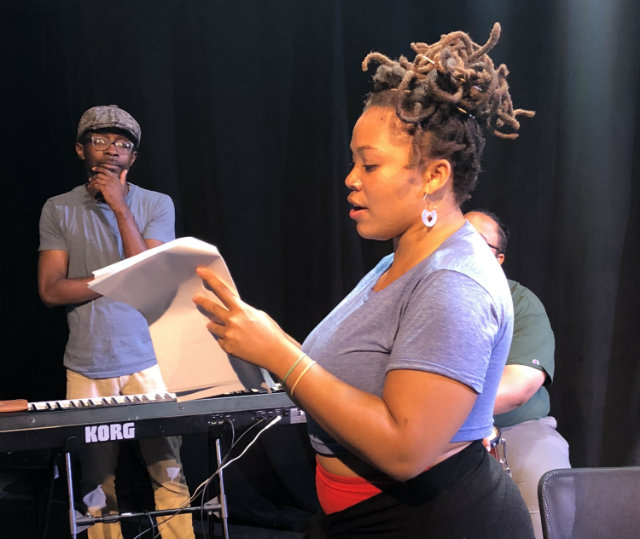
 Brittney Sankofa, who plays Brittney in “East of the River,” practices a rap for the musical. (Photo courtesy of Star Johnson)
To create the new musical “East of the River,” Star Johnson spent months interviewing Anacostia residents about their in-flux neighborhood. Then she turned those conversations into lyrics—raw anxieties and anger and pride that, together, offer a hopeful melody.
“There’s a lot going on right now regarding the transition and gentrification, and I wanted to find out what people in the area are feeling about it,” says Johnson, the musical’s director, writer, and co-lyricist. She lives about 10 minutes outside Anacostia in Prince George’s County, Md. “The show tells the story of the community, and what it’s going through, with music.”
“East of the River” debuts in a workshop performance on Friday at 8 p.m. at Anacostia Arts Center, followed by a community panel moderated by Harvey Fitz, organizer of the Poetic Vibes open-mic nights. The musical is a project from the Arts Center’s Resident Theatre Incubator, which funds and hosts original stage pieces.
“From standing here you can see the whole city view / From here it’s nothing special / A vessel of hope, a stroll from old to new”—lyrics from “Back at Me,” sung by a young Anacostia resident who runs her parents’ mom-and-pop shop
The show follows a group of Anacostia residents who get wind of a revitalization project that will bring a Whole Foods to Good Hope Road and 17th Street—“which means [local nonprofit] Bread for the City and other community staples will be torn down,” Johnson says. Over the course of an afternoon, the group holds an unofficial community meeting to voice their varying opinions on the changes, “all surrounding themes of hope and preservation.” It stars 11 local actors and musicians, including a three-part band (a pianist, acoustic guitarist, and conga drummer).
Patricia Williams Dugueye, a regional performing artist and longtime D.C. resident, portrays Yvonne, an older woman who’s “seen the changes [in the neighborhood], both good and bad,” as Dugueye puts it. She feels an intimate connection to the musical’s plot: When Dugueye moved to the city more than 30 years ago, she lived in Northeast, D.C.
“It was having all these issues—run-down parts, drugs—but it still had a sense of community,” she recalls. “People watched out for each other, they cared for each other.” But she describes a feeling of disrespect as the “gentrified group coming into town disregarded the community that was already there.”
The experience taught her that to survive and thrive in areas undergoing gentrification, like Anacostia, it’s crucial for old and new residents to find ways to work together.
“Just because it’s old doesn’t mean it’s bad,” Dugueye says. “Let’s see if we can bring in the new and think about how to revitalize the community without just getting rid of all the old. Let’s embrace our differences and see how we can collaborate to make the community as a whole better.”
“From standing here a picture perfect view / I wonder what does the rest of the city see / When it looks back at me”—lyrics from “Back at Me”
Dugueye’s sentiments echo the feedback Johnson collected as she interviewed Anacostia residents for the musical. She sought out a diverse selection of locals, from fifth-generation residents to newbies in search of lower rent, to those who work in the neighborhood but don’t live there.
While many acknowledged Anacostia’s reputation for crime and poverty, they didn’t want to dwell on the negatives. “They focused on the culture and spirit of the community,” Johnson says. “There were people who said, clearly things need to change, but there are things you can do to improve it without losing what makes this place beautiful and special. They didn’t want the soul to change.”
Namely, Johnson heard positives about the neighborhood, like “you really get to know people, you know people’s names”—something that’s unusual in many of D.C.’s transient neighborhoods.
“Shine replaces grit / Style replaces spirit / Come on hear it / There’s somebody moving in”—lyrics from “Becky and Bryce,” sung in unison by Chris and Kel, white residents who are fighting alongside their black and brown neighbors to retain the spirit of the community
Dugueye is optimistic that “East of the River” can provide an opportunity for underserved groups to use music and art as a means of healing. “I truly feel that we can marry both our artistry and social activism, our need to try to help our society grow,” she says. “We can tell stories that are meaningful and get people to think, and I really think ‘East of the River’ does that.”
She hopes “East of the River” helps people see the neighborhood as a booming arts community.
“If you haven’t gone to see a show in Anacostia, if you haven’t gone to an exhibit or poetry night in Anacostia, go,” she says. “And you will not be disappointed. If you haven’t already tapped into the Anacostia arts scene, support it, and support its artists, because they are some of the best in the city.”
“What I know is, I know this for sure / We can someday have more / We can someday have more / We can someday have more”—lyrics from “Manchego Cheese,” a rap about all the great things that could come to the neighborhood if a Whole Foods is brought there, including the end of the community’s food desert
Tickets for the workshop performance are pay-what-you-can, but they need to be reserved in advance by emailing anacostiamusical@gmail.com.