Rachel Kurzius
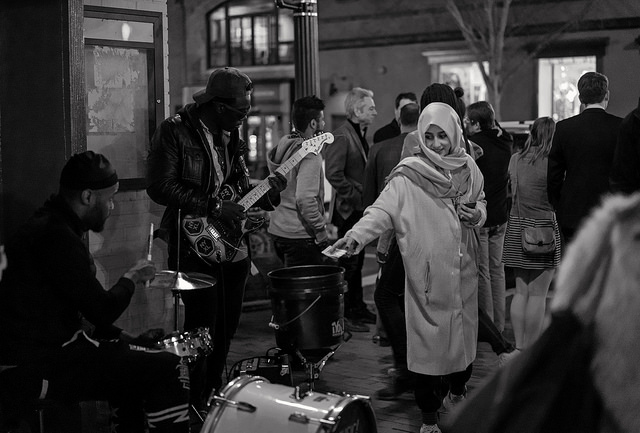 Photo by Mike Maguire.
An emergency bill before the D.C. Council would make it illegal to play amplified sound devices in public that others can hear from 100 or more feet away.
Introduced by Ward 2 Councilmember Jack Evans, Ward 3 Councilmember Mary Cheh, and At-large Councilmember Anita Bonds, the bill seeks to address complaints from people who live and work downtown. They claim the noise from buskers and performers makes it impossible to work or relax.
Opponents worry that the Amplified Noise Amendment Act of 2018 will strip the city of its character, and that its punitive measures will be focused mainly on people of color.
The D.C. Council is set to vote on an emergency bill on Tuesday that would make it illegal to play sound in a public place that can be heard from more than 100 feet away, and give D.C. police, Metro Transit Police, or National Park Service officers the ability to tell people to turn it down. The legislation also prohibits the use of gas generators in public spaces.
The version of the bill discussed at last week’s public hearing included a potential punishment of up to 10 days imprisonment, though the new draft posted on Friday has been amended to remove jail time, while keeping in place a fine not to exceed $300.
Of the nearly 50 witnesses who testified, only one spoke in opposition to the measure. The rest detailed how buskers using noise amplifiers have eroded their quality of life.
Elizabeth Miller, a resident of 7th Street NW for 17 years, said the problem has gotten worse in the past decade. She says she hears street performers from within her home up to 12-14 hours per day, seven days a week.
“Some buskers are very considerate but most can be heard two to three blocks away,” Miller testified. “When walking down the street, the volume hurts my ears and the volume in my home impacts my ability to concentrate and relax, causing me extreme headaches, anxiety and stress.”
Jerry Amato, a senior property manager with Lincoln Property, manages the office building on top of the Macy’s on G St NW between 12th and 13th streets. He said he receives complaints from tenants on a near daily basis about sidewalk musicians playing their music too loudly, and calling the police has not helped.
The way that the current law is enforced requires an official from the D.C. Department of Consumer and Regulatory Affairs to come and measure the sound levels to ensure it does not exceed 80 decibels, and they must compare the sound of the musicians to ambient sound. They can currently issue fines of up to $1,000 in residential zones, which doesn’t include areas like Chinatown, Farragut North, and other mixed-use areas. The new bill would cap fines at $300, but would be applicable to more neighborhoods.
Amato wants police to be enabled to tell performers to pipe down, including in neighborhoods like Metro Center.
“This request is no different than one a neighbor might ask another neighbor who is playing their music too loudly,” Amato said. He urged the council to act before it goes on recess at the end of the week.
Syndey Hawthorne, legislative counsel for the Committee of the Whole, explained the bill is being proposed on an emergency basis because “this has been an ongoing issue, these increased sound levels, for the past few years and in the summer months, it’s anticipated these activities will increase.”
But the bill’s opponents say it would harm the city’s music community.
“Street performers play so they can afford to eat,” says Aaron Myers, a musician and community organizer in D.C. “They’re out there for the sake of being seen, to help tide them over. Sometimes people hear them and they hire them. Being charged $300 or so, they might not even make that in a day of busking.”
Some District musicians, like Kenny Sway and Malik Stewart, have achieved fame from recordings of their public performances going viral.
Myers has been thinking about the Metro PCS store on the corner of Florida Avenue and 7th Street NW, which is well-known for blaring go-go music. “There are people walking around and bopping of all colors,” says Myers, who worries that they’d no longer be able to play their tunes, which create a sense of place in the city. “You can’t remove the culture or the character of Washington and expect to attract big business,” he says.
He headed to the John A. Wilson Building to talk about his concerns with councilmembers on Monday morning.
Chris Naoum, the founder of Listen Local First, says that the legislation is flawed and describes it as a “quick fix for a couple of pissed off people … [who] moved into a neighborhood that is the center of entertainment.”
The first issue he has is with the standard of 100 feet. “Decibels, not distance, is the right way to measure sound,” he says. He’s also concerned that the standard of “plainly audible to an individual of normal hearing” is vague and difficult to enforce.
The biggest problem he sees is that “the artists were not part of the discussion on what to do in this situation … You cannot have a coalition just made up of developers, condo associations, and aggrieved people to discuss the future of a whole community.”
The council went through the standard public hearing process, but both Naoum and Myer says legislators should have done a better job reaching out to people in the music community.
Hawthorne, legislative counsel for the Committee of the Whole, says that “we’re not in the business of seeking witnesses to be there.”
Since last week’s public hearing, more than 60 people have signed onto testimony submitted by Listen Local First.
There is a protest slated for Monday at 6 p.m. at the corner of 7th and H NW, in Gallery Place in which “artists from all over the city will converge on the most prominent public space in the city to ensure their voices are heard in a debate that largely excluded them and propose their own solutions to the problems increasing density and gentrification are causing,” per the invitation.
Amplified Noise Emergency Amendment Act by Rachel Kurzius on Scribd