Martin Austermuhle
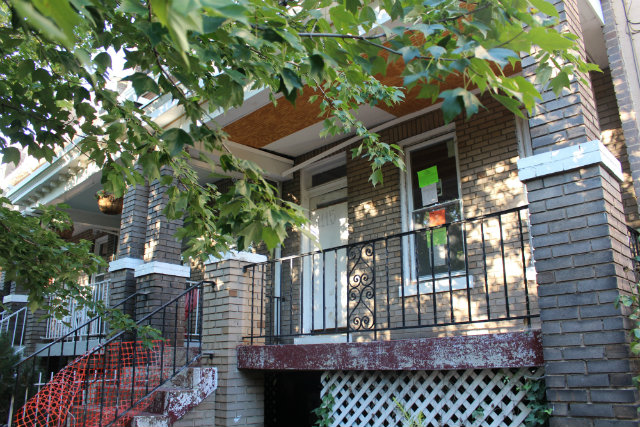 The founder of Taylor Gourmet bought this Northeast house in 2015 and set about renovating it. One of his next door neighbors says the work, which remains incomplete, damaged her own home. (Photo by Martin Austermuhle)
Rosalind Fowler had been living in a modest rowhouse on Fourth Street NE for 30 years when the vacant house next door was sold to a young couple in late 2015. But before she even had a chance to meet the new owners, workers began renovating the house.
“Some contractors came in and they started just hammering and hammering. I never met the owner until later on,” says Fowler, a 68-year-old native Washingtonian. “He never came over to introduce himself as the new owner and tell me what his intentions were with the property.”
That owner is Casey Patten, founder of Taylor Gourmet, the popular hoagie chain that first opened on H Street in 2008 and has since grown into a fast-casual empire of sorts with 16 other locations in the region and two in Chicago. He and his wife, Vanessa, bought the house for $540,000, and set about renovating it.
Construction is nothing new in many of D.C.’s rapidly changing neighborhoods, including around H Street NE. But what Fowler didn’t expect is how Patten’s house would eventually impact her own. First it was damage from significant renovations that started next door, and then it was the challenges of living next to what became a vacant and half-finished home improvement project.
D.C. has laws to protect residents whose homes are damaged by construction on adjacent houses, but they rely on prompt enforcement by city regulators. Thursday, the D.C. Council is holding a hearing on a bill that would give homeowners additional avenues to get repairs made when damage occurs.
And while the city can currently employ a number of tactics to bring vacant and blighted homes back to full use, the process can feel far too slow for adjacent neighbors who have to live with the consequences of absentee homeowners.
Fowler held out for three years, but after it seemed that Patten had given up on his house, she also gave up on her own and moved.
“We were excited that someone had bought the property,” she says about her new neighbor at the time. “We were saying our dreams came true and someone will fix up the place, but it became the worst nightmare there was.”
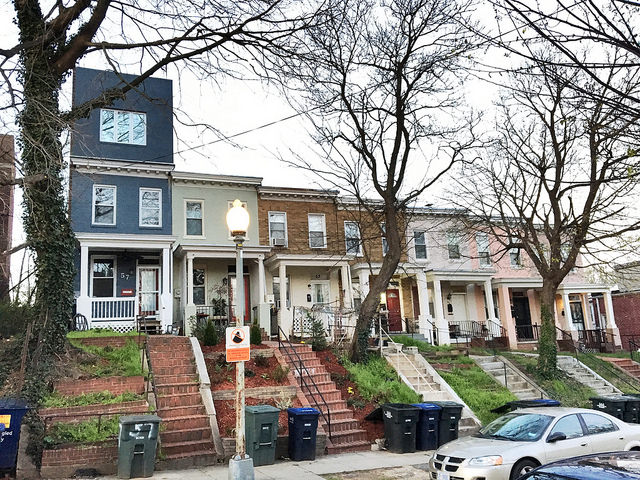 Removing a roof to add an additional floor, like this pop-up in Eckington, are a common renovation. (Photo by airbus777)
Streets lined with rowhouses are an iconic part of D.C.’s residential landscape. While they fit more people on a block than traditional stand-alone homes, they also suffer from a basic flaw: what happens in one rowhouse can impact the ones right next door.
In recent years, rowhouse renovations have often involved expanding them to include an extra floor or more space in the back and digging out the basements so they can be used as a legal second unit. And that can easily lead to damage to homes next door.
“There’s a house on pretty much every block that is undergoing a roof removal or a back removal,” says Jonah Goodman, an ANC commissioner in Petworth, about his neighborhood. “I have about four or five houses right now that have some degree of damage to them caused by renovations [on adjacent rowhouses]. Some is minor like water damage from a roof being removed, but at the other extreme I have a property where the construction has caused erosion and partial collapse of the rear entrance of the house.”
For Patten’s house on Fourth Street NE, permits show that he was planning on interior renovations, the replacement of some floor joists and the roof rafters, and upgrades on the mechanical, electrical, and plumbing systems. But at some point the work expanded beyond that; records with the Department of Consumer and Regulatory Affairs show a number of stop-work orders in 2016 and 2017 for work without a permit or work exceeding the scope of the permit.
Fowler says her home eventually started bearing the brunt of the construction happening right next door.
“When they were placing the beams in the house, I could actually feel the hammering and then see the wall [in my house] crack,” she says, describing what would eventually be a litany of problems that she believes were caused by the construction in Patten’s house.
The removal of the roof and its flashing appear to have led to water leaking into Fowler’s upstairs bathroom. After workers at Patten’s house dug out the basement, they left pipes exposed which burst in the cold winter months. And the presence of open garbage cans and construction pits allowed water to pool during warmer months, offering mosquitoes a rich breeding ground.
Other neighbors along the street also took notice.
“It’s not just a vacant house. It is a house you can see through. It has inadequate doors and windows and it’s falling apart. It looks like no one has touched it since I moved into the neighborhood,” says Salim Bhabhrawala, who lives on Fourth Street NE and regularly walks his dog by the site.
By August of 2016, Fowler and the immediate neighbor on the other side of Patten’s house sued him in Superior Court, alleging that Patten has subjected them both to “imminent threat in the form of dangerous mold, vagrant access, and other toxic chemical dangers, including a visibly apparent oil leak from a heating system.”
In a response, Patten and his wife denied all the claims against them. A few months later, Fowler and the ther other neighbor gave up on the lawsuit — largely, Fowler says, because their attorney wasn’t doing what they expected.
“We just didn’t feel that the attorney who was representing us was doing a good job.” she says.
As for Patten, he had already moved on — quite literally.
According to property records, some seven months after buying the house on Fourth Street NE, Patten and his wife purchased a $1.75 million rowhouse on Maryland Avenue NE that once housed the Washington Junior College of Music.
Neither Patten nor his wife responded to multiple requests for comment, either directly or through Taylor Gourmet.
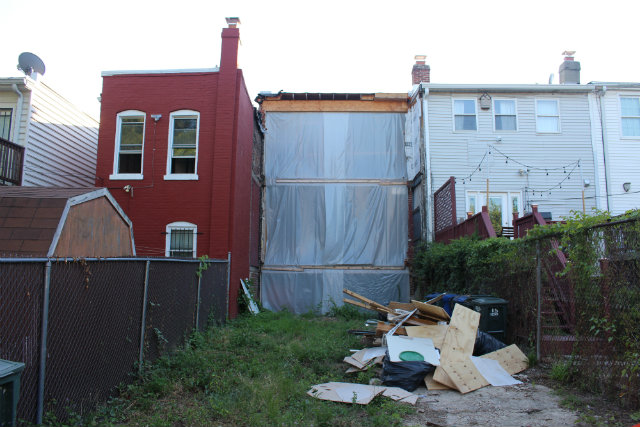 Patten’s home has been classified as blighted by the city, which significantly increases property taxes. The most recent tax bill says he owes more than $74,000 for the last two years alone. (Photo by Martin Austermuhle)
D.C. regulators currently have a number of tools at their disposal to deal with vacant or abandoned houses, of which there are more than 1,500 across the city. Most of them come down to cost — the longer a house is left vacant and untended to, the more expensive the city makes it for the owner to keep doing nothing about it.
First, DCRA can levy fines for everything from uncut grass to doors and windows that are left unsecured, which it did with Patten’s house on multiple occasions from 2015 through to this year. The most recent notices of violation came on June 1, when Patten was cited for excessive vegetation, unsecured doors and windows, graffiti on the property, and excessive trash.
If things get bad enough, the house can be referred to the Board for the Condemnation of Insanitary Buildings, which has the power to condemn a house and ordered that it be razed.
The board first took notice of Patten’s house in mid-2016, and later that year called Patten in to explain the condition of the house. He told the board he was in the process of renovating it, and that he had permits pending before DCRA. He and his attorney also complained that they hadn’t been properly notified that the house could be condemned, which drew a stern response from Gilbert Davidson, a DCRA inspector who sits on the board.
“You have a responsibility to make sure this property is sanitary,” he told Patten, according to a recording of the November 2016 meeting. “So you need to do what you need to do to get this property into compliance. You obviously know the condition of the property without this government making you aware of this. This property in this condition can eventually affect adjoining properties.”
Despite that admonition, the board gave Patten a 60-day extension to get his permits in order and start addressing the issues at the house. Board recordings show that he made some fixes and also paid some fines to address stop-work orders, but did not address some of the more substantial problems board members had raised.
“The front looks okay. The windows, he fixed the ceiling. It’s curb appeal. You might die in the back, but it looks good [in the front],” joked board member Timothy Denne at a board meeting in March 2017.
Patten made a few more fixes after that, and got more extensions in 2017 and early 2018. But by March of this year, board members still said there was work left to be done, and also cited him for trash and debris on the property.
At the same time as the house was going through the condemnation process, DCRA used the other tools at its disposal — it turned the financial screws. The house was classified as vacant in late 2016, which ratcheted up the property tax rate Patten had to pay from 85 cents for every $100 dollars of assessed value to $5 for every $100. For Patten, that meant his property taxes jumped from $4,000 a year to close to $27,000.
And if a vacant home falls into disrepair, the next step is to classify it as blighted, which hikes property taxes even further: to $10 for every $100 of assessed value. DCRA did just that in March of this year, pushing Patten’s property taxes even higher, to $56,000 a year. (There are more than 450 officially designated blighted homes in the city.)
It did not have a real impact. City records show that Patten has not paid any property taxes on the house since he bought it in late 2015; the most recent tax bill says he owes more than $74,000 for the last two years alone.
And that led D.C. to employ its option of last resort: a tax lien sale. When a property owner is delinquent on their property taxes, the city can sell a lien to a private individual. The city gets some money for property taxes it assumes will never be paid, and the new lien-holder can sue the property owner for what they paid for the lien — and if that doesn’t work, the property itself.
In July 2017, the city sold a tax lien on Patten’s house for $5,924.39. In May of this year, the holder of the lien sued Patten in Superior Court for ownership of the house. That process can take more than a year to complete.
This isn’t the first time Patten has been taken to court for housing-related issues. From 2005 through 2010, Patten was hit with five liens on his condo in a Chinatown condo building. And in 2011, he was sued by the homeowners association for close to $11,000 worth of unpaid condo fees. He sold the unit in 2013.
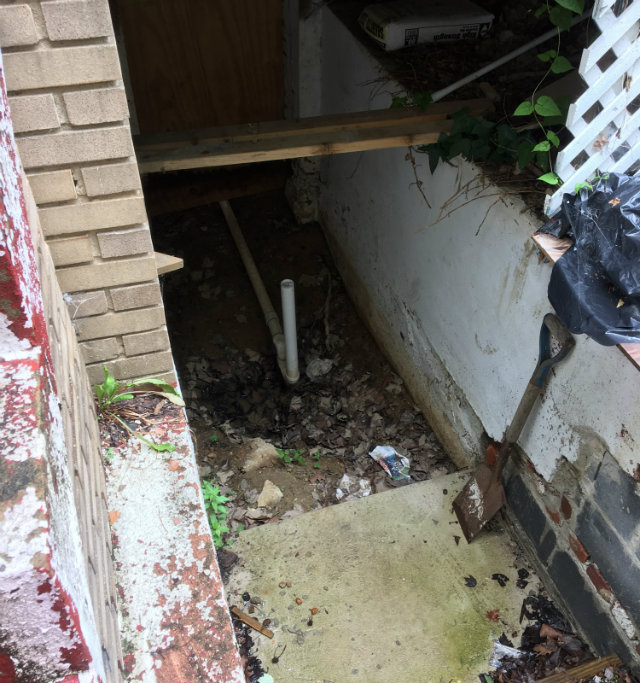 The basement entrance to Patten’s house shows exposed construction materials. (Photo by Martin Austermule)
Other than filing a lawsuit—which can be cost-prohibitive for many homeowners, not to mention time-consuming—Fowler had few official resources at her disposal to address the damage to her home. When construction on one home damages adjacent homes, DCRA can cite the offending homeowner — and order their contractors to repair the damage they did.
But that’s not a palatable option for some people.
“The main issue is that if you own a property that’s damaged by a contractor, there’s no way you want that person touching your house to fix it. And the way our current law is written is that that’s the only remedy a homeowner has,” says At-large Councilmember Elissa Silverman.
A bill Silverman has introduced would offer impacted homeowners a second option beyond having the existing contractors on a neighboring property fix the damage.
“You can use that remedy, or you have a second avenue to have the contractor to pay another contractor to do it,” she says. The bill has a public hearing on Thursday.
While DCRA did act to designate Patten’s house as vacant and then blighted, the agency has been accused of having a spotty and inconsistent record in doing so in other cases.
Last year, the D.C. Auditor said that in 2015 DCRA had failed to properly designate many vacant and blighted homes, missing out on what could have been millions of dollars worth of fines. DCRA officials have told the council they have since improved the system to track vacant and blighted houses. Still, council members remain focused on reforming DCRA; a current bill would split the agency up in two, one to deal with business licensing and regulations and the other to handle construction permits and enforcement.
For Goodman, the ANC commissioner in Petworth, the main source of the problem is that DCRA inspectors may not respond to specific complaints, or may respond too late. He says the D.C. Council could consider other protections for homeowners living next to houses undergoing extensive renovation or construction.
“DCRA can’t be everywhere and look at everything. We have to realistic,” he says. “One thing I did hear in talking to some people was can we do more about holding bonds from these private funders of construction? We bond contractors. Can we do more with property owners?”
For Bhabhrawala, one of Fowler’s neighbors on Fourth Street, what happened to her isn’t just about what the law offers homeowners in the city, but also the personal responsibility he thinks everyone needs to take when they start working on their own homes.
“I think as a member of a close-knit community it’s extremely important to be responsible and make decisions that are in the best interest,” he says. “Leaving that house vacant… it’s disrespectful to our community.”
Fowler agrees, and says she still doesn’t understand why Patten walked away from a house he had bought.
“Why buy a property and just let it sit and deteriorate? It was better off in the condition before you bought it. At least it had a roof on it and a back porch,” she says.
Ultimately, Fowler decided trying to wait out repairs to Patten’s home wasn’t worth it for her. So she put her house on the market late last year and moved out, 30 years after she had moved in.
“Since it had been three years and nothing had come about, I had to make a change for myself. And I was blessed because I was presented with options,” she says. “But if I didn’t have that option, I would still be there dealing with the same problems.”
“I do miss my neighborhood,” Fowler says of her house of three decades, her street and her neighbors. But she knows she made the right call to move. “I don’t wish this nightmare on any D.C. resident.”