

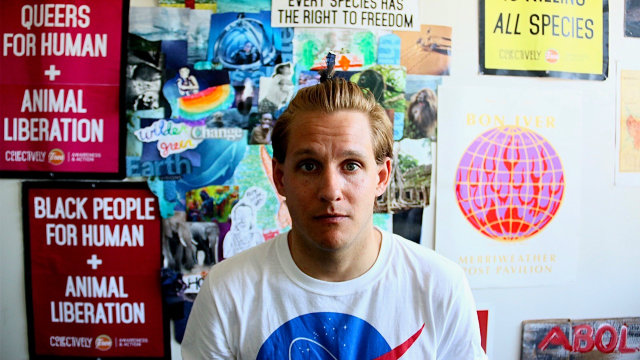
 Rivers Wilder Green leads a rousing call to action in How to Fall in Love on a Warming Planet. (Photo by Monika Shayka)
When most people talk about saving the planet, they bring up solutions like solar panels, conservation, or recycling. Rivers Wilder Green talks about imagination.
“We imagine our future before we enact it, from the banal things like tying our shoes to what kind of career we want,” he says. “I want to encourage in other people the imagining of the most verdant, wild future. This project is my version of setting myself on fire to get people to mobilize.”
How to Fall in Love on a Warming Planet, a pop concert about climate change that begins a five-show run at Capital Fringe on July 20, is Green’s act of imagining. During a tech rehearsal this week, the stage is set with handmade protest signs that read “Their Planet Too,” “Black Lives Matter,” and “Ban Speciesism.” Green sings his heart out, beating his chest to turn his voice into percussion during some songs and jumping off stage to walk out into the audience during others. While he usually works with just one other musician, this show includes two collaborators: drummer Yousef Shami and keyboardist Amir Shami, brothers and fellow vegans that Green met through climate change activism.
Green, whose given name is Christopher Barclay Cox, draws on the musical influences that came with growing up in churches and in his grade school’s step clubs in Reston, Virginia. Another Reston native, Grammy-winning producer/songwriter Benny Blanco (profiled this week in the New York Times) is a childhood friend and produced Green’s first two EPs, Naked and Green Eyes.
In an interview with DCist, Blanco describes Green’s sound as “unapologetically pop and unapologetically himself. No one else could sing one of his songs other than him.”
Indeed, it takes a unique voice to pull off songs titled “Stop Eating My Friends” and lyrics such as “We can save the planet if we’re brave enough to change,” but Green manages to keep the tone relatable rather than corny with a mix of mournfulness, urgency, and humor. Many of the refrains become mantras, and parts of the show encourage call and response, a bit like an actual rally. But there are also lighthearted moments, like a fast-paced riff on Nelly’s “Hot in Herre.”
Green has performed some of the music from How to Fall in Love on a Warming Planet in New York and Los Angeles, everywhere from hair salons to backyards, but the Fringe iteration will be the biggest production he’s done. But it’s not his first bit of environmental activism. After working as a political organizer out of college, Green became increasingly devastated about the state of the planet after visiting the Amazon rainforest and the Great Barrier Reef. While studying in Australia and hearing a talk by a conservation biologist, Green began to see how his knack for music could be combined with his passion for political activism.
“I realized that politics trails pop culture,” he says. “If we can show people that what we aspire to is being ecologically conscious, if we can own the fact that we’re culture brokers for what’s cool and not cool, we could save the planet overnight.”
Blanco remembers that even as a kid, Green was stalwart about his beliefs. That conviction carries over into his music.
“There are a lot of serious issues that we’re faced with right now and a lot of people don’t want to look them in the eye because they feel uncomfortable,” Blanco says. “Chris is really going head-on and putting those problems in your face.”
Also interspersed throughout How to Fall in Love on a Warming Planet are some solutions, such as a projected video about Jadav Payeng, an Indian man who singlehandedly reforested Majuli Island over 30 years of planting trees. Green also makes some not-so-subtle appeals to veganism: “We can eat vegan tacos ‘til we’re old,” he sings in the love song, “Safe-Wild.”
One protest sign that reads “Rewild Earth” is displayed prominently on stage. Green is especially interested in the rewilding movement that envisions large-scale ecological restoration through individual action—as Green puts it, “reimagining what the good life is.” He thinks that we can look to the animal kingdom for ideas—and perhaps forewarnings—in the midst of our environmental crisis. Traditionally, which species survive depends on which adapt and find balance within changing circumstances. The humans that persist on a warming planet probably won’t work for an oil company or eat meat three times a day, Green says.
But the show’s title suggests more than a survival guide. To Green, thinking about how to fall in love on a warming planet is not frivolous; in fact, it may be just as fundamental as the needed changes in our food and energy systems. Meeting today’s environmental challenges is “going to require new and deeper levels of intimacy,” Green says.
“I’ve never been brave enough to try something new unless I was loved enough that someone would catch me if I fell,” he says.”I feel like to meet the challenges we face right now, we need to be loved in a new way.”
Where to see it: Blind Whino, 700 Delaware Ave SW.
When to See It: Friday. July 20 at 5:15 p.m.; Saturday, July 21 at 7:15 p.m.; Sunday, July 22 at 9 p.m.; Thursday, July 26 at 9:15 p.m.; Saturday, July 28 at 12:15 p.m.
Check out all of DCist’s Capital Fringe coverage here.


