 Jordan Pascale
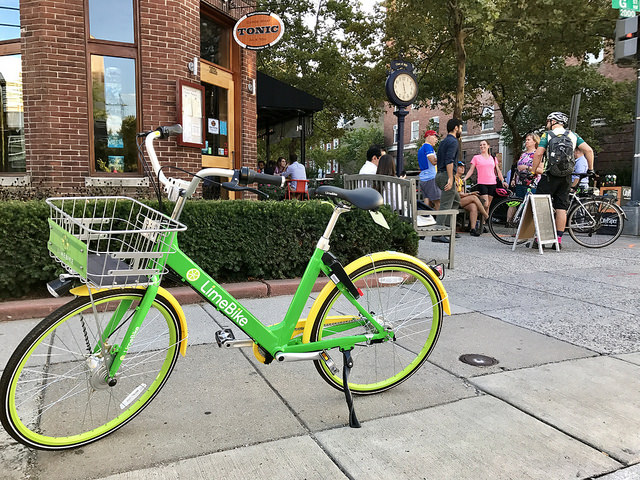 (Photo by Joe Flood)
The District announced it is extending its dockless bike and scooter pilot program through the end of the year — with one new wrinkle.
Starting in September, riders will have to lock dockless bikes to racks or street signs. More permanent rules will be drafted by the end of the year.
It’s a big change for riders who were allowed to leave the bikes, well, almost anywhere.
Dockless companies encouraged people to leave them off to the side of a sidewalk to not block traffic, but that didn’t always happen.
Bikes or scooters left on sidewalks created issues for those who use wheelchairs or strollers.
“Bikes blocking the pathways or end up tipped over are more of an obstruction than a benefit,” said Sam Zimbabwe, the chief project delivery officer of the District Department of Transportation.
“So this helps us keep things a little more orderly,” Zimbabwe said.
The new rules must be included in each company’s terms and conditions, Zimbabwe said, but more enforcement tools will likely have to wait until permanent rules are in place next year.
Many of the dockless bikes do not have the ability to be locked to something. Only JUMP, the electric bikes, offer that capability.
But that may not be a big problem. At least three dockless bikeshare companies have left the market and others are transitioning to scooter-only fleets.
Greg Billing, executive director of the Washington Area Bicyclist Association, says the idea to lock bikes is good in theory, but there’s not enough bike parking or places to lock bikes for it to be a fair requirement.
Instead, companies should educate riders on proper parking and the District should add bike parking areas on the street in busy areas and on every corner, Billing said.
WABA, along with other community groups, wrote a letter to the mayor calling for 20,000 bikes and scooters in D.C. — an ambitious 10-fold increase on the current District-mandated cap of 400 units per company. The groups are basing their estimate on the Institute for Development and Transportation Policy’s recommendation of 10 to 30 shared bikes per 1,000 residents.
“With sufficient bike parking in all areas, a requirement to lock dockless bikes to a rack would not be an undue burden,” the letter says.
DDOT has installed 200 new bike racks around the District, and 300 more are on the way this fall.
Dockless companies have also said that D.C.’s cap on how many units they can have is restrictive, but that won’t change for now.
By next year, DDOT aims to have a permanent bikeshare program with equipment standards, fees, data sharing requirements and a mandate to serve all eight wards.
It will take public comment on the issue in September and roll out new rules in January. Residents can also weigh in by emailing dockless.bikeshare@dc.gov
All companies will have to re-apply for a permit.
DDOT says it hopes the policies allow the program to expand while “maintaining the integrity and safety of our public space.”
This is the second time the District has extended the pilot program. It began last September and was set to go through April 2018 before it was extended again to the end of this August.
During that time, dockless scooters entered the fray, quickly overtaking the popularity of bikes.
Scooters don’t come with locks, so Zimbabwe said it will take continued rider education to make sure they’re parked correctly.
Previously:
Report: Seven In 10 D.C. Residents Have Positive View Of Electric Scooters
Two Dockless Bike Companies Announce They’re Leaving D.C.