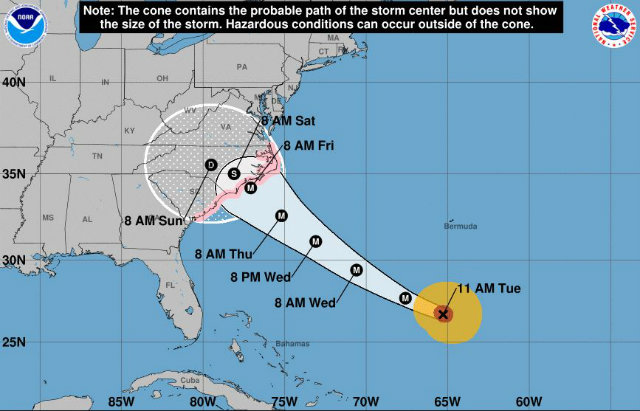
 (Image courtesy of the National Weather Service)
By WAMU’s Kathy Goldgeier
Update 9/14
Mayor Bowser rescinded the state of emergency for the District on Thursday night after Hurricane Florence moved south of D.C. The emergency declaration would have allowed Washington to apply for FEMA assistance in the wake of the storm, but it looks like the city won’t be needing it anymore.
Original
D.C. Mayor Muriel Bowser has declared a state of emergency in the District as Hurricane Florence spins toward the East Coast. Virginia Gov. Ralph Northam and Maryland Gov. Larry Hogan have also declared states of emergency so they can mobilize resources in preparation for the Category 4 storm, which the National Hurricane Center is calling “extremely dangerous.”
“I encourage all District residents and visitors to take this storm seriously and stay up to date on the latest emergency information,” Bowser said in a statement, “including signing up for our AlertDC messaging service.” The mayor asked that residents use 311 to report flooding and other non-emergency issues.
In D.C., the emergency declaration authorizes several agencies to apply for financial assistance through the Federal Emergency Management Agency (FEMA) and other appropriate federal agencies. The declaration also prohibits price gouging during the public emergency. The last time the mayor declared a state of emergency was in January 2016, before the winter storm known as Snowzilla.
Metro General Manager Paul Wiedefeld said the system plans on normal service this weekend, but advised Metro Access customers to cancel trips on Thursday and Friday.
Amtrak has canceled a number of trains along the Eastern Seaboard starting Wednesday and has modified the schedules of others. Amtrak is waiving charges for travelers who need to change their reservations.
As people brace for high winds and heavy rain, Bowser made the following recommendations:
- Sign up for alerts. AlertDC is your personal connection to real-time updates and instructions to protect yourself, your loved ones, and your neighborhood.
- Encourage family and friends in the storm’s path to listen to officials and have a plan on how you will communicate once the storm passes.
- Replenish your emergency supply kit, especially if you have dietary or medical needs. For a list of items you need, visit ready.dc.gov/kit.
- If you have access and/or functional needs, take steps to prepare in advance, including informing your support network of your emergency supplies and planning for your critical needs, such as transportation, power, and communications.
- Monitor local radio or TV stations for updated emergency information.
- Clean out your home’s gutters and empty out your rain barrels.
- Contact DC Water at (202) 612-3400 to report any clogged sewer basins and clean out any trash or litter around sewer basins.
- Follow HSEMA’s Twitter and Facebook for updated information from the District on potential impacts.
Northam told NPR that preparing for big storms like this one requires an early start. “They’re unpredictable, they have a mind of their own,” he said. “So in order to get our resources that we need, we found it necessary to declare a state of emergency on Saturday.”
Hogan said in a statement that while it’s still not clear exactly where the storm will track, “we are preparing for any possible outcome, including the potential for historic and catastrophic rainfall, life-threatening flooding, and high winds.” He said the state is taking every precaution, and urged residents to do the same.
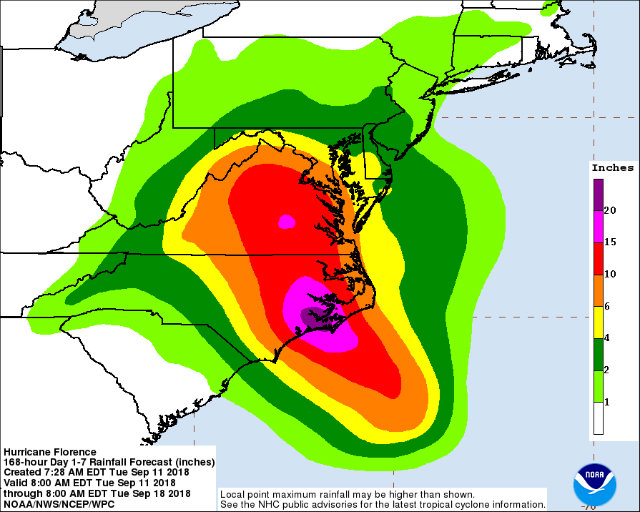 The National Hurricane Center projection shows significant rainfall for the D.C. region. (Image courtesy of the National Hurricane Center)
This post has been updated.
This story originally appeared on WAMU.
Previously:
Hurricane Florence Is Traveling A Similar Path As A 1933 Storm That Got Very, Very Close To D.C.